Sample No. 0099
Bald Eagles Lock Talons in Midair: Courtship Display or Territorial Fight?
A dramatic eagle plunge could be courtship or conflict. The birds’ movements offer clues, but this clip doesn’t provide enough context to decide.
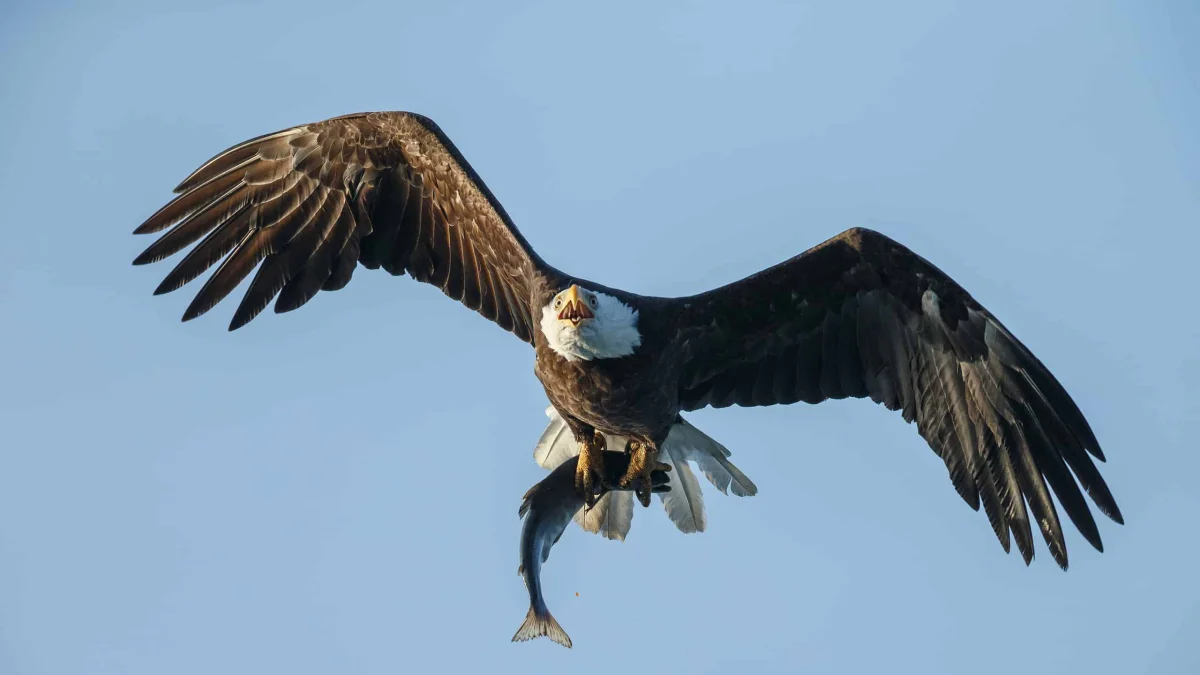
Two bald eagles clasp talons in midair, spin downward together, then let go and fly out of view. The plunge looks alarming, but the footage doesn’t show whether it’s a courtship display or a dispute. Both are plausible: bald eagles perform dramatic aerial displays while courting, and they can also grapple during conflicts.
That uncertainty matters. A few seconds of striking behavior can invite a confident story, but the clip doesn’t identify the birds, the location, or what happened before or after their descent. The most reliable reading is also the simplest: the eagles locked talons, rotated as they fell, and separated before reaching the ground. The reason remains unclear.
What the footage can—and can’t—tell us
The birds maintain contact as they turn, then break apart and spread their wings. That sequence resembles the bald eagle’s well-known cartwheel display, in which a male and female lock talons and tumble together. But birds of prey may also grab one another during serious disputes, including territorial conflicts. The uploader calls this encounter a fight; the visible action alone doesn’t settle the question.
Clues from the surrounding behavior would help. A bonded pair making coordinated displays near a nesting area would be more consistent with courtship. A chase, defensive calls, or one eagle repeatedly trying to force the other away would make conflict more likely. The birds’ sexes, relationship, timing, and behavior after the plunge are all unknown here, so neither interpretation can be confirmed.
The National Eagle Center has discussed similar footage and identified the same two possibilities: courtship cartwheeling or a territorial fight. Even a specialist can only interpret what the birds do; without more context, the clip remains open to more than one explanation.
Why eagles perform the cartwheel
In the familiar courtship version, a male and female climb, grasp each other’s talons, and descend while revolving around a shared center. The Cornell Lab of Ornithology describes the pair separating near the ground to avoid a collision. Bald eagle courtship also includes pursuit flights and dives, so the cartwheel is one conspicuous part of a wider set of aerial behaviors.
People often describe the display as a demonstration of strength or flying skill. That may be a reasonable interpretation, but it’s hard to assign a precise purpose to every maneuver. What’s clear is that the birds must control their wings while turning, falling, and holding onto each other, then release with enough room to recover stable flight. It’s an impressive display, but it leaves little margin if the descent continues too long.
The fall can be dangerous
Many cartwheel displays end safely, but not every talon-locking encounter does. Eagles can strike the ground, trees, or other surfaces if they don’t separate in time. In a 2023 Minnesota incident, two bald eagles fell onto an asphalt lot while locked together. One flew away; the other needed treatment for a wing injury.
Conflict can make a fall harder to manage if the birds are focused on overpowering each other rather than separating. Their grip doesn’t mean they’re permanently trapped, but each turn brings them closer to the ground. In the video, they break apart in time. Beyond that, the camera offers no confirmation of what happened to either bird.
Season, habitat, and food offer context
Bald eagle breeding schedules vary across North America. The U.S. Fish and Wildlife Service reports that eagles across much of their range breed from early spring into summer, while those in warmer states such as Florida and Louisiana may nest in winter. Pair bonding and nest work begin before eggs are laid, and established pairs may return to the same area year after year.
Some northern eagles move south or head for open water when lakes and rivers freeze; many adults farther south stay closer to their usual areas. Food, age, weather, and breeding location all affect movement. Knowing the season could help interpret an encounter, but it wouldn’t prove whether a particular aerial tumble was courtship or conflict.
Bald eagles live across much of North America, from Alaska and Canada through the contiguous United States and into northern Mexico. They’re often found near coasts, rivers, lakes, reservoirs, and marshes, where food and open flight paths are available. Nesting pairs generally choose large trees or other sturdy sites with a clear view. Eagles are also nesting in farmland and suburbs, including areas farther from major waterways.
Where food is plentiful, eagles may gather close to human activity: below dams, near coastal processing facilities, or around dumps and carcasses. Breeding pairs defend areas, while winter food supplies can draw many eagles to communal roosts. Both a solitary eagle and a large gathering can be typical, depending on season and available food.
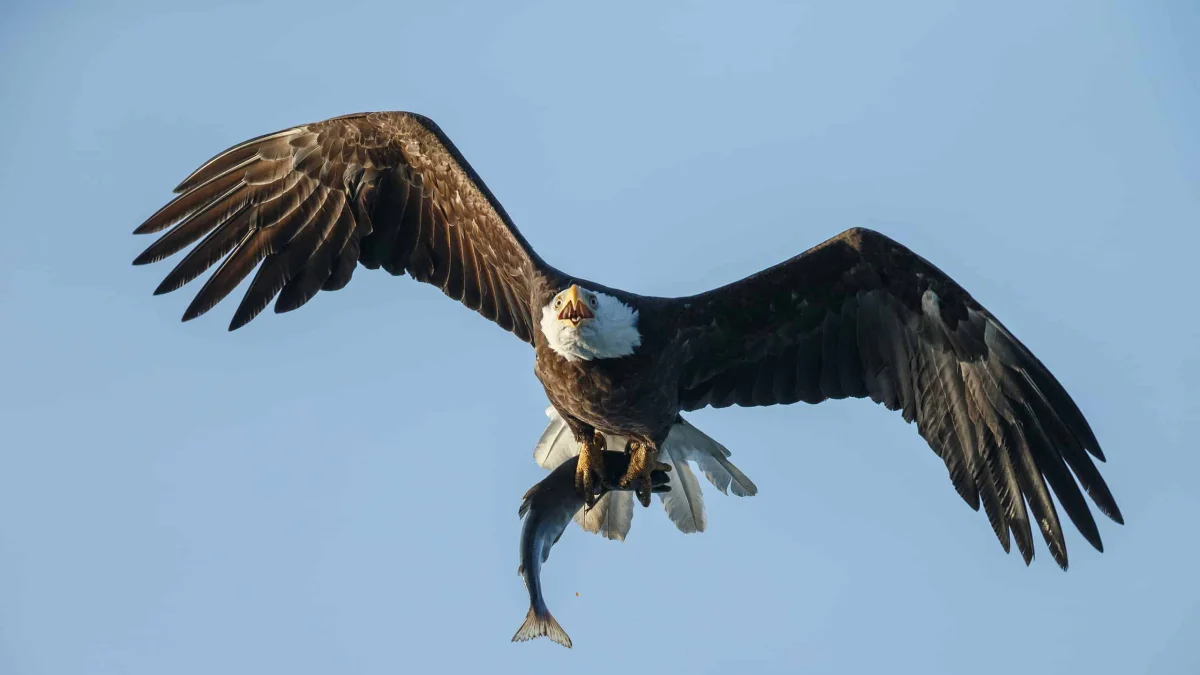
Fish are a major part of the bald eagle’s diet, but these opportunistic raptors eat whatever is locally available.
©iStock.com/Schaef1
Fish are a major food source in many regions. Eagles may eat salmon, herring, shad, catfish, and other fish, as well as waterfowl, shorebirds, turtles, snakes, small mammals such as rabbits, and carrion. Their varied diet helps explain why they appear in such different settings.
They also steal food. An eagle may pursue an osprey until it drops a fish, which the eagle can seize in midair. Cornell has documented eagles taking fish from osprey talons and from people. This behavior is called kleptoparasitism: one animal obtains food caught by another.
Bald eagles have also been observed hunting cooperatively, with one bird flushing prey toward another. A report describes six eagles passing sticks in the air. Courtship, conflict, food theft, cooperation, and play all belong to the range of behaviors these birds display. This clip shows a plunge and a safe separation—not enough to reveal which story the eagles were acting out. When watching, treat courtship and conflict as possibilities, and let the missing context stay missing.


