Sample No. 0098
Why Wolves Howl Together: What a Wolf Duet Can Tell Us
A wolf’s howl can help companions stay connected, but its meaning depends on context, relationships and body language.
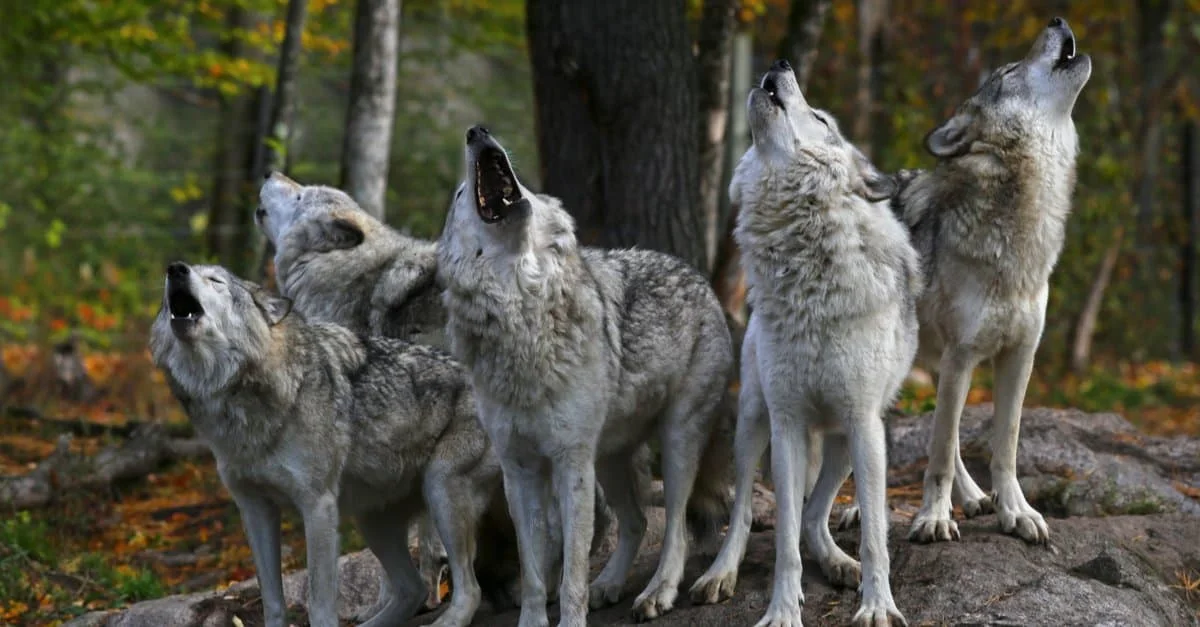
When one wolf howls and another joins, the exchange is easy to hear as a conversation. But there’s no reliable word-for-word translation. A howl can help wolves locate companions, gather the group, signal their presence or maintain social bonds; the setting and the wolves’ relationship shape what the call may mean.
That’s the useful way to read a duet between Silas and Nikai, two captive-born gray wolves who live together at the Wolf Conservation Center in South Salem, New York. Silas starts with a long, rising call, and Nikai joins before he finishes. Their voices don’t quite blend, but that may be beside the point: one wolf calls, and a companion responds.
Two companions at the Wolf Conservation Center
Nikai was born in 2014 and came to the center as a pup. Silas arrived in 2023, also as a young pup. Both take part in the center’s ambassador program, helping visitors learn about wolf behavior and conservation.
They live together, but they aren’t biological brothers. Their age difference doesn’t stop them from responding to one another. Wolves build and maintain relationships through repeated social contact, and vocal calls are one visible part of that connection.
The center’s endangered red wolves and Mexican gray wolves are generally kept from public contact because some of those animals, or their descendants, may take part in recovery efforts. The ambassador wolves have a different role: they help people observe and learn about wolf behavior.
A howl can serve several purposes
Wolves use long calls in different situations. A separated wolf may call to locate its family. Pack members may howl before moving or hunting, announce that they are in an area, or warn unfamiliar wolves away. A group calling together may also reinforce its social ties.
Biologists still don’t know every reason wolves howl, and context matters. A lone wolf calling after losing contact with companions is in a different situation from a group answering unfamiliar wolves across a territorial boundary. A chorus among wolves resting together may be a social exchange rather than an urgent call to coordinate travel.
Silas and Nikai are close to each other in a familiar enclosure, so the duet probably isn’t a long-distance search for a missing packmate. The clip alone can’t establish exactly what prompted either wolf. Their posture and other behavior would help the care team interpret the moment. The most careful description is a social duet: Silas calls, and Nikai joins.
Why a companion might answer
Howling can make an individual call into a group announcement. A chorus may help wolves gather companions or signal that the group is present, and it can communicate across distance without bringing neighboring wolves face to face.
The bond between wolves may also matter. A 2013 study of captive wolves found that an animal was more likely to howl when a socially important companion was led away. The strength of the relationship predicted the response better than the measured stress hormones did. That finding doesn’t explain Nikai’s choice in this specific clip, but it supports the idea that howling can reflect social connections as well as location.
Wolf educators sometimes describe group howling as “social glue.” It’s an informal phrase for a plausible function: sharing a call can help a group stay connected. A chorus alone doesn’t reveal precisely what the wolves are communicating, but the social context offers useful clues.
Calls built to carry across distance
Under favorable conditions, a wolf’s howl can carry for several miles. The distance depends on wind, terrain, vegetation, weather, background noise and the positions of the caller and listener. An open, quiet area carries sound differently from a forest near a busy road.
That reach helps wild pack members stay in contact while spread out during travel, hunting or territory patrols. Wolves often howl in the evening and early morning, when they’re active and the air may be quieter, though they can call at any time of day.
Moonlight doesn’t cause howling
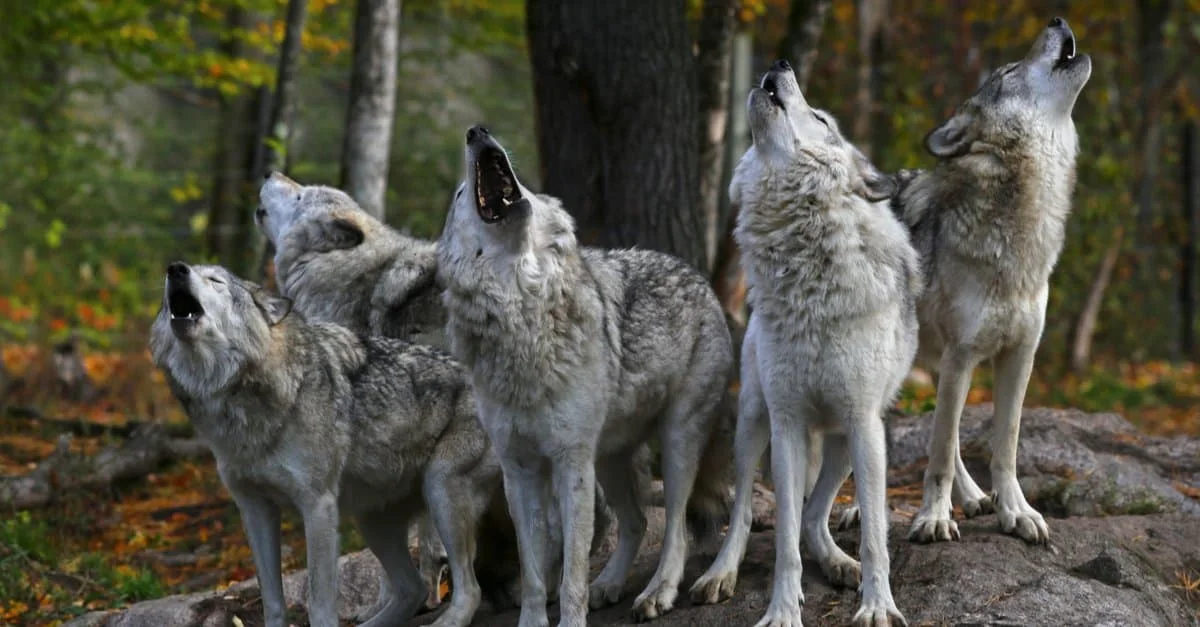
Wolves may howl during bright moonlight, but lunar phases do not cause the behavior.
©Alexander Sviridov/Shutterstock.com
Wolves howl under a visible moon, beneath cloud cover, during a new moon and in daylight. Raising the muzzle helps project a long call; it isn’t a sign that the wolf is addressing the moon. The familiar image likely stuck because wolves are easier to see on bright nights and the pose lends itself to folklore and illustration.
Wild packs are usually family groups
Gray wolves generally live in family groups made up of parent wolves and offspring from one or more years. Pack size varies with births, deaths, dispersal, prey and local conditions. Some packs have only a few members; unusually large groups can exceed 20. Family members may hunt, travel, raise pups, protect food and defend territory together.
Young adults often leave their birth pack to find a mate and unoccupied territory, though when they leave varies. Some remain with their family, while others disperse and start families of their own. Pack membership changes over time.
The familiar “alpha wolf” idea needs similar context. The image of unrelated wolves in constant competition for leadership came largely from observations of artificial captive groups. In a typical wild pack, the leading male and female are usually the parents. Biologist L. David Mech has argued that calling them “alphas” adds little to describing them as the adult parents of a family. Dominance and conflict can occur, but the usual structure is a family group.
Listen to the whole wolf
Howling is only one part of wolf communication. Wolves also bark, whimper, whine, growl and combine sounds, as in a bark-howl. A short bark may warn of danger or accompany defensive behavior. Whines can appear in exchanges between adults and pups or in submissive interactions. Growls may warn another animal away from food or space.
Sound needs to be read alongside scent, facial expression, ear and tail position, posture, touch and movement. A growl paired with a stiff body and bared teeth carries different signals from one during play. Looking at the whole animal gives a more responsible reading than assigning a fixed meaning to one sound.
Silas’s call and Nikai’s answer offer a brief glimpse of a broader social system. The duet can’t be translated word for word, but a companion responding to a companion fits a species whose lives depend on staying connected.


