Sample No. 0087
Boxer Dog Food: Choosing Complete Meals for Puppies, Adults, and Seniors
Compare life-stage labels, calories, portions, and storage to find a practical feeding plan for your Boxer’s age and routine.

A Boxer’s build can suggest athleticism, but it can’t tell you which food or portion suits an individual dog. Age, ordinary activity, calorie needs, storage space, and meal size all matter. Start with the food’s life-stage information, then work out how its calorie density fits your dog’s daily plan.
The four JustFoodForDogs recipes discussed here offer different combinations of life-stage eligibility, ingredients, energy density, and storage. Chicken & Rice and Fish & Sweet Potato are labeled for all life stages, including growth of large-size dogs. Turkey & Whole Wheat Macaroni and JustFresh Home-Cooked Chicken are for adult maintenance. Three are fresh frozen; JustFresh is shelf-stable until opened.
These comparisons use the recipes’ stated information and practical feeding considerations. They are not based on a hands-on feeding trial, and none of the foods is presented as a way to treat or prevent a disease. A dog with individual veterinary feeding instructions should follow that plan.
Choose for life stage, then for the individual dog
Boxers can have very different days, even within the same household. One may take long walks and join regular activities; another may spend more time at home. Puppies are a separate consideration because their food needs to be suitable for growth, regardless of how energetic they seem.
Check the nutritional adequacy information on the exact recipe. The FDA’s complete and balanced food guide explains how foods for growth and adult maintenance apply to different life stages. An adult-maintenance food does not become a puppy food because the puppy likes it. Conversely, a food labeled for all life stages still needs a portion suited to the individual dog.
A useful shopping sequence is to confirm that the food is intended as a complete meal, match its life-stage wording to the dog, note its calorie content, and calculate the daily weight from the dog’s established calorie plan. Then compare serving size, storage needs, cost, and availability. A package image or a large number on the front cannot answer those questions.
Marketing terms need their own context. AAFCO’s explanation of natural labeling describes how the term relates to ingredients and processing. The word “natural” does not, by itself, establish whether a food is nutritionally suitable for a particular Boxer.
Read the ingredient list to see which proteins, grains, oils, and nutrient additions are present. Use the life-stage information to assess suitability and calorie data to calculate portions. Those details serve different purposes; appealing ingredients alone don’t establish the nutritional result of a complete recipe.
Chicken & Rice, Turkey & Whole Wheat Macaroni, and JustFresh Chicken contain grains. Fish & Sweet Potato is grain-free. The breed name alone does not mean every Boxer needs grains included or excluded. Follow individualized veterinary instructions where they apply.
Four fresh recipes and their practical differences
| Recipe | Practical fit | Life-stage wording | Calories | Storage before opening |
|---|---|---|---|---|
| Chicken & Rice | Grain-inclusive fresh meal; also eligible for growth | All life stages, including large-size growth | 1,530 kcal/kg; about 43 kcal/oz | Frozen |
| Turkey & Whole Wheat Macaroni | More calories in less food weight among these picks | Adult maintenance | 1,741 kcal/kg; about 49 kcal/oz | Frozen |
| Fish & Sweet Potato | Fish-based alternative with a larger serving at equal calories | All life stages, including large-size growth | 922 kcal/kg; about 26 kcal/oz | Frozen |
| JustFresh Home-Cooked Chicken | Adult meals without freezer storage before opening | Adult maintenance | 1,254 kcal/kg; about 36 kcal/oz | Shelf-stable |
Chicken & Rice: a flexible grain-inclusive choice
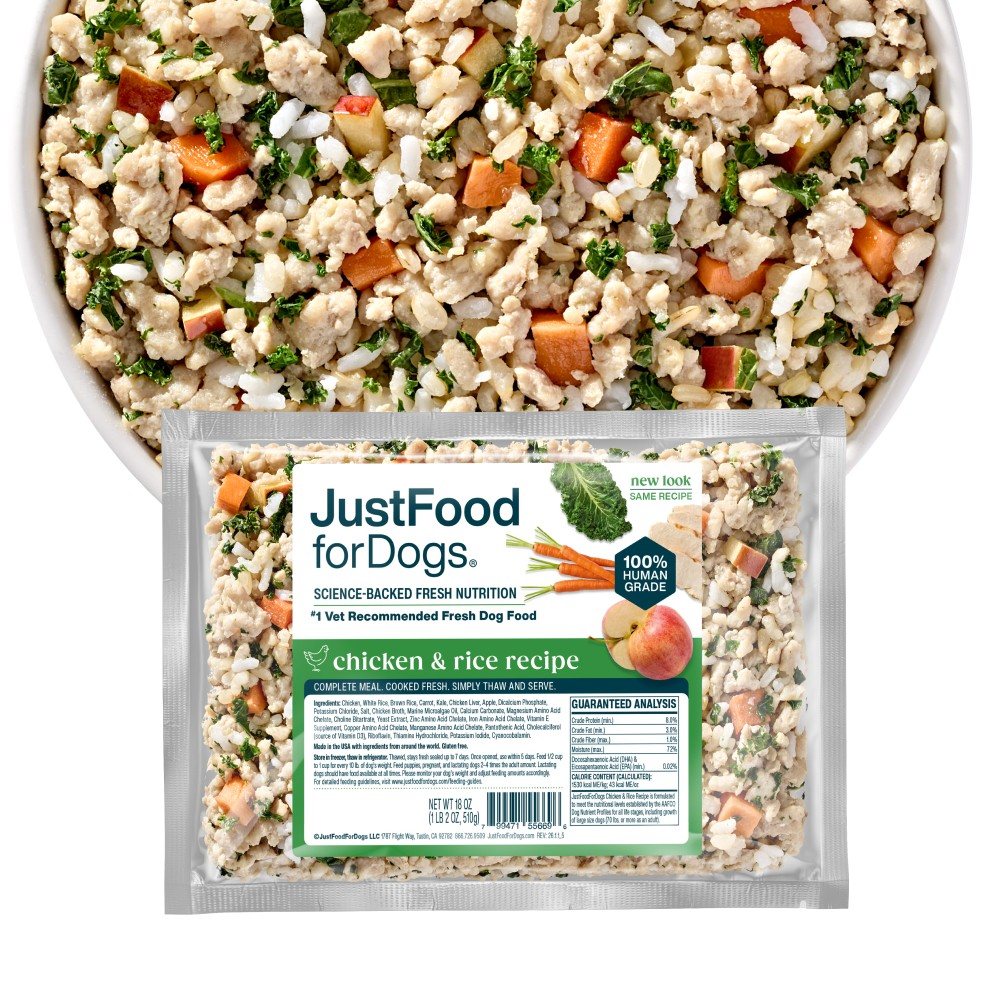
This recipe combines chicken thighs and liver with white and brown rice, vegetables, fruit, oils, and a nutrient blend. Its current adequacy wording covers all life stages, including growth of large-size dogs. That makes it relevant to puppy feeding as well as adult meals, with portions calculated separately for each dog.
At 1,530 kcal/kg, it provides 1.530 calories per gram. Once a dog’s daily calories from this food have been established, dividing that number by 1.530 gives the approximate food weight in grams. The same calculation can help whether the recipe supplies every meal or forms part of a mixed plan.
Chicken & Rice is a reasonable comparison point when you want a grain-inclusive fresh meal with a calorie density between the other featured options. Keep it frozen and thaw it according to its package directions. If someone else feeds your Boxer, provide the recipe name and measured amount; “a full bowl” can mean different things to different people.
View Chicken & Rice at JustFoodForDogs
Turkey & Whole Wheat Macaroni: a smaller weight for the same calories
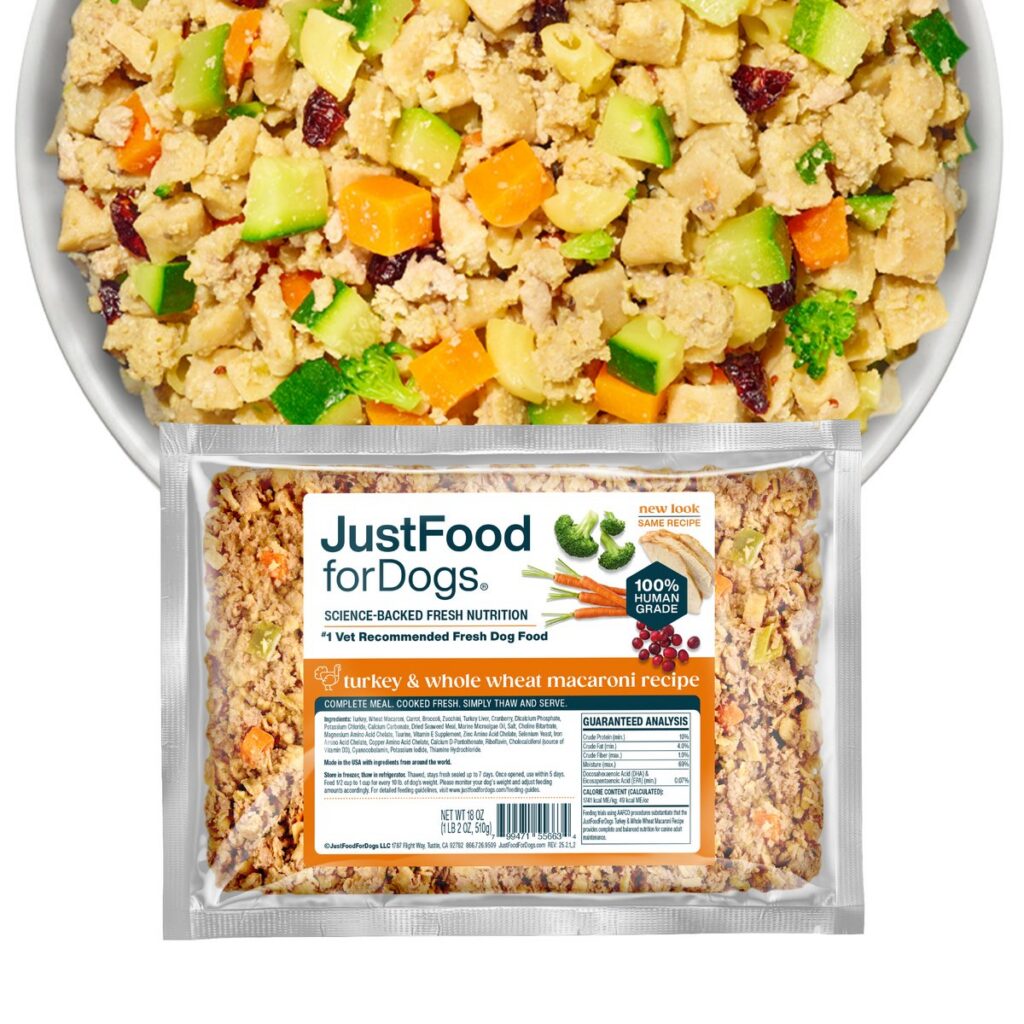
Turkey, liver, whole wheat macaroni, vegetables, cranberries, and a nutrient blend make up this adult-maintenance recipe. At 1,741 kcal/kg, or 1.741 calories per gram, it is the most calorie-dense option in this comparison. A fixed calorie amount therefore requires less food by weight than the same amount from a less dense recipe.
That can matter when a dog’s individual plan involves a relatively large calorie allocation, or when the weight of a less dense food would make portions awkward to divide or store. It does not mean the dog should receive more calories. Work out the allocation first, then use the recipe’s calorie density to calculate the corresponding grams.
The food is for adult maintenance, and it contains wheat. Keep puppy meals separate, and review the ingredients if your dog has specific feeding instructions. A preference for turkey is not the same as a medically directed feeding requirement.
View Turkey & Whole Wheat Macaroni at JustFoodForDogs
Fish & Sweet Potato: a lower-density fish-based option
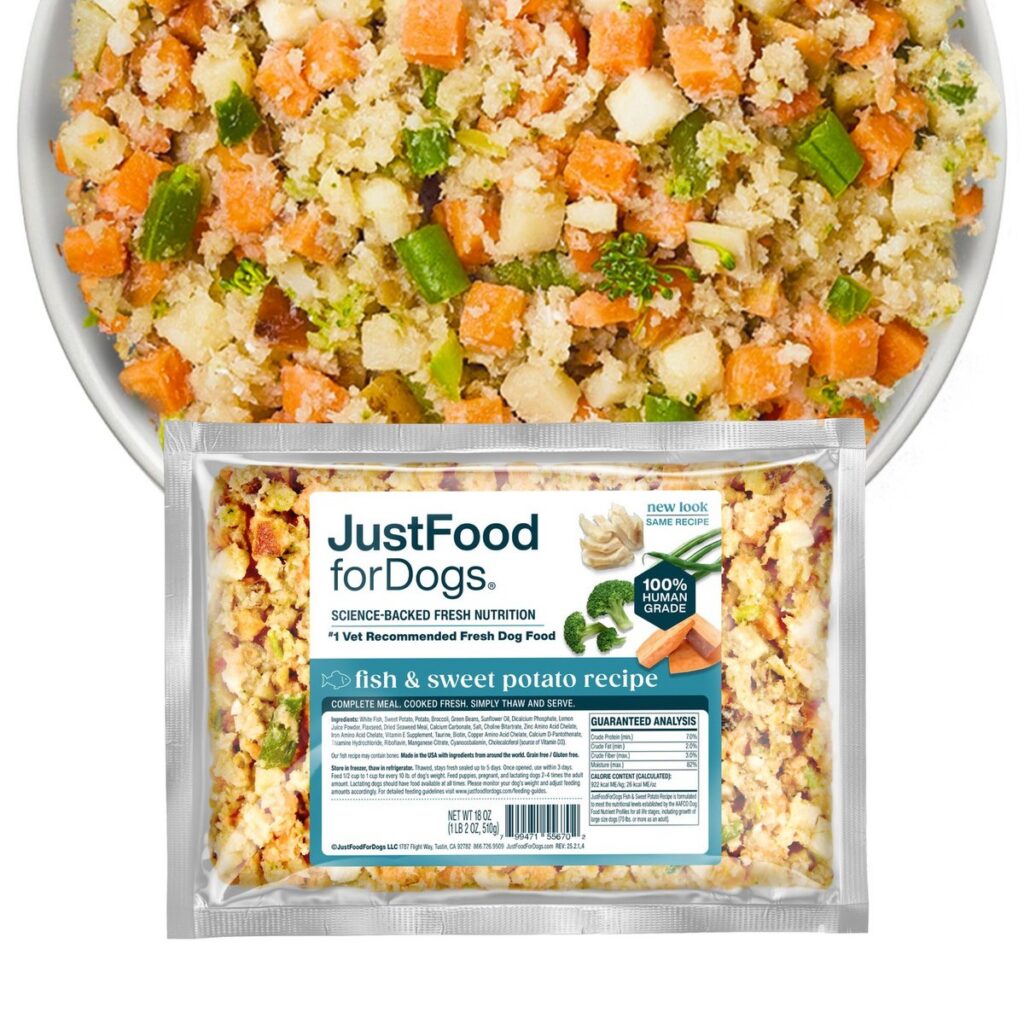
This recipe contains white fish, sweet potatoes, russet potatoes, green beans, broccoli, oils, and a nutrient blend. Its current all-life-stages wording includes growth of large-size dogs. It offers a fish-based option in a complete prepared meal.
At 922 kcal/kg, it supplies 0.922 calories per gram, the lowest density among these four recipes. A dog receiving a fixed number of calories will need more of it by weight than of the other foods. Keep that in mind when planning meal size, thawed portions, freezer space, and how long an order will last.
A lower calorie density does not make this a weight-management prescription, and a grain-free label does not establish that the recipe is better for Boxers. Consider it when the recipe’s ingredients suit the dog and its larger food weight fits the household routine.
View Fish & Sweet Potato at JustFoodForDogs
JustFresh Chicken: shelf-stable before opening
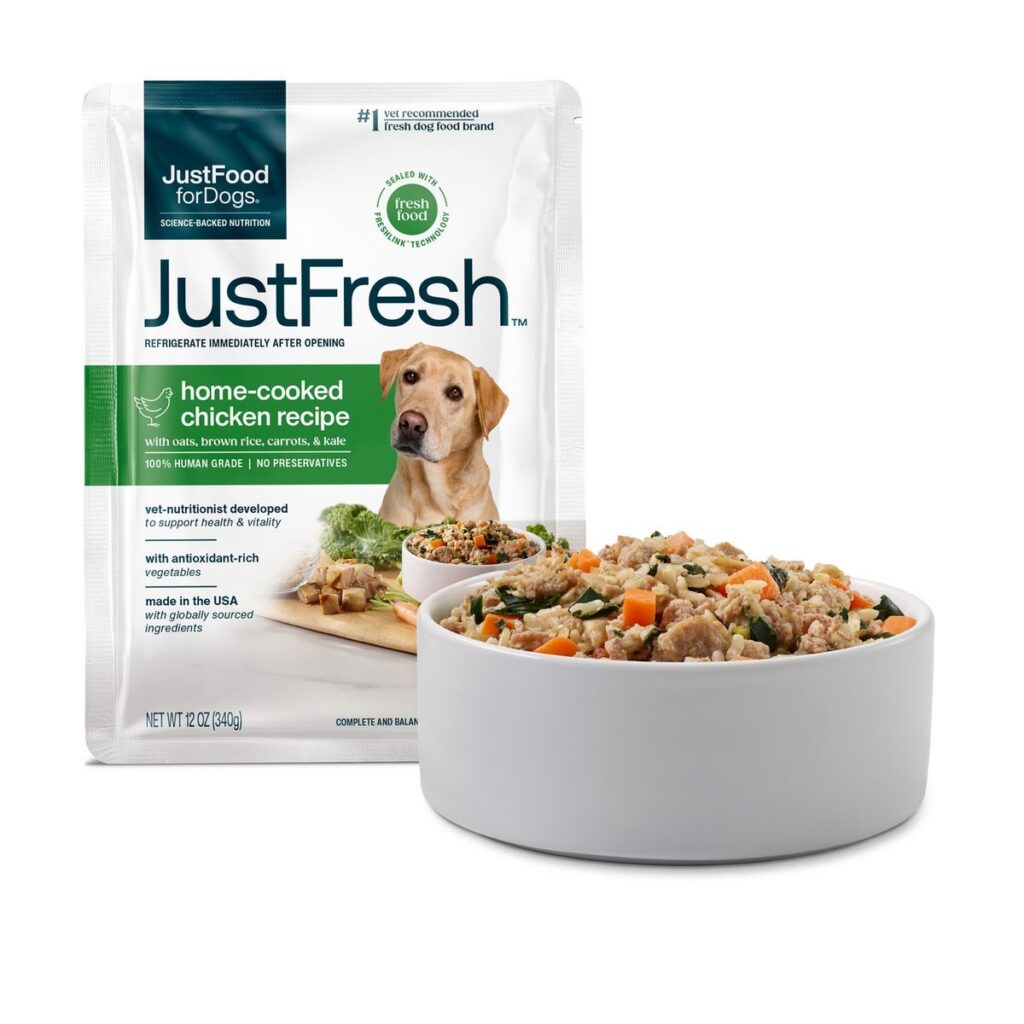
JustFresh Home-Cooked Chicken is an adult-maintenance food with a different storage routine. Unopened pouches are shelf-stable, so they don’t take up freezer space. Once opened, the food needs refrigeration and, according to the current directions, use within three days.
The recipe includes chicken thighs and liver, oats, brown rice, carrots, and kale. Its 1,254 kcal/kg equals 1.254 calories per gram. The adult-maintenance wording matters if a household also feeds a puppy: convenient storage doesn’t change which life stage the food is for.
Before choosing it, work out how many meals an opened pouch supplies and whether the remainder can be used within the stated refrigerated period. This is particularly useful when planning for travel, a sitter, or a household schedule that changes from day to day.
View JustFresh Home-Cooked Chicken at JustFoodForDogs
Feeding puppies and older Boxers

For puppies, confirm the growth wording
Among these recipes, Chicken & Rice and Fish & Sweet Potato are labeled for all life stages, including growth of large-size dogs. Turkey & Whole Wheat Macaroni and JustFresh Chicken are adult-maintenance foods, so they are not the complete growth meal choices in this comparison.
Expected adult size is part of the label check. If a puppy is expected to reach 70 pounds or more, look for the large-size growth wording. Vetstreet’s large-breed puppy food guide offers more selection context. A puppy’s size does not make an adult-maintenance recipe appropriate before growth is complete.
Keep track of the puppy’s weight, exact recipe, and feeding directions. Portions change as a puppy develops, so a serving that worked earlier should be reviewed rather than repeated indefinitely. Discuss the amount and schedule with the veterinary team.
Young puppies typically need more frequent meals than adults. The AKC feeding-frequency guidance describes small meals in early months and commonly three to four feedings per day for puppies. Individual advice may differ, so divide the daily amount according to the schedule recommended for that puppy.
In a home with an adult and puppy, use separate bowls and clear feeding instructions. Watch both dogs during meals so the puppy doesn’t take food from the adult’s dish, or vice versa. Track training rewards for each dog too; food given during practice belongs in the daily plan.
For older dogs, review the dog’s current routine
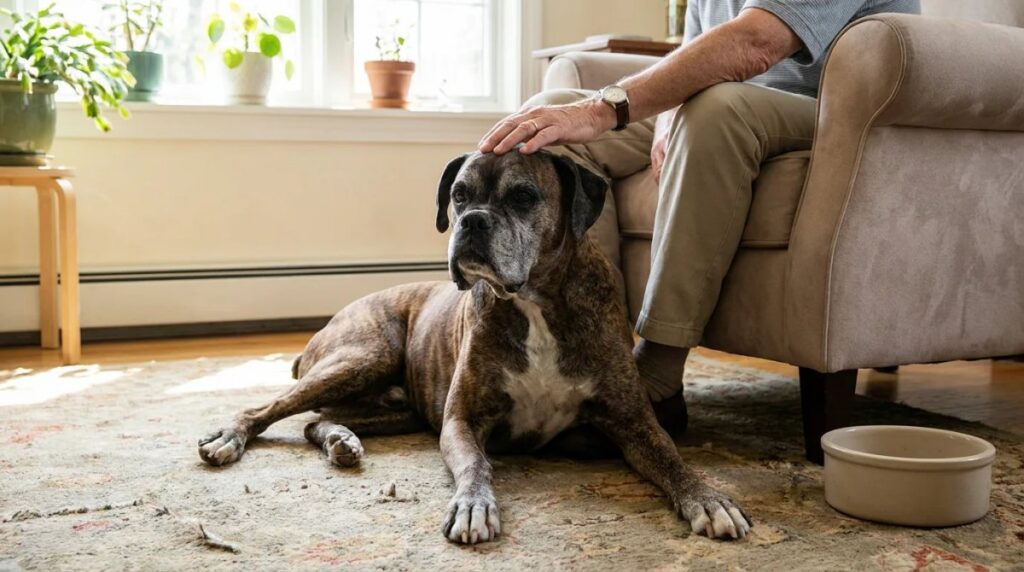
A senior Boxer may have different habits from the dog you fed several years ago. Consider current activity, appetite, body condition, comfort while eating, and any veterinary instructions. Age alone doesn’t establish that every dog needs fewer calories or softer food.
The adult-maintenance options here may suit an older adult whose needs fit them; growth-inclusive foods may also be appropriate when the portion and individual plan do. Life-stage wording is one part of the decision and does not set the dog’s daily amount. Vetstreet’s senior dog food guide discusses the broader category.
For a feeding review, bring the exact food label and measured daily amount, including treats. Owners comparing other breeds can also read WebVet’s Boston Terrier feeding guide and Petful’s guide to Great Danes.
Portions: convert calories into food weight
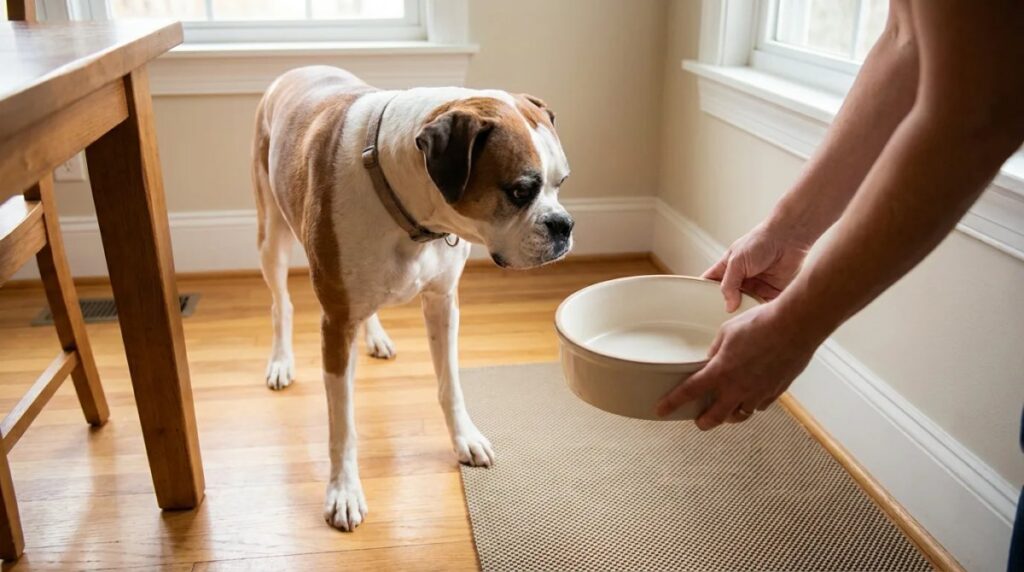
The calorie allocation for an individual dog is the starting point for measuring food. Account for calories set aside for treats or other extras, then calculate the weight of the main food from its label. There is no single breed-wide bowl count that applies across foods with different calorie densities.
For a gram-based calculation, divide kcal/kg by 1,000 to get calories per gram. Divide the calories assigned to that food by the resulting figure. For example, a food labeled 1,530 kcal/kg supplies 1.530 calories per gram. Keep the units consistent and weigh portions rather than estimating from bowl size.
The table below uses an illustrative allocation of 1,000 calories per day from main food. It is a comparison tool, not a recommended daily intake for a Boxer.
| Recipe | Calories per gram | Grams for 1,000 calories | Approximate grams per meal when split into two |
|---|---|---|---|
| Chicken & Rice | 1.530 | 654 | 327 |
| Turkey & Whole Wheat Macaroni | 1.741 | 574 | 287 |
| Fish & Sweet Potato | 0.922 | 1,085 | 542 |
| JustFresh Home-Cooked Chicken | 1.254 | 797 | 399 |
At the same illustrative calorie amount, Fish & Sweet Potato takes roughly 511 more grams per day than Turkey & Whole Wheat Macaroni. That affects meal size and supply planning. It doesn’t mean one dog should receive more calories, and it doesn’t make the lower-density recipe a way to address weight concerns.
Two adult Boxers may have different individual calorie plans. For illustration, imagine one is assigned 900 calories from main food daily and another 1,500. Those figures aren’t recommendations for quiet or active dogs. At 1.530 calories per gram, the amounts of Chicken & Rice would be about 588 and 980 grams. At 1.741 calories per gram, the amounts of Turkey & Whole Wheat Macaroni would be about 517 and 862 grams.
The calorie plans remain individual; the recipe changes the weight of food needed to meet them. That’s why an “active” label or description can’t replace a calculation. WSAVA nutrition resources include body-condition tools that can support discussions with a veterinary professional.
Track activity and food extras
Describe what the dog actually does on an ordinary week: walks, play, training, rest days, and food offered during those activities. A brief burst of play and sustained regular activity are different routines. A simple record gives the veterinary team a clearer picture than choosing a recipe based on an aspirational exercise schedule.
Include both weekdays and the busiest day. A weekend outing may not reflect the usual routine, and food from another caregiver can be easy to overlook. If activity or the household schedule changes, write down the current food amount so any review starts with what the dog actually receives.
Training treats and other extras count toward the daily intake. If appropriate, some of the main food can be set aside for training, simplifying the accounting. For example, if a plan allows 1,100 calories total and 100 are allocated to extras, 1,000 remain for main food. Serving 1,100 calories of meals and then adding treats produces a different total.
An eager dog doesn’t automatically need a larger meal. If you’re unsure about intake or body condition, discuss the measured amounts and routine with your veterinarian rather than adding unrecorded snacks.
Mix fresh food with dry food or canned food
A complete dry food can be a practical option for a Boxer. Check its life-stage suitability, calories, texture, and serving directions. JustFoodForDogs does not make kibble; its fresh recipes can be considered as alternatives or as part of a mixed plan.
When serving fresh and dry food together, allocate calories to each component. In the illustrative 1,000-calorie main-food day, a half-and-half calorie split gives 500 calories to fresh food and 500 to dry. At 1.530 calories per gram, the fresh half from Chicken & Rice is about 327 grams. Calculate the dry portion using that food’s own label.
Equal calories do not mean equal bowl volume. Don’t add the fresh portion to the full previous dry-food serving. Write down the amount of each food and follow directions for introducing the new food.
Canned food is another format to compare by checking life-stage information, calories, and storage directions. Sealed cans can be convenient to store, but opened food needs the refrigeration and use period specified by its maker. Food texture also varies: pâté and pieces in gravy may be experienced differently at mealtime.
Frozen fresh food requires freezer space and thawing. Shelf-stable fresh food changes unopened storage but still needs appropriate handling after opening. These are practical differences; format alone doesn’t establish that one type is more nutritious. When comparing containers, check calories per package and net weight rather than assuming one package equals one meal.
Estimate costs and how long an order lasts
Compare cost using the amount your Boxer actually eats. Divide the order price by its food weight, then multiply by daily food weight. Use comparable prices and include applicable shipping. An introductory offer and an ongoing price are different parts of a budget.
For one historical example, regular prices recorded on September 28, 2026 were $153.99 for fourteen 18-ounce Chicken & Rice packs and $167.99 for fourteen 18-ounce Fish & Sweet Potato packs. Each order contains 252 ounces. At the illustrative 1,000 food calories per day, using rounded label figures of 43 and 26 kcal/oz, estimated daily costs are about $14.21 and $25.64 before tax and shipping. Prices can change; this comparison doesn’t identify the least expensive food available.
The same example shows why equal-weight orders may last different lengths of time. Chicken & Rice at about 23.3 ounces per illustrative day would last roughly 10.8 days in a 252-ounce order. Fish & Sweet Potato at about 38.5 ounces daily would last roughly 6.6 days. The calculation is separate from whether an order is affordable when purchased.
For a mixed meal, calculate each component’s cost and add them. Half of the illustrative main-food calories from Chicken & Rice would cost about $7.11 at the recorded price; the dry-food share depends on its own package and serving amount.
Estimate how many days an order covers before you buy. Check pack dimensions against freezer space, and thaw frozen food according to package instructions. For JustFresh, plan around the three-day refrigerated use period after opening. Delivery timing and conditions can vary, so use the information shown when ordering and keep a practical supply of the dog’s established suitable food.
For shared care, write down the recipe, the dog it belongs to, the daily total, meal amounts, treats already set aside, and instructions for opened food. If two Boxers share a recipe, calculate portions separately and supervise meals. Sharing a food does not mean sharing a calorie requirement.
Compare protein percentages with care
A Boxer’s athletic appearance can make a high protein number seem persuasive, but percentages on dry food and moist food aren’t directly comparable because they contain different amounts of water. The Pet Food Institute’s guaranteed-analysis guide explains the use of a dry-matter comparison.
Consider a hypothetical fresh food labeled 8% minimum protein and 70% maximum moisture. Its estimated dry matter is 30%. Dividing 8 by 30 and multiplying by 100 gives an estimated 26.7% protein on a dry-matter basis. A hypothetical dry food labeled 25% minimum protein and 10% maximum moisture gives about 27.8% on that basis. The printed 8% and 25% figures appear far apart, while the adjusted estimates are close.
These figures are invented to show the arithmetic; they are not analyses for the featured recipes. Minimum protein and maximum moisture figures also make the result approximate. For a more exact comparison, ask the maker for typical nutrient analysis.
- A dry-matter calculation helps compare protein percentages across foods with different moisture levels.
- It doesn’t tell you how many calories the dog needs.
- It doesn’t measure digestibility or establish the adequacy of every nutrient.
- A higher calculated percentage doesn’t automatically make a food the better choice for an active Boxer.
After comparing percentages, return to life-stage suitability and the individual feeding plan. If two foods meet the dog’s needs, calorie density, ingredients, meal size, storage, and cost can help make the practical choice.
Keep changes measurable and watch for concerns
When reviewing a feeding plan, bring the dog’s current weight, body-condition observations, measured food intake, treats, and usual activity. Keep the labels for both foods when changing recipes. Equal weights of two foods can provide different calories, so follow the transition directions and update household instructions once the change is complete.
Persistent appetite changes, difficulty eating, vomiting, or diarrhea call for veterinary attention. Those signs don’t establish that a particular ingredient is unsuitable for every Boxer. A record of the food, amount, and timing can help the veterinary team assess the individual dog.
Frequently asked questions
Which featured foods can suit a growing Boxer?
Chicken & Rice and Fish & Sweet Potato are labeled for all life stages, including large-size growth. Turkey & Whole Wheat Macaroni and JustFresh Chicken are adult-maintenance foods. Confirm the puppy’s individual portion and schedule with the veterinary team.
How do I compare fresh food with my dog’s current kibble?
Compare calories, not bowl volume. Calculate the fresh portion from its calorie density and the dry portion from its own label. Together, those amounts make the meal plan; adding a full fresh serving to a full dry serving would count both as complete portions.
Does every active Boxer need a higher-calorie food?
No. Consider the dog’s actual activity, individual calorie plan, body condition, and how comfortably the dog eats its meals. Turkey & Whole Wheat Macaroni supplies more calories per gram than the other recipes listed here, but that alone isn’t a reason to change a suitable diet.
Can I purchase prepared fresh meals without a subscription?
JustFoodForDogs offers one-time purchase options. Work out the portion and storage needs before ordering, and compare current purchase terms if you’re also considering recurring orders. Keep promotional pricing separate from the ongoing food budget.
What if two Boxers eat the same recipe?
Calculate each dog’s portion individually and supervise meals so one doesn’t eat the other’s ration. In a puppy-and-adult home, confirm that the puppy’s food is suitable for growth and assign adult-maintenance food to the adult.
Related breed feeding guides: Best Dog Food for Dobermans and Best Dog Food for Cane Corsos from Petful, plus WebVet’s Best Dog Food for Boston Terriers.
A practical Boxer feeding plan comes down to a suitable life-stage food, an individually measured portion, and storage and meal instructions everyone in the household can follow. Review those details as your dog’s routine changes, and bring questions about appetite or body condition to the veterinary team.


