Sample No. 0086
Pomeranian Food Guide: Puppy Growth, Adult Portions and Fresh Meal Choices
Compare growth suitable and adult Pomeranian foods by calories, texture, storage and cost, then measure portions to fit your dog’s daily needs.
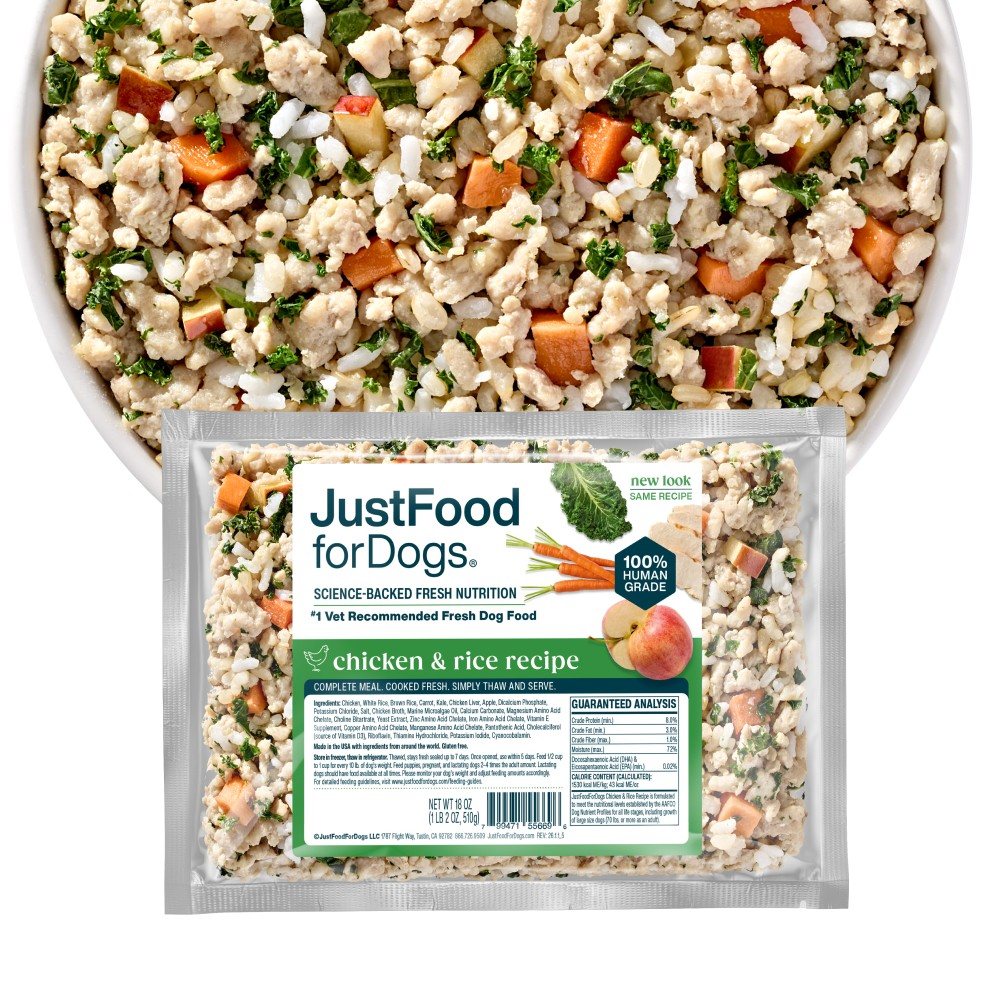
For Pomeranians, choosing food is only half the job: a small daily serving makes life-stage fit, calorie density and accurate measuring especially relevant. The four JustFoodForDogs recipes compared here differ in growth suitability, calories per gram and storage, so the right fit depends on the dog and the household routine.
The comparison uses current product information and handling directions; it isn’t a hands-on feeding trial. A recipe’s nutritional adequacy statement identifies the life stages it suits. For a puppy, look for wording that covers growth or all life stages. Adult-maintenance food is meant for adults, even if its texture or ingredients appeal to a puppy’s caregiver.
Start with life stage and the individual dog
A breed name doesn’t give you an exact calorie target. Age, body size, activity, body condition and the food’s calorie density all affect the portion. Begin with the recipe’s feeding directions, then ask your veterinarian to help tailor the amount to your dog. The Pomeranian breed guide offers more background on the breed, while the FDA’s guidance on complete and balanced pet food explains why the nutritional adequacy statement matters.
Among these four choices, Chicken & Rice and Fish & Sweet Potato have all-life-stages statements that include growth. Turkey & Whole Wheat Macaroni and JustFresh Home-Cooked Chicken are labeled for adult maintenance. That distinction is more useful than choosing by a “small breed” label or a soft texture alone. For more comparisons, see Vetstreet’s small-breed food guide and dog food guide.
The same portioning questions apply to other small dogs, though each animal still needs an individual plan. Related guides cover Maltipoos, Dachshunds, Toy Poodles, and Corgis.
Four recipes, four practical differences
These recipes provide a useful comparison across calorie density and storage. The numbers below are calories per kilogram as listed in the source material; the portions later in this guide use the equivalent calories per gram.
| Recipe | Practical fit | Life-stage statement | Calories per kilogram | Storage |
|---|---|---|---|---|
| Chicken & Rice | Grain-inclusive fresh meals for puppies or adults | All life stages, including large-size growth | 1,530 | Fresh frozen |
| Fish & Sweet Potato | Fish-based fresh meal | All life stages, including large-size growth | 922 | Fresh frozen |
| Turkey & Whole Wheat Macaroni | More calories in a smaller adult serving among these picks | Adult maintenance | 1,741 | Fresh frozen |
| JustFresh Home-Cooked Chicken | Adult meals with pantry storage before opening | Adult maintenance | 1,254 | Shelf-stable before opening |
Chicken & Rice: a growth-suitable grain-inclusive choice
This fresh recipe combines chicken thighs and liver with white and brown rice, vegetables, fruit, oils and a nutrient blend. Its all-life-stages statement includes growth, so it can be considered for a puppy as well as an adult. Each dog still needs a portion calculated for its own needs.
At 1.530 calories per gram, it supplies more calories for a given food weight than Fish & Sweet Potato. That makes it useful to compare when the amount in the bowl matters to your routine. Plan for freezer space, thawing and consistent weighing.
- Consider it for: A grain-inclusive fresh recipe with growth suitability.
- Plan around: Frozen storage and separate puppy and adult portions.
View Chicken & Rice at JustFoodForDogs
Fish & Sweet Potato: lower calorie density by weight
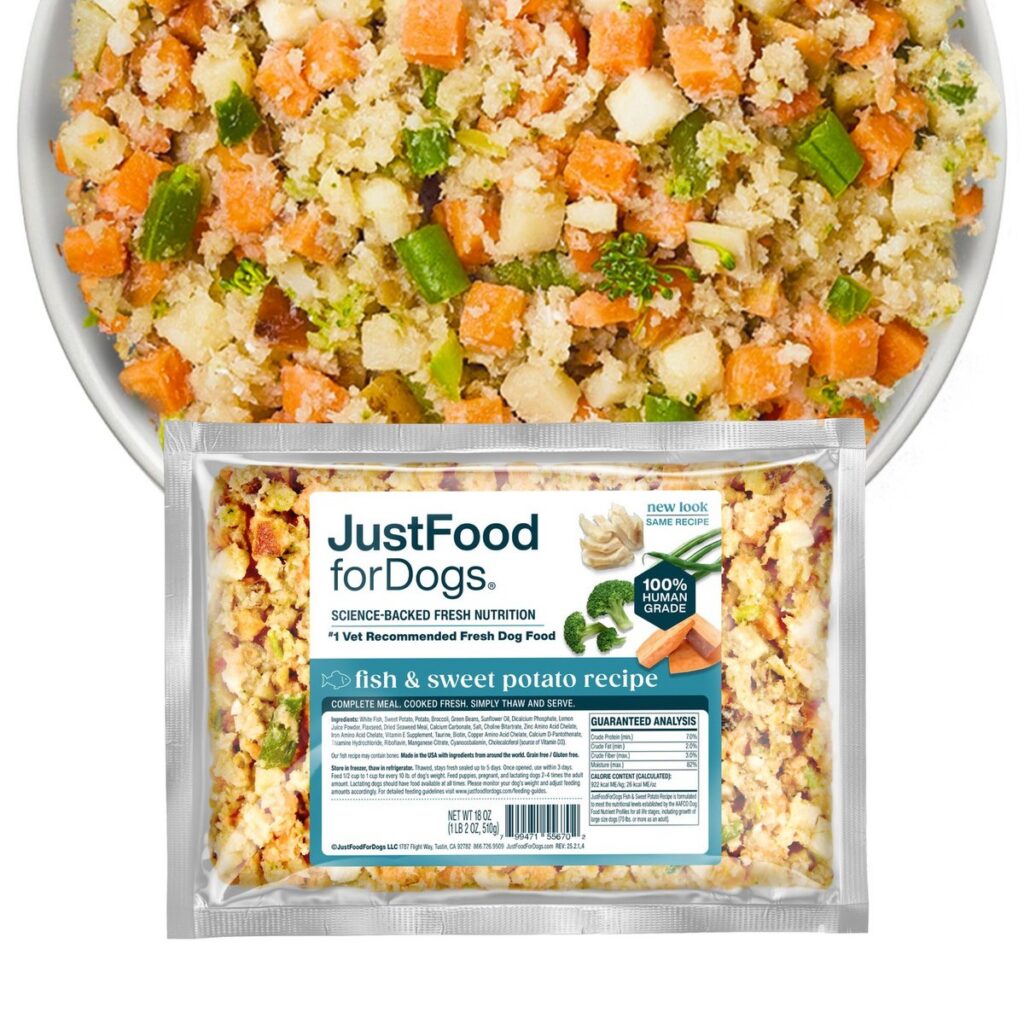
White fish, sweet potatoes, russet potatoes, green beans, broccoli, oils and a nutrient blend make up this fresh recipe. Its all-life-stages statement includes growth. At 0.922 calories per gram, it takes more food by weight than Chicken & Rice to provide the same number of calories.
That difference affects serving size and how quickly a pack is used. Work out the daily amount before ordering, then consider how to divide and store it. The recipe is grain-free; that describes its ingredients, but doesn’t mean a Pomeranian needs to avoid grains or that this food will resolve a health concern.
- Consider it for: A fish-based fresh food that’s suitable for growth.
- Plan around: A larger serving by weight and freezer storage.
View Fish & Sweet Potato at JustFoodForDogs
Turkey & Whole Wheat Macaroni: a compact adult portion
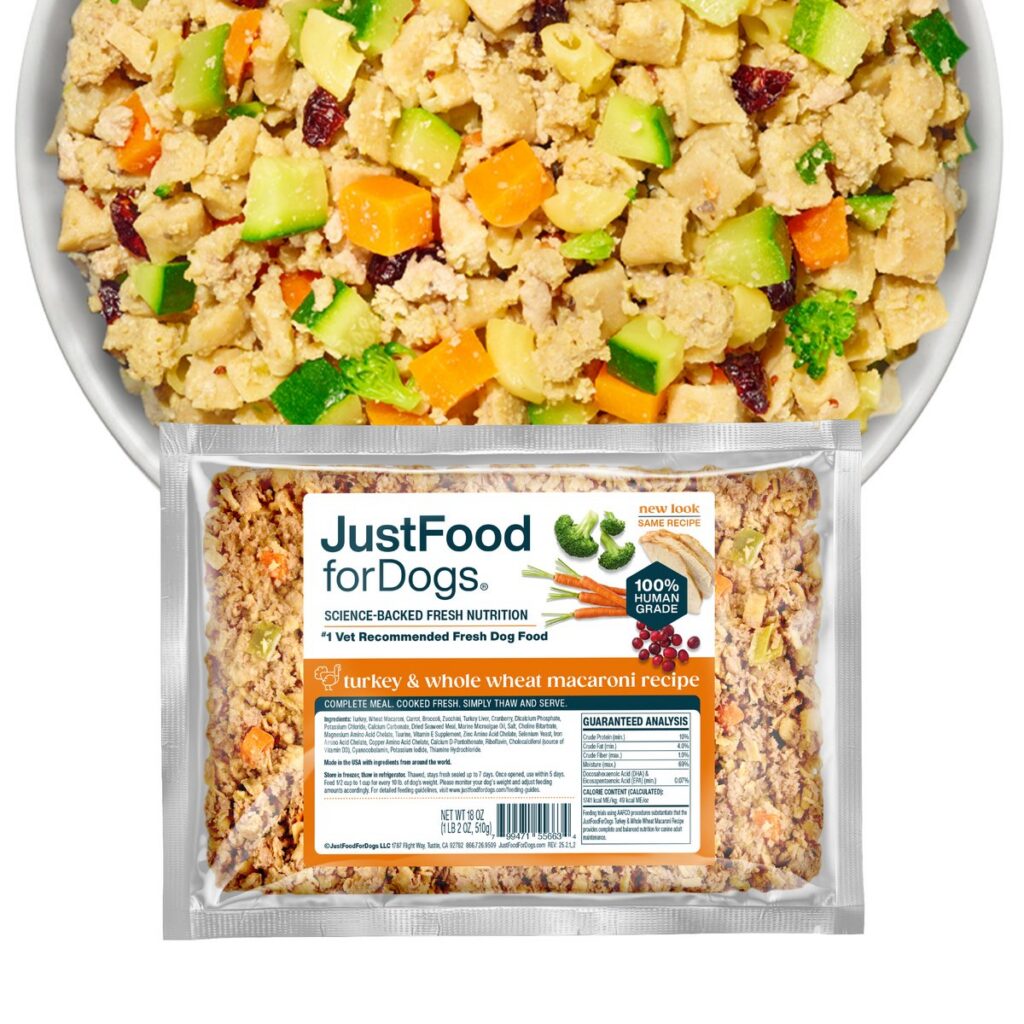
This adult-maintenance recipe includes turkey, liver, whole wheat macaroni, vegetables, cranberries and a nutrient blend. At 1.741 calories per gram, it’s the most calorie-dense of the four selections. An adult may need less food by weight to reach a given calorie amount than with the other options.
That can help when comparing portion size and how much food an order supplies. It also makes accurate measuring useful: an extra spoonful adds calories, even when the amount looks modest.
- Consider it for: An adult turkey-based meal with a relatively small portion by weight.
- Plan around: Adult-only feeding, freezer storage and wheat in the recipe.
View Turkey & Whole Wheat Macaroni at JustFoodForDogs
JustFresh Home-Cooked Chicken: pantry storage before opening
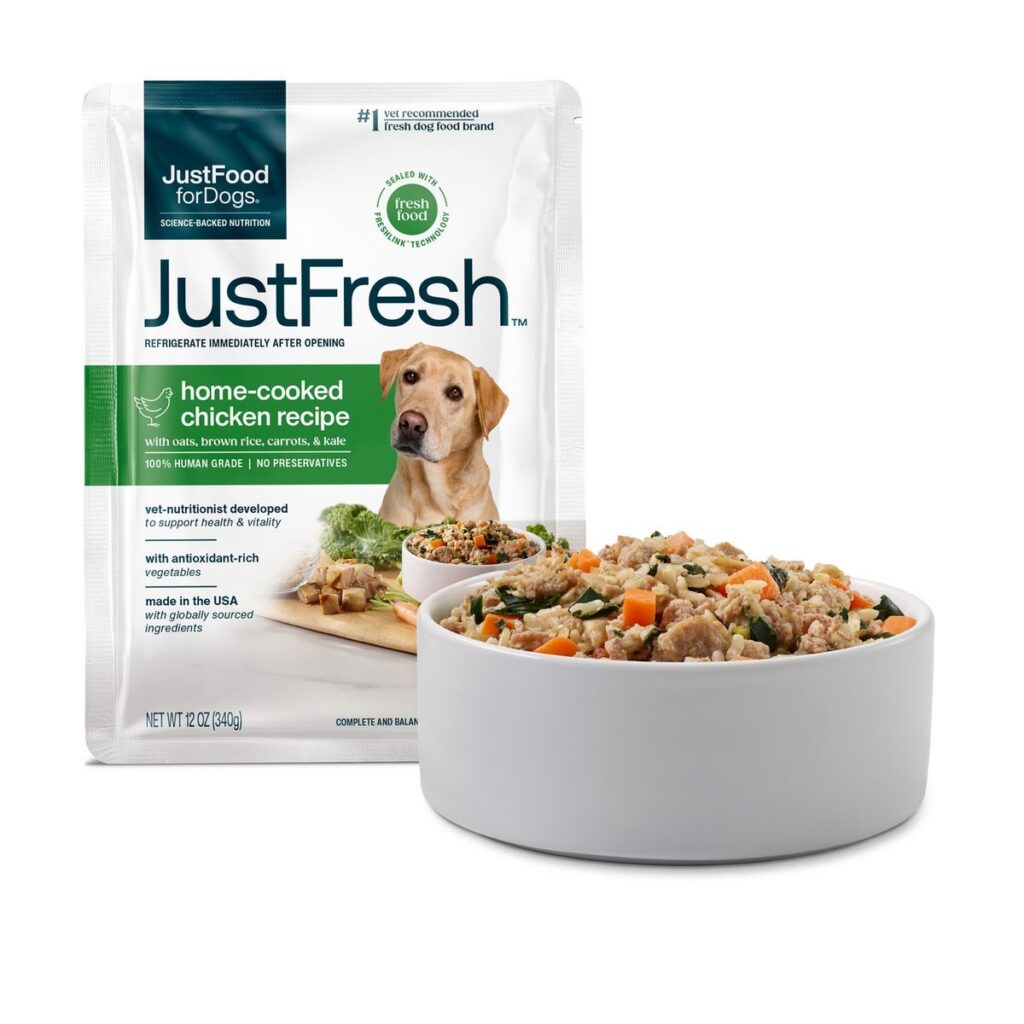
This adult-maintenance option is shelf-stable while unopened, which may suit households with limited freezer space. Once opened, refrigerate it and use it within three days. Its label lists 1.254 calories per gram.
The recipe contains chicken thighs and liver, oats, brown rice, carrots and kale. Before buying, estimate how much your dog will eat within the three-day refrigerated period. Pantry storage simplifies unopened-food planning, but an open pouch still needs a clear use-by routine.
- Consider it for: Adult meals that don’t need freezer space before opening.
- Plan around: Refrigeration and timely use after opening.
View JustFresh Home-Cooked Chicken at JustFoodForDogs
Adjust portions for puppies, adults and seniors

For a puppy, the two growth-suitable recipes in this comparison are Chicken & Rice and Fish & Sweet Potato. An adult-maintenance label alone doesn’t establish that a food supports growth; adding more of it doesn’t change its formulation.
For a young Pomeranian, including a three-month-old puppy, build a regular schedule with your veterinarian’s guidance. The AKC guidance for toy- and small-breed puppies describes dividing the daily ration across three to four meals. Revisit portions as the puppy grows.
Adults may be considered for any of the four recipes if the life-stage statement and individual feeding plan fit. For senior dogs, review portions, texture and routine as needs change; age alone doesn’t determine one ideal food or an automatic calorie reduction. Vetstreet’s senior dog food guide discusses food choices for that stage. For notes on texture and bowl shape in flat-faced small breeds, see the guides for Pugs and Boston Terriers.
Measure small servings and keep the plan clear
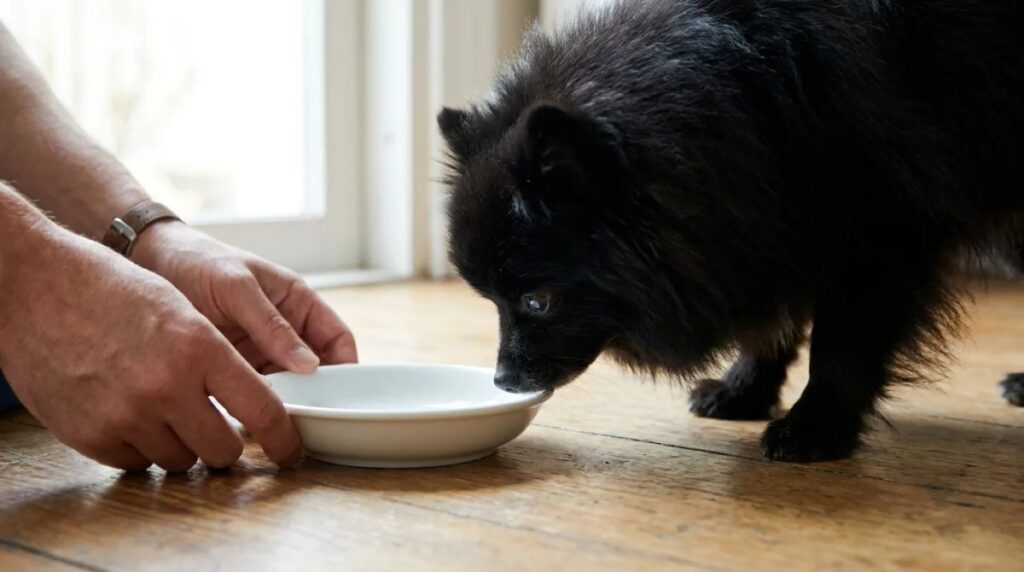
The following comparison uses an illustrative allowance of 250 calories per day from the main food for an adult. It’s an arithmetic example, not a recommendation for any Pomeranian’s age, weight or activity. Turkey & Whole Wheat Macaroni and JustFresh Chicken are adult-maintenance recipes; puppies need the growth-suitable options.
| Recipe | Calories per gram | Grams for 250 calories | Approximate grams per meal, split in two |
|---|---|---|---|
| Chicken & Rice | 1.530 | 163 | 82 |
| Fish & Sweet Potato | 0.922 | 271 | 136 |
| Turkey & Whole Wheat Macaroni | 1.741 | 144 | 72 |
| JustFresh Home-Cooked Chicken | 1.254 | 199 | 100 |
To calculate a daily weight, divide the food calories by the recipe’s calories per gram. Set an empty dish on a kitchen scale and reset it before adding food. Record whether the amount is for the full day or one meal, so another caregiver can follow the same plan.
Include treats and other extras in the daily calorie plan. If the allowance includes treats, subtract those calories before working out the main-food portion. For mixed feeding, assign calories to each food and calculate each portion separately. Adding fresh food on top of the previous ration can quietly increase the daily total.
Even small differences accumulate when they recur. Ten extra grams of Turkey & Whole Wheat Macaroni provides about 17 calories; ten extra grams of Fish & Sweet Potato provides about nine. Keep the scale near the preparation area, write down the daily total, and mark meals as they’re served when more than one person feeds the dog.
Combining fresh food with dry food
A complete dry food may suit a Pomeranian when its life-stage statement, calorie content and texture fit the individual dog. A small-breed label can help narrow options, but check the actual recipe and feeding directions. JustFoodForDogs doesn’t make kibble; its prepared meals are a different format that can be included in a measured plan.
For the illustrative 250-calorie adult allocation, half from Chicken & Rice would be about 82 grams. Calculate the other 125 calories using the dry food’s label. Simply serving half the former dry portion by weight works only if it already represented the right calorie amount and the food hasn’t changed.
Write both amounts down and keep the units clear. Don’t transfer a gram amount or cup measure to a different product without recalculating. When changing the split, replace calories from the previous food instead of adding another portion.
Compare daily cost and storage needs
Prices recorded September 28, 2026, were $153.99 for fourteen 18-ounce Chicken & Rice packs and $167.99 for fourteen 18-ounce Fish & Sweet Potato packs. Using rounded label values of 43 and 26 calories per ounce, respectively, the illustrative 250-calorie day costs about $3.55 for Chicken & Rice or $6.41 for Fish & Sweet Potato, before tax and shipping.
Prices may change, and these figures compare two selected fresh recipes at an equal calorie amount. They aren’t a market-wide price ranking. They do show why the pack price alone can mislead: the lower calorie-density fish recipe provides fewer days of food at the same weight.
Factor in storage and waste. A small dog may take longer to use an opened pack than a larger dog. Check the handling directions and choose a quantity you can use within the stated period. Before ordering, confirm pack size, daily portion and storage space; dividing the order’s total weight by the daily amount gives a rough estimate of how long it will last.
Make caregiver instructions equally specific. Label the recipe, daily amount and opened date, and leave the storage directions with the food. JustFresh Chicken can stay in the pantry unopened, but it needs refrigeration after opening and should be used within three days.
Texture, appetite and homemade meals
No single food is a known favorite for every Pomeranian. Notice whether your dog approaches the bowl, manages the texture and eats the measured meal. Treats or food from other people may also affect appetite. A moist prepared meal offers a different texture from kibble, but softness alone doesn’t make a food the right choice.
When changing foods, make one planned change at a time and follow the product’s transition directions. Persistent refusal, a sudden appetite change or difficulty eating calls for veterinary advice. A recipe comparison can’t diagnose or treat dental disease, allergies or tear stains. If you’re discussing diet with your veterinarian, bring the exact recipe name, a label photo, daily food weight and a list of treats or extras. Note changes in appetite, activity or measured body weight too.
Homemade meals need a properly formulated, complete recipe for the correct life stage. Combining meat and vegetables by eye doesn’t ensure complete nutrition, and an adult recipe doesn’t become suitable for growth when you increase the amount. Vetstreet’s guide to homemade pet diets covers formulation considerations.
Before choosing homemade food, consider whether you can weigh ingredients, obtain each required supplement, follow cooking directions and store the finished batch correctly. Substituting ingredients or leaving out a supplement changes the formula. Prepared meals shift formulation and cooking to the manufacturer; the caregiver still needs to select an appropriate life-stage recipe, measure portions and follow handling instructions.
Keep unsafe foods out of reach
Chocolate, grapes and raisins, onions, and products containing xylitol are unsafe for dogs. If your Pomeranian eats a potentially toxic food, contact your veterinarian promptly and share the ingredient, estimated amount and time it was eaten. Vetstreet’s guide to foods not to share with dogs covers additional exclusions. Snacks should not replace a complete main diet.
Frequently asked questions
Can fresh food and kibble be served together?
Yes, if both foods suit the same life stage and their calories fit one daily allowance. Assign calories to each, calculate the portions separately and let the fresh food replace its share of the existing ration.
Should a small dog automatically get soft food?
No. Choose a texture the individual dog can eat comfortably, along with suitable nutrition and portions. If chewing or eating becomes difficult, seek veterinary advice rather than cycling through flavors.
Which wet food in this comparison suits a Pomeranian?
Chicken & Rice is a grain-inclusive fresh option with growth suitability. Fish & Sweet Potato is another growth-suitable choice with fish. For adults who want pantry storage before opening, compare JustFresh Chicken. Match the recipe to life stage and portion needs.
Can a puppy eat an adult-maintenance recipe?
An adult-maintenance statement by itself doesn’t establish that a food supports growth. In this comparison, Chicken & Rice and Fish & Sweet Potato have growth-suitable statements; Turkey & Whole Wheat Macaroni and JustFresh Chicken are adult-maintenance foods.
How should I compare food costs for a small dog?
Compare price per calorie or gram, then apply your dog’s actual daily food allowance. Check how long opened food can be refrigerated and how quickly you’ll use it. Include shipping when comparing purchase costs.
The useful choice is the recipe that fits your dog’s life stage and your household’s measuring and storage routine. Keep the portion specific, review it as your Pomeranian changes, and ask your veterinarian when appetite or eating ability shifts.
Related breed feeding guides: Best Dog Food for Maltipoos, Best Dog Food for Poodles, and Best Dog Food for Corgis.


