Sample No. 0088
Wet Puppy Food Compared: Fresh, Shelf-Stable, and Canned Meals
Compare growth labels, calories, portions, and storage to find a complete wet puppy food that fits your feeding routine.

Choosing wet food for a puppy comes down to two related questions: does the exact recipe provide complete nutrition for growth, and can your household portion and store it as directed? Cans, frozen fresh meals, and shelf-stable fresh cartons answer different storage and serving needs. The package alone can’t tell you whether a food is suitable for your puppy.

This comparison looks at three JustFoodForDogs recipes and one canned meal using their current manufacturer labels. Chicken & Rice is the most calorie-dense fresh choice in this group, Fish & Sweet Potato is a fish-based option with larger portions for the same calories, and PantryFresh Chicken & White Rice can be stored unopened in a cupboard. Purina Pro Plan Puppy Chicken & Rice Entrée Classic provides a canned comparison. The analysis is based on labels, not a feeding trial.
Start with the growth statement
Before comparing texture, ingredients, or package size, check the nutritional adequacy statement on the exact recipe. It tells you whether the food is formulated to meet a relevant nutrient profile or tested through feeding trials, and which life stages it covers. Growth and adult maintenance are different intended uses.
For a puppy’s main diet, look for a statement that covers growth or all life stages. If your puppy is expected to weigh 70 pounds or more as an adult, check for wording that includes growth of large-size dogs. That threshold refers to expected adult weight, not the puppy’s current size. The FDA’s guide to complete and balanced pet food explains how to read these statements.
Use the same checks for every format:
- Purpose: Is the recipe a complete meal or intended only as a topper or supplemental food?
- Life stage: Does its adequacy statement cover puppy growth?
- Expected adult size: Does its growth statement fit your puppy when large-size wording applies?
- Calories: How many calories are in a gram, ounce, or whole container?
- Handling: Can you reliably store, portion, and serve it according to the label?
A soft texture doesn’t make an adult food suitable for a puppy. JustFoodForDogs’ adult-maintenance JustFresh Home-Cooked Chicken and Turkey & Whole Wheat Macaroni, for example, are different from the growth-suitable recipes compared here. Similar packaging or familiar brand names don’t make recipes interchangeable.
Also distinguish a complete meal from a topper. A small pouch might contain a full meal, or it might be intended only to add flavor to another food. Read the feeding-purpose language instead of assuming the pouch can replace a meal. If a food is labeled for intermittent or supplemental feeding, it shouldn’t take the place of the puppy’s complete growth diet.
Fresh recipes differ in portion size and storage
All three JustFoodForDogs recipes below currently carry all-life-stages statements that include large-size growth. Their calorie densities and storage formats differ, so the right comparison depends on the puppy’s feeding plan and the household’s routine.
| Recipe | Reason to compare it | Growth statement | Calories | Format |
|---|---|---|---|---|
| Chicken & Rice | More calories per ounce than the other two fresh picks | All life stages, including large-size growth | 1,530 kcal/kg; about 43 kcal/oz | Fresh frozen |
| Fish & Sweet Potato | Fish-based recipe; larger serving at equal calories | All life stages, including large-size growth | 922 kcal/kg; about 26 kcal/oz | Fresh frozen |
| PantryFresh Chicken & White Rice | Unopened cupboard storage | All life stages, including large-size growth | 1,093 kcal/kg; about 31 kcal/oz | Shelf-stable fresh before opening |
Chicken & Rice: A compact, grain-inclusive fresh meal
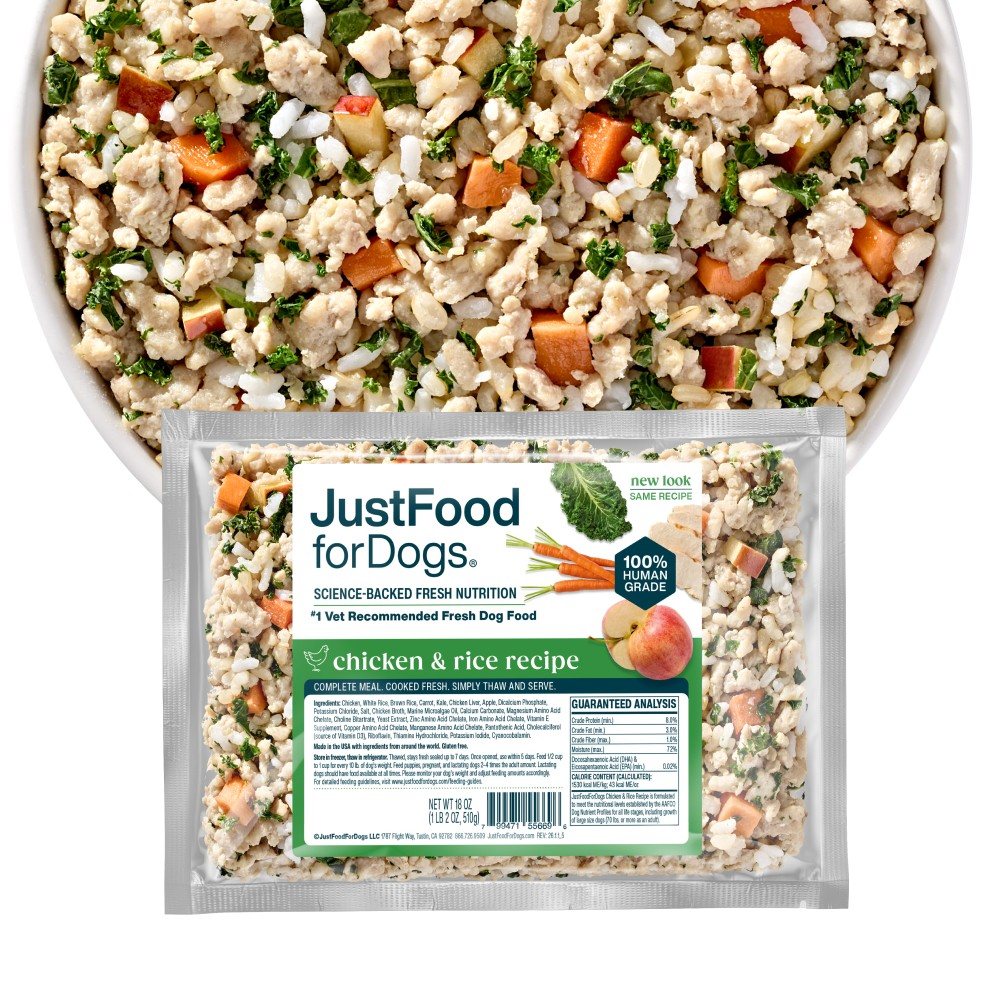
Chicken thighs and liver, white and brown rice, vegetables, fruit, oils, and a nutrient blend make up this recipe. Its current adequacy statement covers all life stages, including growth of large-size dogs. It can be considered for puppies across size categories, with the serving set for the individual dog.
At 1,530 kcal/kg, Chicken & Rice provides 1.530 calories per gram. It is the most calorie-dense of the three fresh choices here, which means less food by weight is needed to supply a given number of calories than with Fish & Sweet Potato or PantryFresh Chicken & White Rice. That can make a difference when dividing food across several meals or fitting opened portions into the refrigerator.
Its practical appeal is a grain-inclusive fresh recipe with published calorie information and a comparatively compact serving in this group. It needs freezer space and thawing according to the package directions, so it fits best in a household that can keep track of what needs to be thawed next.
Weigh the prepared portion according to the package instructions and divide the daily amount among the planned meals. If more than one person feeds the puppy, write down the recipe and portion so the day’s total stays clear. When switching from a can, compare calories and serving weight; the old portion won’t necessarily supply the same energy.
Fish & Sweet Potato: A lower-calorie-per-ounce option
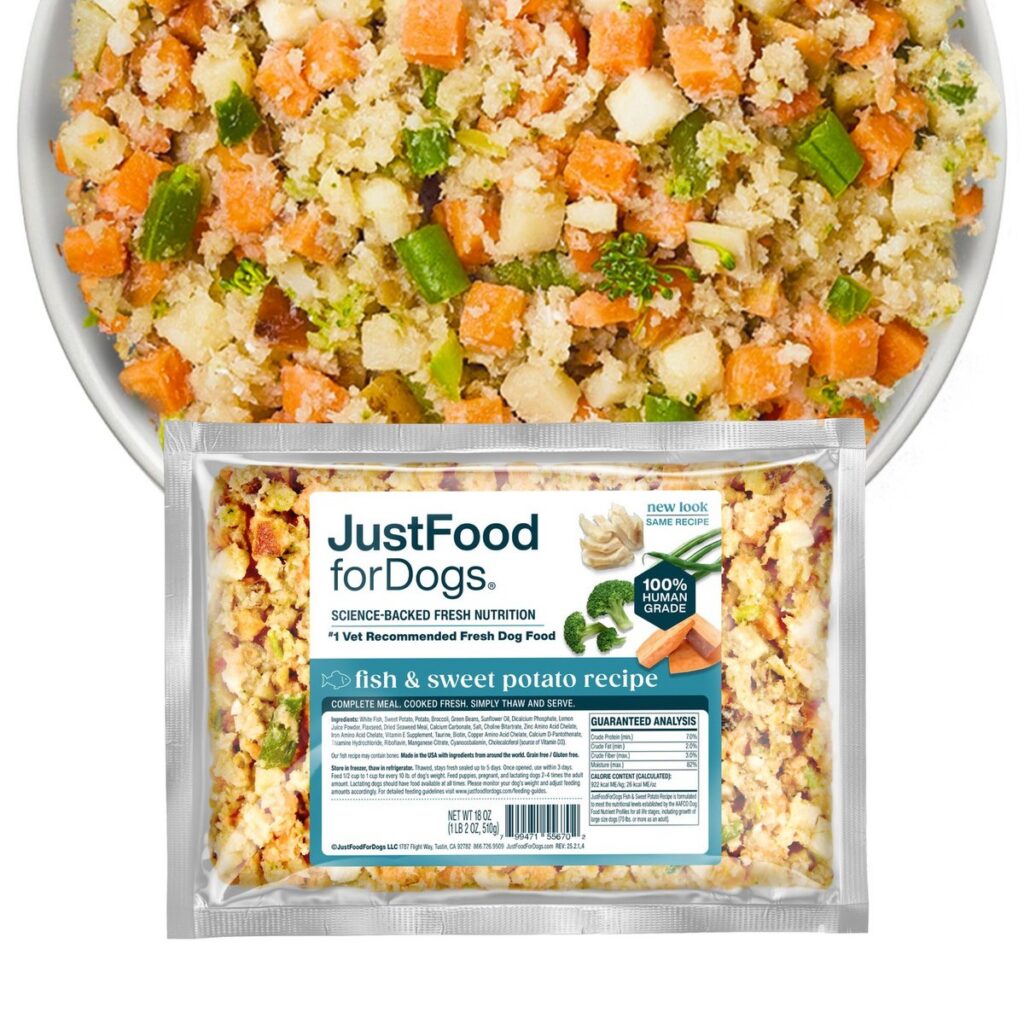
This recipe combines white fish, sweet potatoes, russet potatoes, green beans, broccoli, oils, and a nutrient blend. Its current all-life-stages statement includes large-size growth, making it a growth-suitable complete-food option in this comparison.
Its calorie density is 922 kcal/kg, or 0.922 calories per gram. At equal calories, the puppy needs a larger portion by weight than with Chicken & Rice. Consider that difference when estimating how many meals a pack supplies, how much freezer space you need, and whether the puppy can comfortably eat the planned amount across the day.
Fish & Sweet Potato is included as a fish-based complete meal, not merely fish added as a treat. Its lower calorie density doesn’t establish that it has lower nutritional quality; it changes the serving weight needed for a particular calorie allocation.
This recipe is grain-free. That describes its ingredients; it doesn’t mean all puppies should avoid grains or that the recipe addresses a suspected allergy. If your puppy has specific dietary instructions, review the full ingredient list with your veterinary team rather than relying on the main protein name.
PantryFresh Chicken & White Rice: Fresh food with cupboard storage
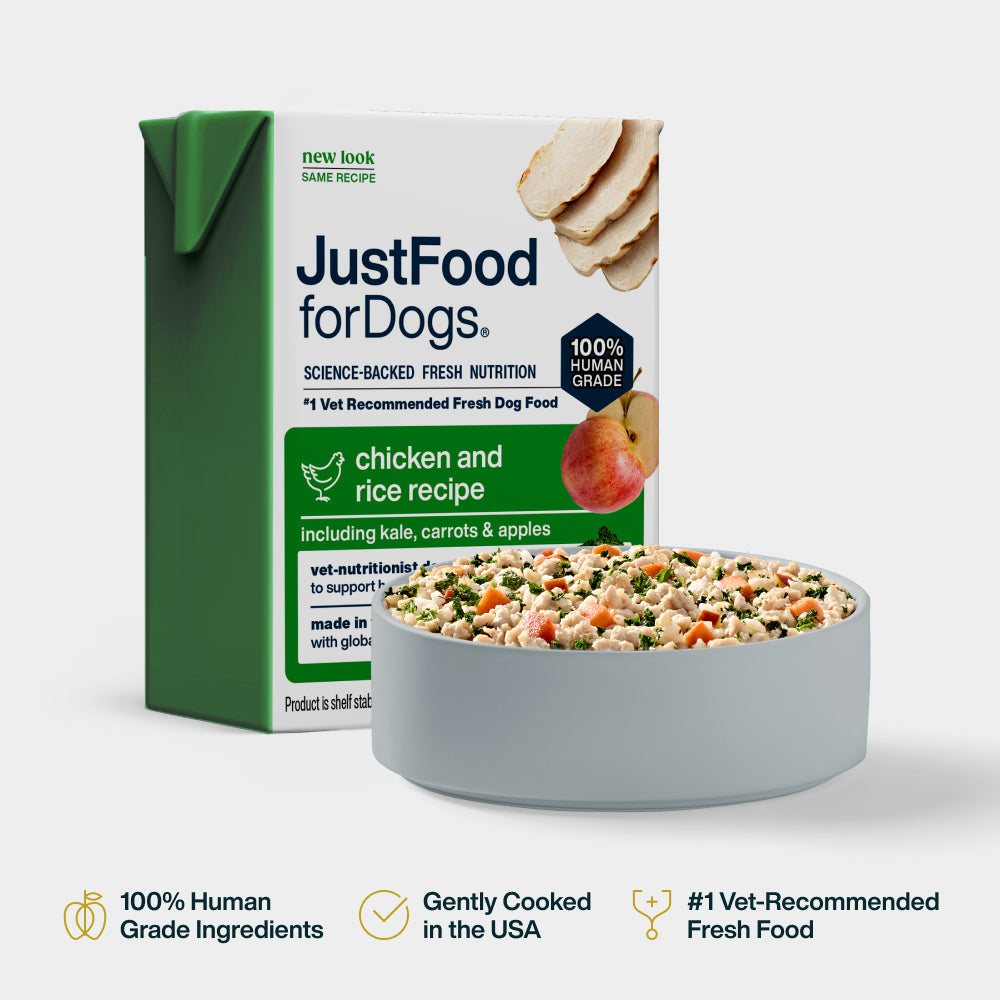
PantryFresh Chicken & White Rice has an all-life-stages statement that includes large-size growth. It is shelf-stable before opening, so an unopened supply doesn’t need freezer space or thawing. That makes it a distinct option for households that want fresh food but have limited freezer capacity.
The label lists 1,093 kcal/kg and about 31 kcal/oz. Using the rounded ounce figure, a 12.5-ounce carton contains about 387.5 calories. That number helps compare the carton with a can whose label lists calories per container.
After opening, the current directions call for refrigeration and use within five days. Write the opening date on the carton so everyone who feeds the puppy can identify which food to use. The cupboard convenience applies to unopened food; leftovers still need the specified cold storage.
For travel, an unopened carton can simplify packing. Plan for refrigeration once it’s open, and estimate how much the puppy will eat before choosing the number of cartons. Don’t apply PantryFresh’s five-day instruction to every JustFoodForDogs product; handling directions differ between products.
How canned food compares

Packaging and nutritional suitability answer separate questions. A can, tray, pouch, or carton affects storage and portioning. The adequacy statement tells you whether the food is appropriate as a complete growth diet.
Purina Pro Plan Puppy Chicken & Rice Entrée Classic is a canned pâté with 437 calories per 13-ounce can. Its manufacturer label covers puppy growth, including large-size growth, making it a specific canned option to compare with the fresh meals.
For an illustrative 600-calorie allocation to complete food, this canned meal supplies that amount in about 1.37 cans, or 17.8 ounces. The same calories require about 14.0 ounces of Chicken & Rice or 23.1 ounces of Fish & Sweet Potato, using the rounded calories per ounce for each. These figures compare equal calories; they aren’t instructions to combine those quantities.
Choose the canned pâté if its texture and unopened-can storage suit your routine. Chicken & Rice is a fresh starting point for a grain-inclusive meal with a smaller serving weight in this comparison. PantryFresh offers cupboard storage while unopened. To compare cost for the canned example, multiply the actual price per can by 1.37.
Texture, trays, and package size
A pâté can be broken into a measured portion and spread in a dish. Pieces in gravy offer a different eating experience. Neither texture alone shows which food has better nutrition. Follow serving directions and portion a representative mix of the food rather than repeatedly spooning mostly gravy or leaving the solid pieces for another meal.
A shallow dish may make it easier to see what the puppy eats and may be easier to reach than a deep container. Watch how the individual puppy manages its food. Trouble chewing, swallowing, or reaching food is a reason to ask a veterinarian for advice, rather than simply cycling through flavors.
A small tray or pouch isn’t automatically one meal. The appropriate quantity depends on the puppy’s calorie plan and the calories in that exact package. A larger puppy may need more than one container, while a small puppy may need only part of one. Before buying a case, calculate how many packages cover the planned day and where opened leftovers will go.
- Smaller packages can leave less food to store after opening.
- Larger packages can mean fewer containers to open but more leftovers to refrigerate.
- Resealable packaging may simplify handling, but the label’s storage directions still apply.
- Package dimensions affect refrigerator and travel space separately from the calories inside.
Before buying a new product in quantity, record the exact recipe name, growth statement, calorie unit, net weight, and opened-food directions. Online product families may include puppy meals, adult meals, and toppers with similar names or artwork. Check the delivered label too, and ask the manufacturer to clarify if it differs from the information you used to calculate portions.
Plan portions using calories
Start with the puppy’s individual feeding plan, then translate it into the exact recipe. Age, current weight, growth, expected adult size, and the food’s calorie density all matter. A feeding chart for one recipe may not match another.
The table below uses a hypothetical allowance of 600 calories per day from complete food. It shows how much of each food supplies that same amount; it isn’t a recommendation for a particular puppy.
| Food | Calories per ounce | Weight for the illustrative 600-calorie day | Package comparison |
|---|---|---|---|
| Chicken & Rice | 43 | About 14.0 oz | Use the exact pack weight to estimate how many days it supplies |
| Fish & Sweet Potato | 26 | About 23.1 oz | More ounces than Chicken & Rice at equal calories |
| PantryFresh Chicken & White Rice | 31 | About 19.4 oz | About 1.55 of the 12.5-ounce cartons |
| Purina Pro Plan Puppy Chicken & Rice Entrée Classic | About 33.6 | About 17.8 oz | About 1.37 of the 13-ounce cans |
The canned calculation uses the listed 437 calories per 13-ounce can. Label values can change, so check the package you buy. For a gram-based calculation, divide kcal/kg by 1,000 to get calories per gram.
Equal-calorie comparisons also help make costs clearer. A cheaper package may not cost less per day if the puppy needs more packages. For example, the source’s Fresh Frozen prices observed on September 28, 2026, were $153.99 for fourteen 18-ounce Chicken & Rice packs and $167.99 for fourteen 18-ounce Fish & Sweet Potato packs. At the illustrative 600-calorie allocation, the comparison works out to about $8.53 and $15.38 per day, respectively, before tax and shipping. These figures use rounded label calories and may change; they aren’t feeding recommendations.
For a fair cost comparison, use the same daily calorie allocation for each food, compare regular prices with regular prices, include applicable shipping, and account for food that may reach its refrigerated use limit. Recalculate if the recipe or package size changes. For canned food, divide the price per can by its calories, then multiply by the number of calories allocated to that food.
Divide the daily amount across meals
Once you know the daily amount, divide it according to the puppy’s feeding schedule. In the hypothetical Chicken & Rice example, 14 ounces spread across three equal meals is about 4.7 ounces per meal; across four equal meals, it’s about 3.5 ounces. The examples show how meal frequency affects each portion while leaving the daily total the same.
Write down planned portions when care is shared. If someone gives lunch, mark it as part of the day’s ration rather than adding a full extra meal. Record what was offered and what the puppy actually ate. Persistent changes in appetite deserve discussion with a veterinarian, especially when accompanied by other signs of illness.
Mixed feeding can work with clear portions
A complete wet growth food doesn’t need kibble added to make it complete. Mixing wet and dry food is a household choice, not a requirement created by the food’s texture. Some owners prefer one food because it simplifies measuring; others find two complete foods useful for their routine.
If you mix formats, make sure both foods are suitable for the puppy’s life stage and expected adult size. Decide what share of the daily calories each will provide. Adding wet food on top of an unchanged full dry-food ration increases the day’s total, even if both foods are complete.
For the illustrative 600-calorie daily allocation split evenly, assign 300 calories to each food. At 43 kcal/oz, Chicken & Rice supplies its 300-calorie share in about seven ounces per day. Calculate the dry-food portion using that product’s own label; equal calories don’t mean equal weights or cup measures.
Record each portion separately if different people provide different meals. Include training treats and other extras in the daily picture so they don’t quietly become additional food between meals.
Account for size, storage, and changes
A small puppy may need manageable portions and regular opportunities to eat. Compare calories per gram to understand the weight needed for the planned intake, and choose a dish the puppy can reach comfortably. The breed name doesn’t set a universal portion. Vetstreet’s small-breed puppy food guide discusses these smaller serving and meal-planning considerations.
For a puppy expected to become a large dog, check the large-size growth wording even if the food comes in a small package. Current size doesn’t replace expected adult size in that label check. See Vetstreet’s large-breed puppy food guide and the WSAVA nutrition resources for tools to support conversations about growth and body condition.
Wet and fresh foods contain water, which changes the percentages shown on their labels. A protein percentage on a moist food can’t be compared directly with a dry-food percentage as if both had the same moisture. The FDA’s complete and balanced food guidance explains this limitation. For daily portions, calories are more useful than judging the amount in a picture. Keep fresh drinking water available regardless of the food format.
Storage plans need to match the exact product. Frozen meals need freezer space and thawing as directed. PantryFresh Chicken & White Rice can be stored unopened in suitable pantry conditions, then refrigerated and used within five days once open. For canned food, follow that product’s own instructions. Don’t leave perishable wet food available for unmonitored grazing.
- Use clean hands and utensils.
- Check which opened container should be used next.
- Weigh the planned serving into a clean dish.
- Return unused perishable food to appropriate storage promptly.
- Write down meaningful leftovers or appetite changes.
For a sitter, leave one clear set of instructions: the recipe, portion per meal, next container to open, and where to refrigerate leftovers. If you’re packing food for a trip, calculate the total amount first. An illustrative daily need of one and a half cartons means one carton per day won’t cover the plan; account for the actual measured amount and storage limits.
When changing foods, follow the manufacturer’s transition directions and any individualized veterinary advice. Keep other extras consistent so you can understand what the puppy is eating. Persistent refusal, vomiting, diarrhea, weakness, or difficulty eating calls for veterinary advice rather than further food experimentation. Avoid improvising a replacement growth diet from household ingredients: a food that’s suitable as a small extra may not provide complete nutrition. Vetstreet’s guide to foods not to share with dogs covers important exclusions.
Frequently asked questions
Can wet puppy food be the entire diet?
Yes, if the exact recipe is complete and balanced for growth and suits the puppy’s expected adult size. A product labeled only for supplemental or intermittent feeding can’t replace the complete diet. The JustFoodForDogs recipes and canned comparison discussed here are evaluated as complete foods.
Is PantryFresh the same as JustFresh for a puppy?
No. PantryFresh Chicken & White Rice carries the growth suitability discussed here, while JustFresh Home-Cooked Chicken is an adult-maintenance recipe. Their opened-food directions also differ. Check the complete product name and label.
Is wet food appropriate for puppies?
Wet food can provide complete nutrition for growth. Check the exact recipe’s life-stage statement, its suitability for expected adult size, and its portion in the puppy’s feeding plan. A soft texture alone doesn’t establish suitability, and wet food isn’t mandatory if another complete growth diet works well.
How do I compare a can with a fresh pouch?
Use the calorie amount per package to work out how many packages supply the calories assigned to that food. Then consider daily cost and how much food will be left after a meal. A 300-calorie pouch and a 450-calorie can aren’t equal portions just because each is sold as one container.
For wider comparisons, Vetstreet’s puppy food guide covers everyday puppy meals, and its wet dog food guide considers wet food beyond puppy growth. Related feeding guides include Poodles, Maltipoos, Corgis, Great Danes, Bernese Mountain Dogs, Pugs, Boston Terriers, and Dachshunds.
Pick the complete growth recipe that fits your puppy’s plan and your household’s storage routine. Measure by calories, follow the exact handling directions, and revisit the portions as your puppy grows.


