Sample No. 0232
Fresh Food for Active Dogs: Match Calories, Meals and Recovery to Workload
Active dogs need portions that follow their workload. Learn how to assess calories, compare recipes, time meals and adjust food safely through changing seasons.
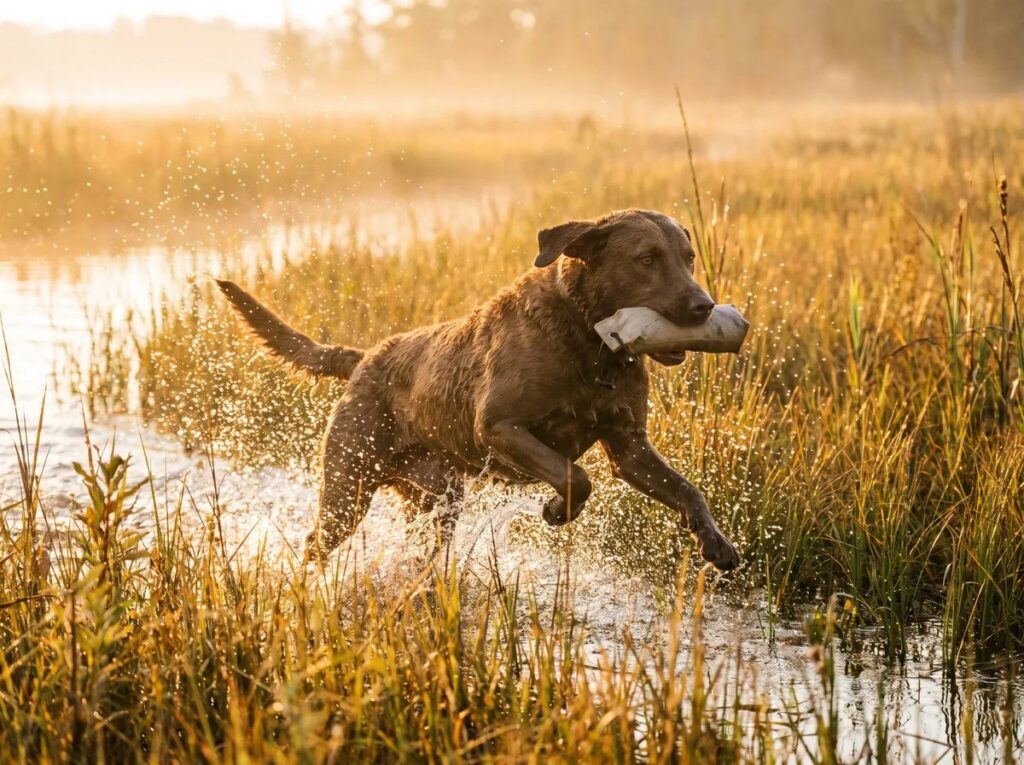
Feeding an active dog well means matching the food’s energy to the work the dog actually does. A retriever in the field all day, a herding dog working stock and a companion who runs each morning can have very different needs. Breed can offer clues, but a dog’s routine, size, age, body condition and recovery all matter more than a label such as “active.”
Fresh food can fit an active dog’s diet when it is complete and balanced for the dog’s life stage, supplies enough energy and is portioned carefully. Its moisture content affects how much food fills the bowl, while its calorie density determines how much energy each pack provides. Owners can use those figures to set a starting portion, then make measured adjustments as training and seasonal work change.
Fat is a concentrated source of energy for sustained exercise, and dietary protein supports muscle maintenance and repair. Neither nutrient is a substitute for an appropriate total portion, rest, hydration or veterinary care. The useful question is not simply which food has the most calories: it is whether the dog stays lean, performs comfortably and recovers well on the amount being fed.
Start with the dog’s workload
“Active” covers a wide range of routines. A dog walking for 30 to 60 minutes a day may need close to its usual maintenance intake. A dog running, playing hard or training for agility for an hour or more on most days may need a modest increase. A dog hunting for hours, working stock or completing long search shifts may need substantially more on demanding days, then less when work eases.
Those are starting points, not feeding prescriptions. Two dogs of the same breed and weight can use energy differently. The pace and duration of exercise, weather, terrain, age, reproductive status and individual metabolism all affect the amount needed. A dog that sprints intensely but rests for much of the day may have different needs from one doing steady endurance work for hours.
Breed history can help owners anticipate the kind of activity a dog may enjoy, but it does not set calorie needs by itself. Labradors and golden retrievers were bred to retrieve and swim, and many do well with regular exercise or a job. Standard poodles have a history as water retrievers and may thrive with activities such as agility. Corgis and other herding breeds can show considerable stamina despite short legs. Beagles and dachshunds have hunting backgrounds, although many pet dogs of these breeds have quieter routines.
Dobermans and Cane Corsos are powerful working breeds that generally benefit from regular, structured exercise. Greyhounds can run at high speed, yet often spend much of the day resting; speed alone does not mean they need endurance-level portions. Pugs and other flat-faced dogs can have difficulty with prolonged, strenuous activity, especially in heat, so exercise should be appropriate to the individual dog and conditions.
Small dogs need the same careful matching of calories to workload as large dogs. A Jack Russell terrier or miniature poodle may use plenty of energy relative to its size, while a calorie-dense food can help meet that need without requiring a very large meal. Large dogs usually need more total calories but fewer calories per pound than small dogs. In either case, the goal is a complete, balanced diet and a lean body condition.
Estimate calories, then check the dog
Veterinary nutritionists estimate energy needs by starting with resting energy requirement and applying a factor for maintenance and activity. The Merck Veterinary Manual gives the resting energy requirement formula as 70 multiplied by body weight in kilograms raised to the 0.75 power. It describes a moderately active neutered adult dog as needing roughly 1.6 times that resting figure for maintenance.
A calculation gives a useful place to begin, but it cannot account perfectly for every dog. The manual notes that an individual dog’s needs may be about 30 percent above or below the calculated amount. Activity can raise needs further. Some active dogs may require roughly 1.5 to 2 times their maintenance calories on busy days, while dogs doing demanding work for long periods—such as hunting in cold weather or sled training—may need more. The dog’s condition over time is the check on whether the estimate is working.
Young dogs still growing need energy for both growth and activity. Their portions should be planned with growth in mind, rather than increased solely because they exercise. A complete and balanced food should be appropriate for their life stage. When a puppy or young working dog’s needs are unclear, a veterinarian can help set a suitable plan.
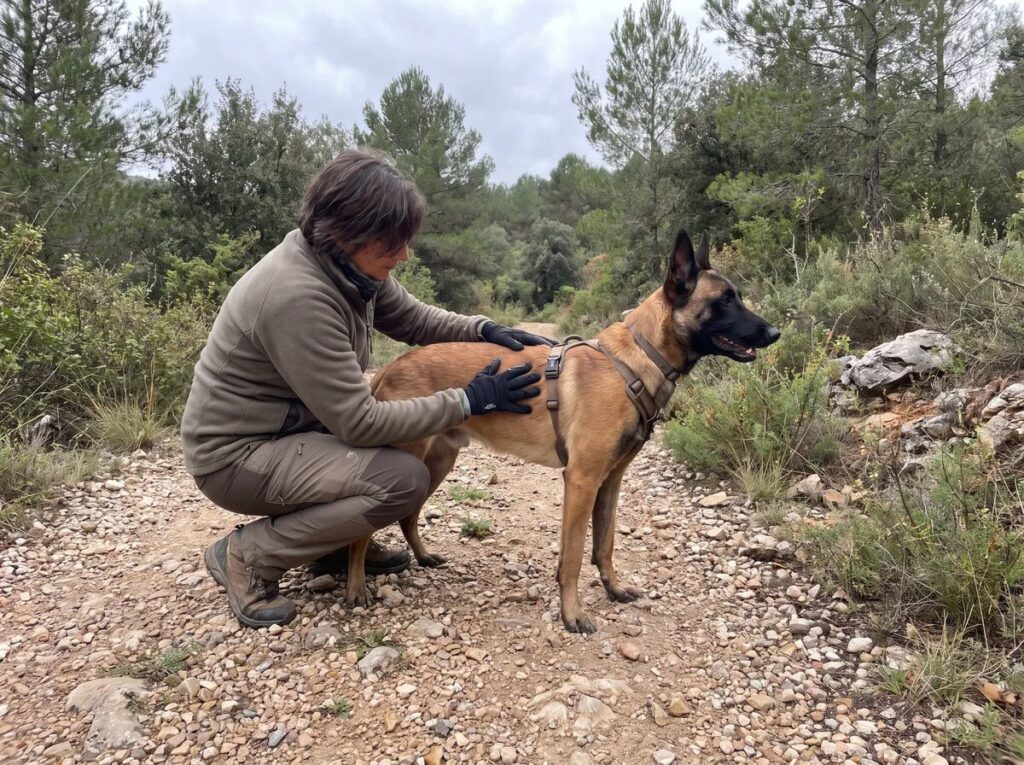
Use body condition alongside weight. On the commonly used 1-to-9 body condition scale, a score of 4 or 5 is generally considered ideal. At that condition, the ribs should be easy to feel beneath a thin covering of fat, the waist should be visible from above, and the abdomen should tuck upward behind the ribs when viewed from the side. A scale alone can miss changes in body composition: a dog building muscle might gain weight while still looking lean.
Check the dog regularly, especially when work intensifies or falls off. If the dog is losing condition during a demanding period, the portion may need to rise. When hunting season or a training block ends, the extra calories should come down as activity drops. Continuing the same portion through a long rest period can lead to gradual weight gain.
Neutered dogs may need fewer calories than intact dogs doing similar work. If an active dog’s routine stays the same after neutering, monitor its ribs and waist closely in the following months and reduce the portion in small steps if it begins gaining excess fat. The guide to keeping a dog at a healthy weight offers more detail on assessing body condition.
What fat and protein contribute
Fat is the most energy-dense of the main dietary nutrients, providing about 9 kilocalories per gram compared with about 4 per gram from protein or carbohydrate. Dogs can use fat efficiently during long, steady exercise, so it is an important fuel source for endurance work. A food with more fat is often more calorie-dense, which can help a dog meet high energy needs without eating an unwieldy volume.
Protein supplies amino acids used to maintain and repair tissues, including muscle. Exercise places demands on muscle, and a balanced diet provides the materials needed for recovery. When a dog eats more of a complete food to meet higher calorie needs, it also takes in more of that food’s protein. A higher protein percentage is not automatically better in every situation; the food needs to be balanced, and the portion needs to suit the dog.
To compare nutrient levels across fresh food and kibble, account for moisture. Fresh food can be about 75 percent water, while kibble is often around 10 percent. The guaranteed analysis on the package lists nutrient percentages as fed, so those numbers can look very different even when the dry portions are more comparable.
A dry matter conversion divides the listed nutrient percentage by the fraction of the food that is dry. For example, a recipe with at least 10 percent protein, at least 8.5 percent fat and no more than 75 percent moisture has a dry portion of 25 percent. Using those label guarantees, the estimates are about 40 percent protein and 34 percent fat on a dry matter basis.
That calculation is an illustration, not a measurement of the recipe’s actual nutrient content. Guaranteed analysis values are minimums and maximums, and the conversion uses those label boundaries. For a meaningful comparison, look at the food’s calories per pack, its guaranteed analysis, its complete-and-balanced statement and the dog’s response when fed.
When reviewing ingredients, named animal proteins such as chicken, beef or turkey can help owners understand the recipe’s main protein sources. Check that the food is complete and balanced for the dog’s life stage. Keep treats, chews and training rewards in the daily calorie total; a useful general limit is about 10 percent of daily calories. For food-motivated training, portions of the regular meal can be set aside as rewards.
Compare calorie density, not just pack size
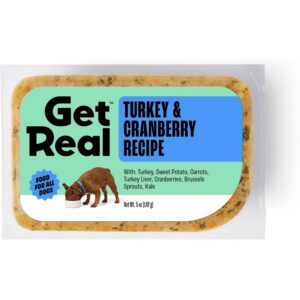
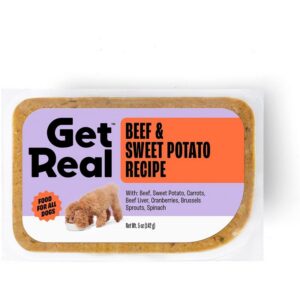
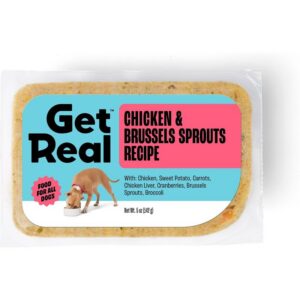
Product labels can make recipe comparisons more practical when they give calories per pack. The source’s published figures for three Get Real gently cooked recipes show differences in calorie content and guaranteed nutrient minimums. These values can illustrate how to do the math, but a recipe’s place in a plan depends on the dog’s needs and the full nutritional information on its label.
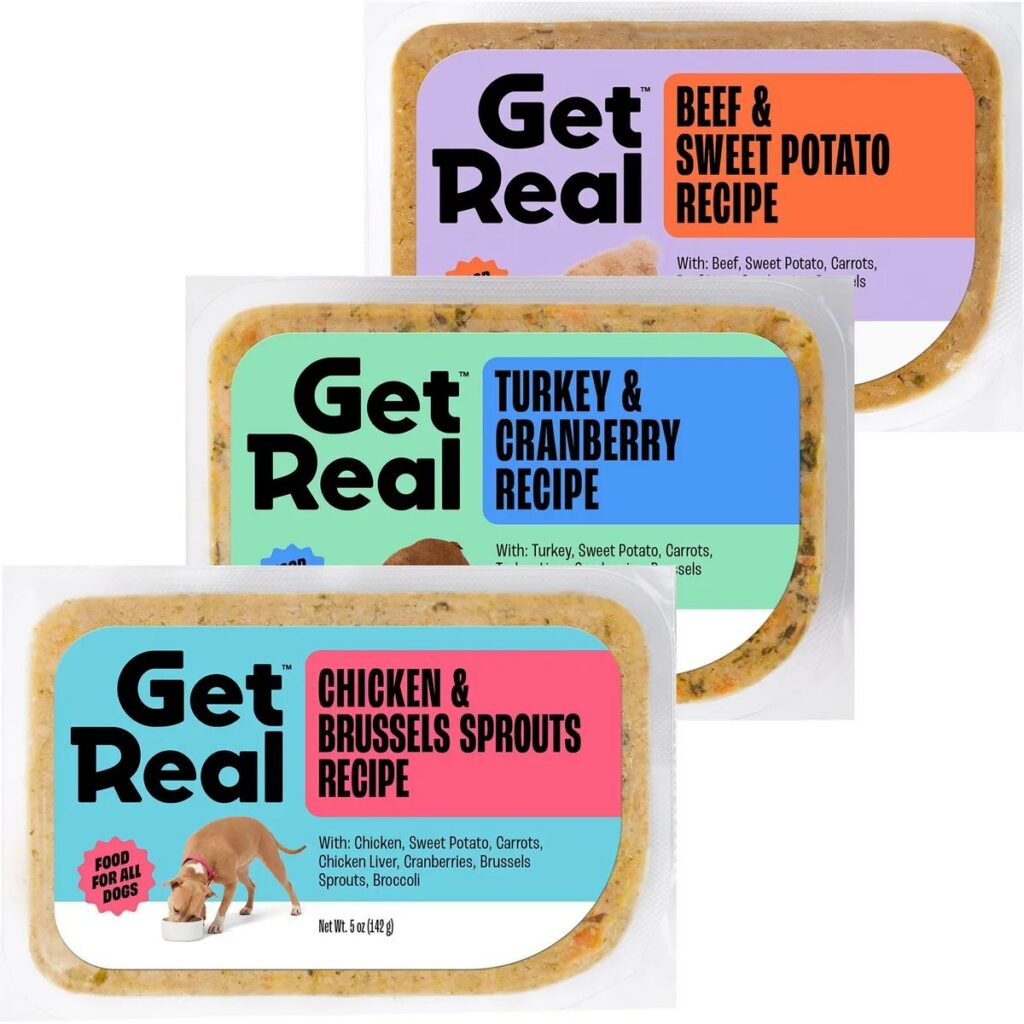
| Recipe | Protein minimum | Fat minimum | Calories per 12 oz pack | Calories per 24 oz pack |
|---|---|---|---|---|
| Turkey & Cranberry | 8% | 10% | 474 | 948 |
| Beef & Sweet Potato | 9% | 7% | 451 | 902 |
| Chicken & Brussels Sprouts | 10% | 8.5% | 428 | 856 |
Turkey & Cranberry has the highest listed calories per pack in this comparison and the highest printed fat minimum. That makes it a recipe to consider when a dog’s work calls for more calories in a given volume, provided the whole diet suits the dog. Chicken & Brussels Sprouts has the fewest listed calories per pack, which may be useful for a dog that needs more food volume while its calorie intake remains controlled. Beef & Sweet Potato falls between them in calories; the listed ingredients begin with beef, sweet potato, carrots and beef liver.
These distinctions do not establish that one recipe is best for every working dog. A dog that trains most days but does not work for hours may do well on a middle-calorie option. Owners may also adjust the recipe as the workload changes, but should keep the diet complete and balanced and watch body condition during any change. If a dog has a health condition or a history of food sensitivity, ask a veterinarian before choosing a new diet.
Fresh food contains much more water than kibble, so the bowl can look larger for the same calorie intake. That can suit a dog that enjoys a generous meal. A dog with very high energy needs may find it difficult to eat enough volume, in which case a more calorie-dense recipe or several smaller meals may be more comfortable. Calorie figures, rather than pack weight or bowl appearance, help owners compare portions.
Grain-free is a label feature, not a performance measure. For an active dog, focus first on the food’s calorie density, nutritional balance and suitability for the dog. The source also links to a comparison of chicken, beef and turkey for dogs for owners weighing protein choices.
Increase portions in measured steps
Begin with the feeding plan supplied for the dog’s weight, age and activity level, then evaluate how the dog responds. Keep a record of the daily amount and weigh the dog under similar conditions each time. A weekly hands-on check of the ribs and a view of the waist from above and the side can reveal trends that a single scale reading won’t show.
- Start with the suggested amount and record the dog’s weight and body condition.
- Review body condition weekly, paying attention to the ribs, waist and abdominal tuck.
- If the dog is losing condition or its ribs are becoming too visible during a heavier work period, raise the daily amount by about 10 percent.
- Keep the new amount steady for a week before deciding whether to adjust again.
- Stop increasing once the dog’s ribs are easy to feel but not prominent, and its condition is stable.
- When activity drops, reduce the portion in similar small steps and continue monitoring.
For a practical example, suppose a feeding plan supplies about 950 calories a day, close to one 24 oz pack of Turkey & Cranberry at 948 calories. If the dog becomes thinner during a busy training month, a 10 percent increase adds about 95 calories each day. That is roughly one-fifth of a 12 oz pack containing 474 calories. Hold the adjustment for a week, then check condition again before making another change.
Small changes make it easier to see what the dog needs and to reverse an adjustment if necessary. A sudden, large increase can upset digestion and makes it harder to tell how much extra food helped. Changes in body condition take time to appear, so adjust gradually and look at the trend rather than reacting to one meal or one weigh-in.
Training rewards, chews and table extras can add up, especially during long sessions. Count them as part of the daily total. Use a portion of the dog’s usual food for rewards when practical, or choose small treats. A note of each portion change, a consistent weigh-in routine and a side-view photo every couple of weeks can help owners track changes through a season.
Plan meals around exercise
Hard exercise with a full stomach can be uncomfortable. In large, deep-chested dogs, gastric dilatation-volvulus (GDV), often called bloat, is a life-threatening emergency in which the stomach fills with gas and can twist. The Merck Veterinary Manual includes limiting exercise around meals and feeding several smaller meals among measures that can help lower risk. The American College of Veterinary Surgeons notes that dogs fed one large meal daily are at higher risk.
A general routine is to allow at least an hour between a meal and hard exercise, and to give the dog time to cool down after work before feeding. Larger, deep-chested dogs may need a longer interval. Individual circumstances vary, so owners can ask their veterinarian for advice tailored to their dog’s risk and routine.
- For morning work, offer a small meal well beforehand if the dog tolerates it, then serve the larger meal after recovery.
- After exercise, let the dog rest in a cool place until its breathing has returned to normal before feeding.
- Divide the daily amount into two or three meals, particularly for large, deep-chested dogs.
- Offer water before activity, during breaks and afterward; give a hot dog time to cool rather than letting it gulp a large volume at once.
- Keep meals calm and avoid vigorous play immediately after eating.
For dogs working through a long day, smaller amounts during breaks may be more comfortable than one large meal in the middle of the activity. Keep the usual feeding routine where possible, since familiar timing can help a dog eat during a busy period. For a day in the field, portion thawed food ahead of time and keep it in a cooler at 40°F or below.
Watch for emergency signs of GDV: a swollen abdomen, unproductive retching, drooling, restlessness or weakness. Seek emergency veterinary care immediately if these signs appear. Do not wait to see whether the dog improves on its own.
Hydration, heat and recovery
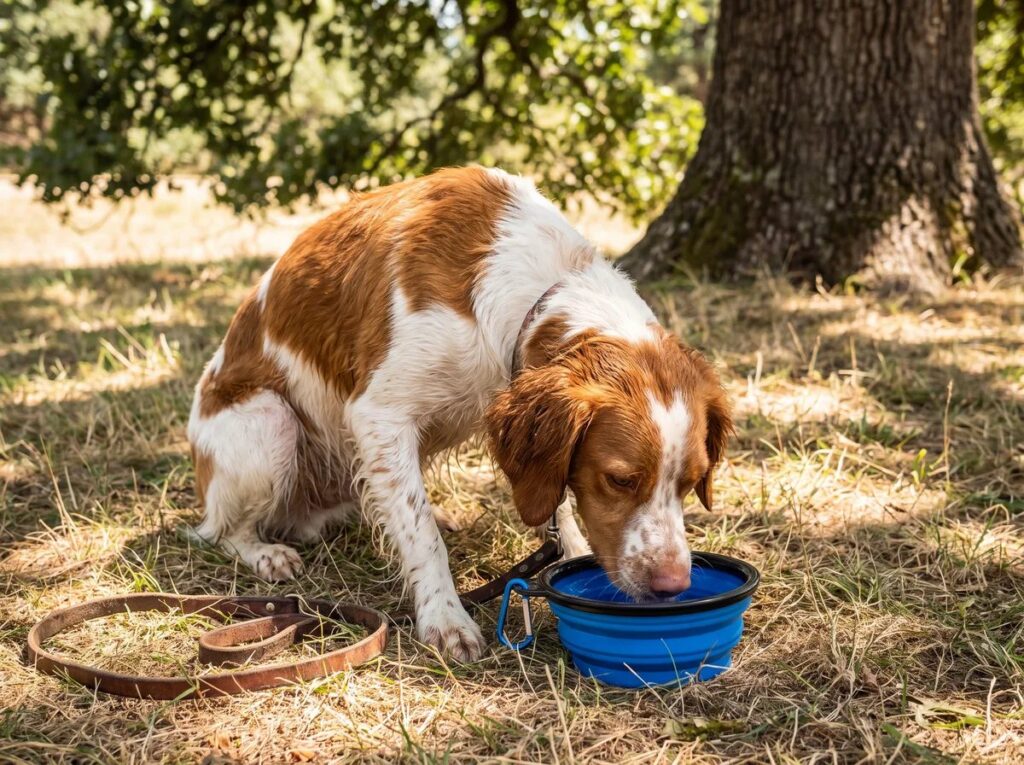
Dogs lose water through panting, and warm weather increases the strain of exercise. Fresh food contributes moisture because it is roughly 75 percent water, but it does not replace access to drinking water. Bring water on outings and offer it regularly. Owners can also plan activity around cooler parts of the day and choose shade and rest breaks when conditions are warm. The source links to guidance on running with a dog in hot weather.
After demanding work, prioritize water, a cool-down and rest. Once the dog has settled and its breathing is back to normal, feed the planned meal. Consistent access to a balanced diet supports normal recovery, but food cannot compensate for inadequate rest or continued exercise when a dog is sore.
- Offer water frequently during and after work.
- Give the dog a shaded place to rest before its post-work meal.
- Check paws, joints and gait after long days, and provide rest if the dog is sore.
- Consider a lighter day after unusually hard work.
- Watch body condition as weather and workload change, adjusting portions in small increments.
Weather can affect both activity and appetite. Dogs working in heat may eat less, while dogs working in cold conditions may use more energy to stay warm. A dog that refuses food after a hot day, or seems weak, wobbly or confused, may be overheated. Move the dog to a cooler place and contact a veterinarian promptly. Flat-faced breeds can be especially poorly suited to prolonged hard exercise in heat.
Transition to a new food gradually
Even a hungry working dog should change foods over several days. A gradual transition gives the digestive system time to adjust and can reduce the chance of loose stools during a demanding training period. The source describes a 7-to-10-day transition, extending it to 10 to 14 days for dogs with sensitive stomachs.
- Days 1–3: mix about one-quarter new food with three-quarters of the current food.
- Days 4–6: use roughly equal amounts of each.
- Days 7–9: feed about three-quarters new food and one-quarter current food.
- From day 10: use the new food as the full meal if that is the intended plan.
When possible, make the switch during a lighter week rather than just before a major event or a particularly demanding work period. For the fresh food described in the source, packs are thawed in the refrigerator for 12 to 24 hours, or 35 to 48 hours for the 24 oz size. Once thawed, use the food within 3 to 5 days and discard food that has remained at room temperature for more than two hours.
Fresh food can also be used as a topper or mixed with kibble, rather than replacing the entire diet. The source describes 5 oz packs for mixing and 12 oz or 24 oz packs for full meals. If changing the full diet, confirm that the food is complete and balanced for the dog’s life stage and calculate the portion from calories. Storage and serving directions on the package should guide handling.
Owners comparing recipes can use the listed calorie figures and ingredient information as a starting point, then observe which food the dog eats comfortably. A sampler containing two packs each of Beef & Sweet Potato, Chicken & Brussels Sprouts and Turkey & Cranberry is one option described in the source. Product availability and subscription details can change, so check the seller’s current information directly.
When energy or behavior changes
A change in energy is not always a sign that a dog needs more calories. Low energy can be related to illness, pain, age or weight changes. If a dog seems unusually tired, struggles to finish familiar exercise or has a sudden shift in appetite or behavior, arrange a veterinary check rather than relying on a diet change alone.
Food also is not a reliable way to calm a dog that seems overactive. Exercise needs, opportunities for mental activity, sleep, routine and training can all affect behavior. If high activity is new, extreme or difficult to manage, a veterinarian can help rule out a health concern and discuss appropriate next steps.
Either complete kibble or fresh food can provide energy for an active dog when the portion matches its workload. Kibble is more concentrated by weight because it contains less water; fresh food takes up more space for the same calories. Choose based on the dog’s nutritional needs, eating habits and body condition rather than assuming one format is automatically better.
A well-fed active dog should maintain a lean condition, have energy appropriate to its work and recover comfortably. Keep water available, protect time for rest, and make portion changes in small steps as workload shifts. If the dog’s condition, appetite, energy or recovery changes in a way that concerns you, involve a veterinarian in the feeding plan.
For further reading, the source includes a fresh food feeding guide, a roundup of athletic dog breeds and information on fresh food portions for large dogs.


