Sample No. 0215
Five Evidence-Based Steps for Uncovering Hidden Health Concerns in Cats
Use five evidence-based steps to investigate casual comments about a cat’s health, from clarifying symptoms to checking whether follow-up care helped.
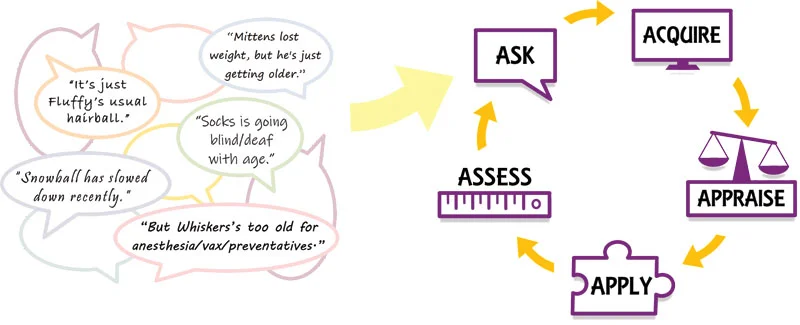
A client’s passing comment at the end of an appointment can change what a veterinary team needs to investigate. A cat described as having “usual hairballs” may be vomiting; a perceived slowdown may reflect pain, weakness or reduced stamina. The detail may sound minor to the person sharing it, but it can matter to the cat’s care.
The evidence-based veterinary medicine (EBVM) cycle offers a useful structure for exploring these remarks: ask, acquire, appraise, apply and assess. These steps are often used to answer clinical questions about tests and treatment. They can also help clinicians clarify what a client has observed, check the available information and decide what to do next.
Ask: Turn a vague remark into a clear question
Start by inviting the client to describe what happened in their own words. Open questions can reveal details that a quick yes-or-no question would miss. Then narrow the conversation with specific follow-ups.
Take a client’s description of a “hairball.” First establish what the cat actually did and what came up. Vomiting, regurgitation, coughing up material, diarrhea and urination are different events, but owners may not know which term fits. One client, for example, was certain a cat had produced a hairball, then described liquid with no hair. Clarifying the observation changes the question the clinician needs to answer.
Ask about duration, frequency, whether the episodes are changing, and what the expelled material looked like. Then use the case details to guide further questions. Did the issue begin around a diet change? Could a plant or toy be missing pieces? These questions can help establish whether an event is isolated or part of a broader pattern.
For literature searches, a well-formed question also helps identify relevant evidence. The PICO framework prompts clinicians to consider the patient or population, intervention, comparator and outcome. Search terms can then be refined with synonyms, Boolean operators such as “AND,” “OR” and “NOT,” and filters.
History-taking can feel less tangible than an examination or diagnostic test, especially during a busy schedule. Yet the client’s account can shape diagnostic reasoning. Missing or inaccurate details can misdirect a workup, so taking time to clarify the initial concern is part of careful care.
Acquire: Build the full clinical picture
A client’s interpretation is one source of information, not the whole record. For a report of weight loss, check the current measurement and compare it with earlier observations. Ask team members whether the cat’s weight was rechecked and whether staff used suitable scales and consistent techniques. A single number is most useful when its accuracy and context are clear.
Review the medical record for trends. A weight graph can help distinguish a sustained decline from fluctuations associated with seasonal changes, medication or illness. Earlier examination notes may add body condition score (BCS), muscle condition score (MCS) and other relevant findings.
Those observations can help clinicians distinguish patterns of tissue loss. Sarcopenia refers to generalized muscle loss associated with aging. Atrophy describes localized muscle loss that may follow inactivity or nerve injury. Cachexia involves generalized loss of fat and muscle associated with disease or malnutrition. The labels describe different patterns; interpreting them requires the broader clinical context.
The record may not contain everything needed. A previous clinic could have useful notes, or a reference laboratory may be able to clarify a flagged result. Information can be hard to obtain when records are incomplete, communications are unclear or the people involved in a case are unavailable. These gaps should be recognized rather than treated as certainty.
EBVM also depends on knowing where to find relevant research, including databases and other online resources. For either a literature question or a patient concern, the aim is to assemble information that helps answer the question at hand. Isolated facts may be accurate yet still leave out the trend that matters.
Appraise: Check how reliable the account is
Before acting on gathered information, consider how trustworthy and applicable it is. When reviewing research, clinicians assess study quality, possible bias and whether the findings fit the patient and clinical question. A paper’s conclusion alone does not establish that its results apply to every case.
Client histories also need careful appraisal. The person at the appointment may not be the person who usually observes the cat. A family member or caretaker may be passing along someone else’s account, and details can shift as they travel through several people. A team member relaying the history can introduce another layer of interpretation.
Vague words need unpacking. “Slowing down” might mean difficulty jumping, lameness, weakness, low energy or tiring quickly. “Recently” may mean days to one client and months to another. Terms such as “sometimes” or “a small amount” also vary from person to person.
Ask for examples and timelines: What activity has changed? When did the client first notice it? Is it happening more often? Did it begin after a medication, procedure or diet change? Details can help separate a consistent pattern from an isolated observation, coincidence or unclear recollection.
Appraisal also calls for awareness of bias in everyone involved, including the clinician. A client may draw a conclusion from a previous experience; a team member may summarize a story too quickly; a clinician may favor an explanation that fits an early impression. Check whether the proposed timeline and explanation are plausible, and be prepared to revisit them when new information emerges.
Several resources can support this work. The Evidence-Based Veterinary Medicine Association offers the free QUIT Tool, which uses 10 yes-or-no questions to flag concerns in treatment studies. RCVS Knowledge’s EBVM Toolkit and its EBVM courses introduce the five steps for everyday practice. For senior cats, the 2021 AAHA/AAFP Feline Life Stage Guidelines and 2021 AAFP Feline Senior Care Guidelines cover preventive and advanced care, including how to distinguish changes linked to aging from health concerns.
Apply: Make decisions around the individual cat
When a client says a cat is “too old” for anesthesia, vaccination or preventive care, first learn what is behind the concern. The client may believe age alone makes a procedure riskier. They may be weighing cost and effort against the cat’s expected quality of life, or recalling another pet’s difficult experience.
Responding with empathy matters, but an age-based assumption should not settle the decision. Consider potential benefits, risks and alternatives for the proposed care. Discuss ways to address pain, anxiety and other risks associated with each option. The cat’s overall health, coexisting conditions, cooperation, resilience and quality of life all matter alongside age.
The client’s circumstances belong in the discussion, too. Finances, time, physical and emotional capacity, personal values and priorities can shape which options are workable. A spectrum-of-care approach takes these factors into account so the client and veterinary team can make an informed plan suited to the case.
This discussion does not require every cat to receive the same intervention. It requires that decisions reflect the best available information, the individual patient and what the client can reasonably provide. Asking about the concern and checking the facts can reveal options that an initial assumption might have obscured.
Assess: Follow up and adjust the plan
The cycle continues after a decision. Check whether the chosen approach helped the cat and whether the client can carry it out. Veterinary teams can assess changes formally, such as through an audit, or informally through reflection on an individual case or a group of cases.
Consider a client who believes a cat is becoming blind and deaf. After gathering and appraising the history and checking for other medical explanations, the team may conclude that cognitive dysfunction better fits the observed changes. Dietary and environmental adjustments could be a starting point. Without follow-up, however, the team cannot tell whether the cat benefited or whether the plan needs revision.
A structured questionnaire may help track signs associated with feline cognitive dysfunction. VISHDAAL covers vocalization, interaction changes, sleep-wake cycle disturbances, house-soiling, disorientation, activity changes, anxiety, and learning or memory deficits. The source describes it as a self-made questionnaire and notes that a validated tool, SeniCat, was not yet available at the time. A simple follow-up call or text can also ask what has changed at home.
Use the client’s observations to decide what comes next. If the cat has not improved, if new signs have appeared or if the first account remains unclear, ask more questions and begin the cycle again. Assessment turns a one-time recommendation into an ongoing, responsive care plan.
Keep the conversation open
Quiet remarks can point to a real concern, a misunderstanding or an experience that has shaped a client’s expectations. Sorting out which one takes patience, active listening, precise and nonjudgmental language, and sound clinical reasoning. A client who says “it’s just a hairball” may not realize that the details they have noticed could help the veterinary team.
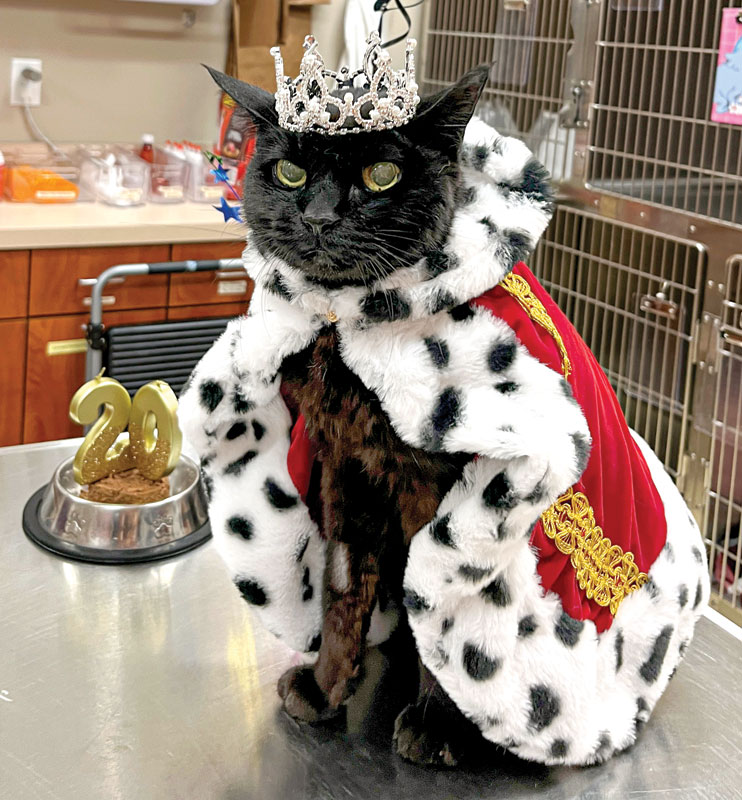
One senior cat case illustrates why age alone should not decide what care is considered. Safire was diagnosed with a splenic mast cell tumor at 18 and also had chronic renal disease, chronic non-regenerative anemia, arthritis, cognitive dysfunction, possible restrictive cardiomyopathy and a history of radioiodine treatment. After weighing her other conditions, personality and the client’s values, the team pursued splenectomy to remove a potential source of discomfort and support her quality of life. Safire reached her 20th birthday. It is an anecdote, not a promise about outcomes; its lesson is that decisions need to account for the whole cat and the goals of care.
When schedules are full, an offhand remark is easy to leave behind as the appointment ends. The five EBVM steps offer a practical way to pause, clarify what the client has seen, check the record and evidence, discuss a fitting plan, and learn from the result. That focused attention helps make sure a cat’s understated signs are heard and considered.
References
- Cockcroft, Peter D., and Mark A. Holmes. Handbook of evidence-based veterinary medicine. Blackwell Publishing Ltd., 2003. https://doi.org/10.1002/9780470690833
- RCVS Knowledge. “Evidence-Based Veterinary Medicine (EBVM): An Introduction.” https://www.rcvsknowledge.org/approach/evidence-based-veterinary-medicine/evidence-based-veterinary-medicine-ebvm-an-introduction
- White, Constance, et al. “Searching for Veterinary Evidence: A Guide for Equine Professionals.” Equine Veterinary Education 35, no. 1 (2023): 45–55. https://doi.org/10.1111/eve.13634
- Turner, Stuart. vet, 2016–2018. https://pico.vet
- Arruda Bergamaschi, Natalie, et al. “Association between Clinical History in the Radiographic Request and Diagnostic Accuracy of Thorax Radiographs in Dogs: A Retrospective Case-Control Study.” Journal of Veterinary Internal Medicine 37, no. 6 (2023): 2453–2459. https://doi.org/10.1111/jvim.16899
- Peterson, M. C., et al. “Contributions of the History, Physical Examination, and Laboratory Investigation in Making Medical Diagnoses.” Western Journal of Medicine 156, no. 2 (1992): 163–65.
- Wallis, Jessica, et al. “Medical Errors Cause Harm in Veterinary Hospitals.” Frontiers in Veterinary Science 6 (2019): 12. https://doi.org/10.3389/fvets.2019.00012
- Russell, Elly, et al. “Uncovering the ‘Messy Details’ of Veterinary Communication: An Analysis of Communication Problems in Cases of Alleged Professional Negligence.” Veterinary Record 190, no. 3 (2022): e1068. https://doi.org/10.1002/vetr.1068
- Dean, Rachel. “How to Read a Paper and Appraise the Evidence.” In Practice 35, no. 5 (2013): 282–85. https://doi.org/10.1136/inp.f1760
- Cordonier, Joseph, et al. “Informant Discrepancy between Caretakers in History Reporting in Veterinary Dermatology.” The Canadian Veterinary Journal 66, no. 7 (2025): 781–788.
- Canfield, Paul J., et al. “Case-Based Clinical Reasoning in Feline Medicine: 2: Managing Cognitive Error.” Journal of Feline Medicine and Surgery 18, no. 3 (2016): 240–47. https://doi.org/10.1177/1098612X16631233
- Cockcroft, Peter. “Evidence-Based Veterinary Medicine and Contextualised Care.” Veterinary Evidence 11, no. 3 (2026). https://doi.org/10.18849/ve.v11i3.754
- Coe, Jason B., et al. “Clinical Communication Tools for Contextualizing Spectrum of Care.” Advances in Small Animal Care 6 (2025). https://doi.org/10.1016/j.yasa.2025.06.013
- Rooke, Freya, et al. “Quality Improvement: Origins, Purpose and the Future for Veterinary Practice.” Veterinary Evidence 6, no. 2 (2021). https://doi.org/10.18849/ve.v6i2.358
- Sordo, Lorena, and Danièlle A. Gunn-Moore. “Cognitive Dysfunction in Cats: Update on Neuropathological and Behavioural Changes Plus Clinical Management.” Veterinary Record 188, no. 1 (2021): e3. https://doi.org/10.1002/vetr.3
- Gunn-Moore, Danièlle. “Developing and Validating a Diagnostic Tool for Feline Cognitive Dysfunction.” Morris Animal Foundation, funded March 28, 2024. https://www.morrisanimalfoundation.org/study/developing-and-validating-diagnostic-tool-feline-cognitive-dysfunction