Sample No. 0198
Samoyed Food Choices, Portion Planning and Body Condition
Compare four recipes by life stage and calorie density, then tailor measured portions to your Samoyed’s activity, condition and routine.

For a Samoyed, a useful feeding plan starts with the dog’s life stage and actual routine. A breed’s working history doesn’t tell you how much energy an individual dog uses in an ordinary week. Recipe eligibility, measured portions, activity and body condition all matter.
This guide compares four JustFoodForDogs recipes and explains how to calculate portions, account for rewards, check condition beneath a thick coat and plan storage. The calorie examples are arithmetic illustrations, not individual feeding recommendations. Use current product labels and your veterinarian’s guidance to set a plan for your dog.
Start with life stage and the individual dog
Samoyeds can eat complete and balanced food suited to their life stage and individual health needs. Dry, wet and fresh formats may all provide suitable nutrition when the specific recipe is appropriate. The label’s nutritional adequacy statement and calorie information are more useful starting points than an ingredient list alone. This guide to dog food labels and nutrition explains the difference.
A growing puppy, an adult who enjoys neighborhood walks and a dog doing sustained physical work may have different needs. Even within those groups, dogs vary. A practical feeding plan answers two questions: does the food suit the dog’s life stage, and does the measured amount maintain appropriate condition?
Before comparing foods, check whether the recipe’s adequacy statement covers your dog’s life stage, how many calories it provides per gram or serving, whether your dog can eat the intended amount consistently, and whether your household can prepare and store it as directed. Revisit the amount when activity, weight or condition changes.
Vetstreet’s Samoyed breed profile offers breed background, but ancestry is not a fixed calorie multiplier. Let the dog’s actual daily life guide the portion.
Four recipes and their practical differences
The four choices below have different life-stage statements, calorie densities and storage considerations. Their shared brand name doesn’t make them interchangeable. Check the label on the exact product you buy, since recipe information may change.
| Recipe | Life-stage fit | Calories per gram | Practical consideration |
|---|---|---|---|
| Chicken & Rice | All life stages, including growth | 1.530 | Fresh option; plan for thawing and refrigerator space |
| Fish & Sweet Potato | All life stages, including growth | 0.922 | More grams are needed to supply the same calories |
| Beef & Russet Potato | Adult maintenance | 1.559 | Adult recipe with its own measured portion |
| JustFresh Home-Cooked Chicken | Adult maintenance | 1.254 | Unopened shelf storage can simplify supply planning |

Chicken & Rice
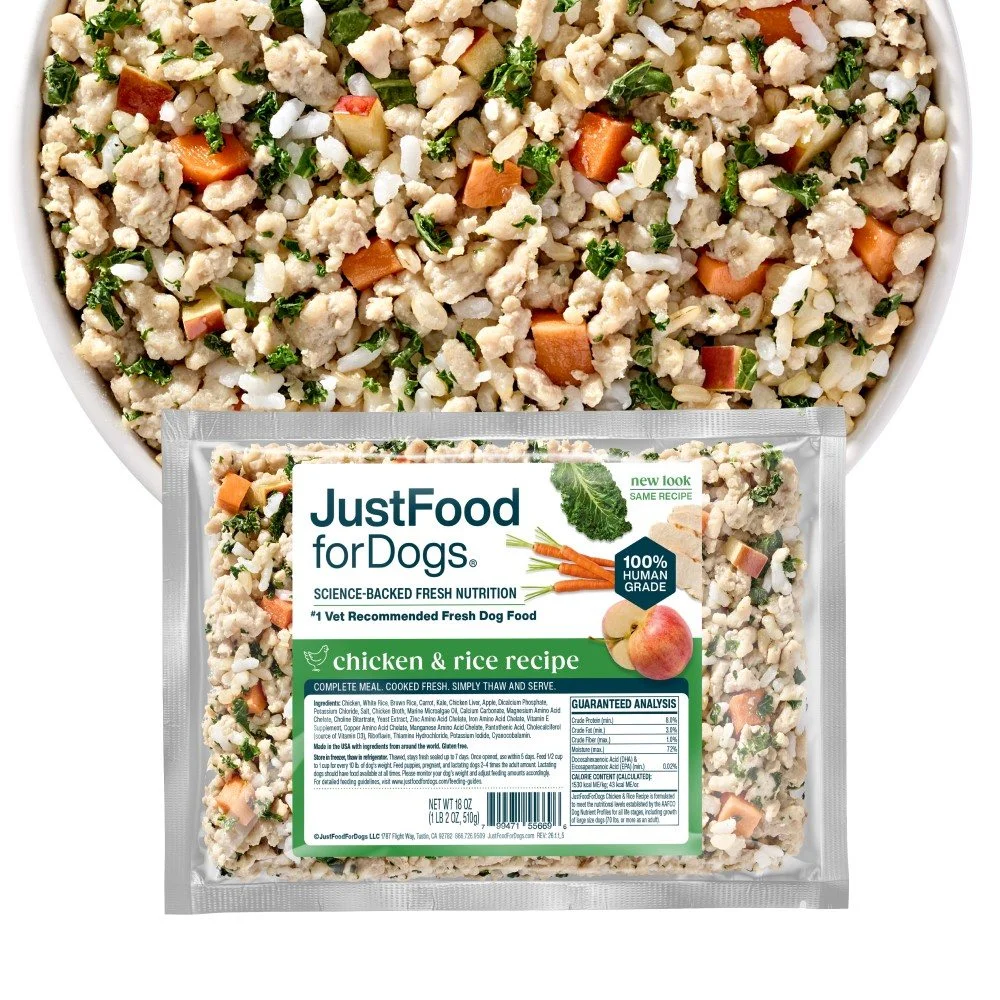
This fresh-frozen recipe is a possible choice for a puppy or adult when its nutritional profile suits the individual dog. The current formulation includes chicken, white rice and brown rice. The manufacturer lists 1,530 kcal/kg, equivalent to 1.530 calories per gram.
Its adequacy statement includes all life stages, including growth of large-size dogs expected to weigh 70 pounds or more as adults. That can make it a growth-appropriate option for a puppy expected to reach that size. It still needs an individual feeding amount, and the portion should be reassessed as the puppy grows and later moves out of the growth stage.
Calculate grams from the calories assigned to this recipe. A fresh-frozen routine also needs space and time for thawing. See product details
Fish & Sweet Potato
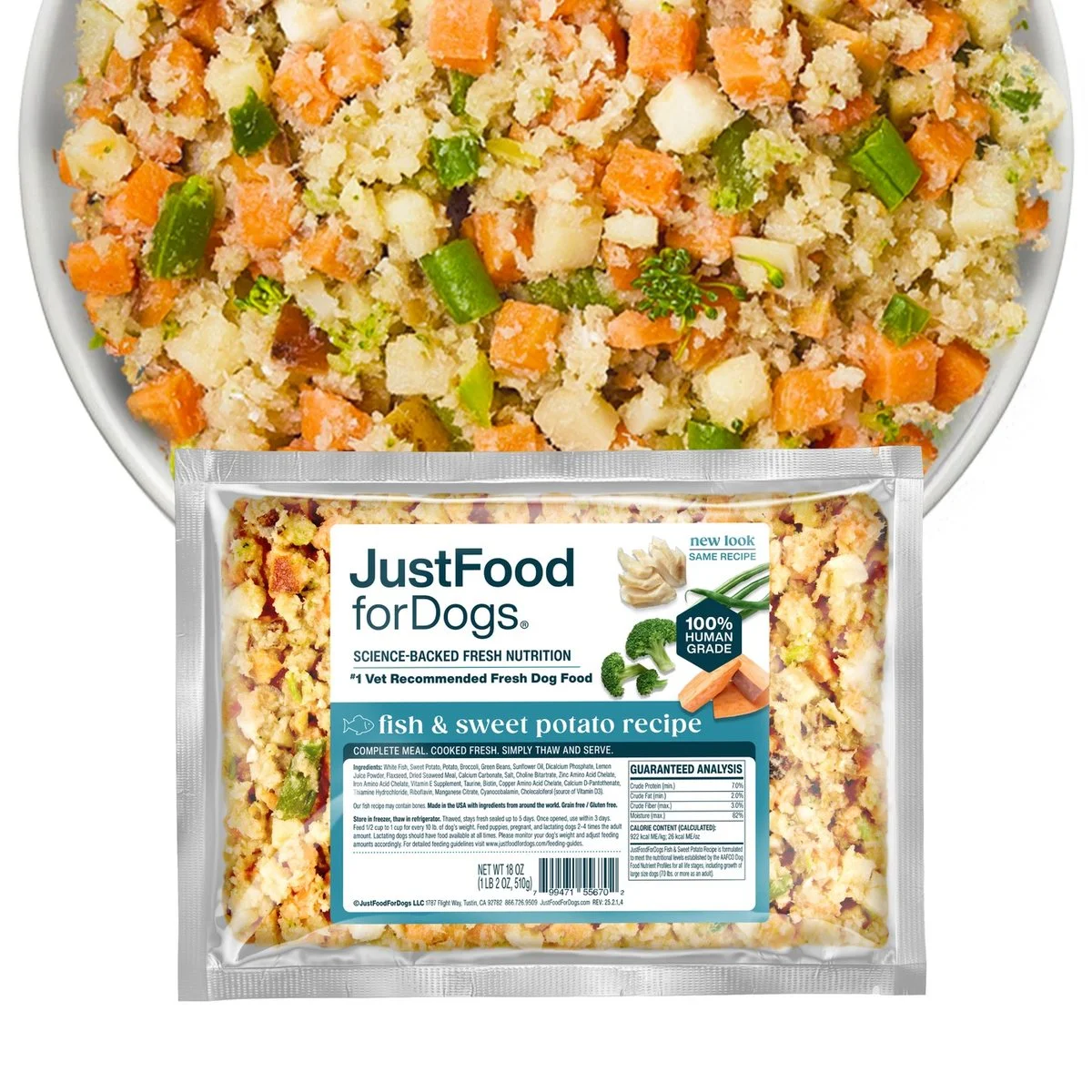
Fish & Sweet Potato has a different protein profile, with a current blend of cod, pollock and haddock. Like Chicken & Rice, its adequacy statement includes all life stages and growth of large-size dogs. Its listed energy content is 922 kcal/kg, or 0.922 calories per gram.
That lower calorie density means a larger weight of food is needed to provide the same calories as the other recipes in this comparison. It isn’t automatically an advantage or a drawback. Consider the intended calorie allowance, meal volume and preparation routine together. The recipe isn’t a treatment for food allergies or weight concerns.
Check the specific storage instructions for fish recipes when planning how much to thaw and use. Reusing another recipe’s gram amount would change the energy supplied. See product details
Beef & Russet Potato
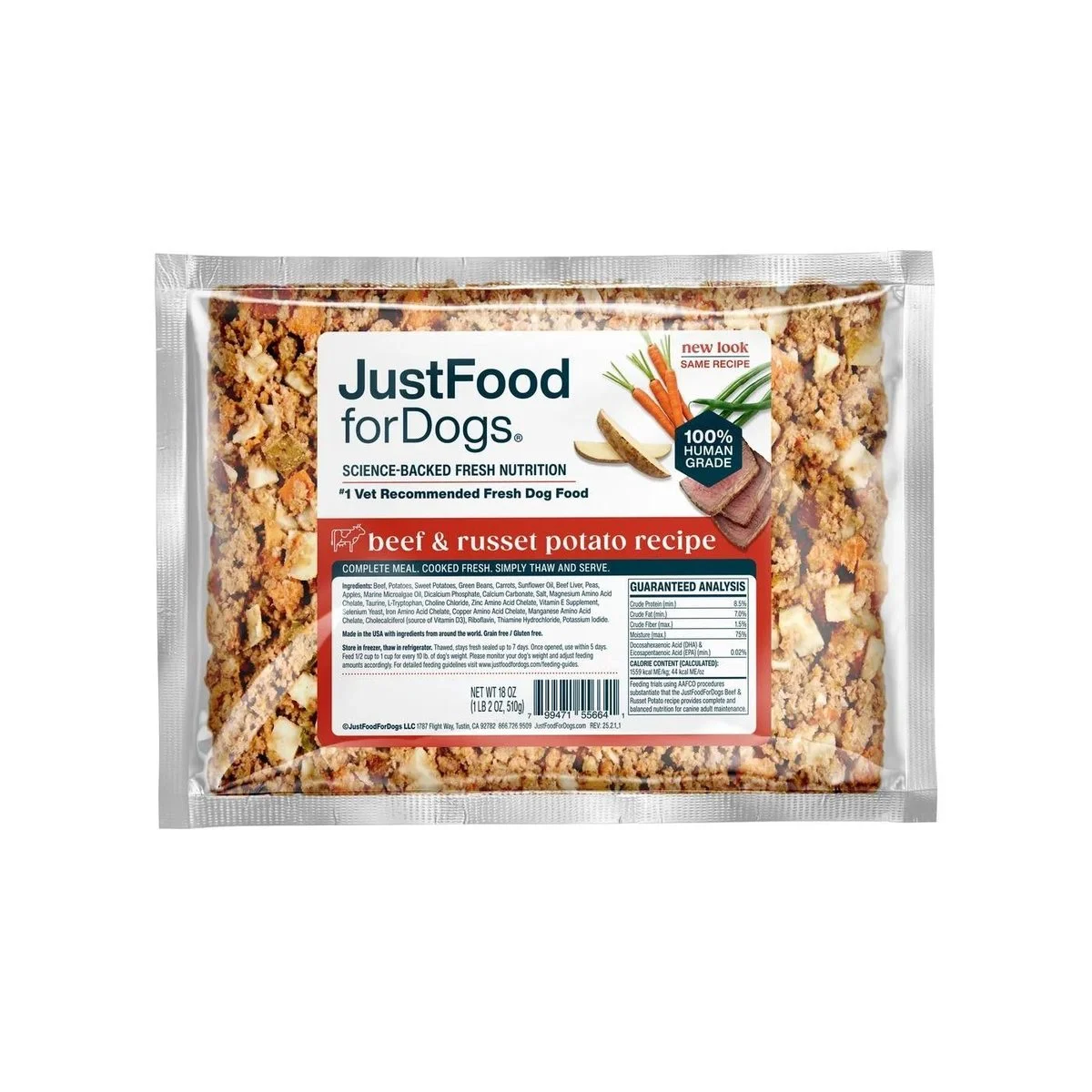
Beef & Russet Potato is for adult maintenance, not for providing the full diet of a growing puppy. Current recipe information lists 1,559 kcal/kg, or 1.559 calories per gram, with adult-maintenance adequacy substantiated through feeding trials using AAFCO procedures. See the current recipe information.
It has the highest calorie density among these four recipes, but that narrow comparison doesn’t establish it as an athletic-performance diet or the best choice for every active Samoyed. Suitability depends on the complete recipe and the individual dog. Weigh the daily amount even if it looks similar to a portion from another food, and make sure shared feeding instructions identify the exact recipe.
JustFresh Home-Cooked Chicken
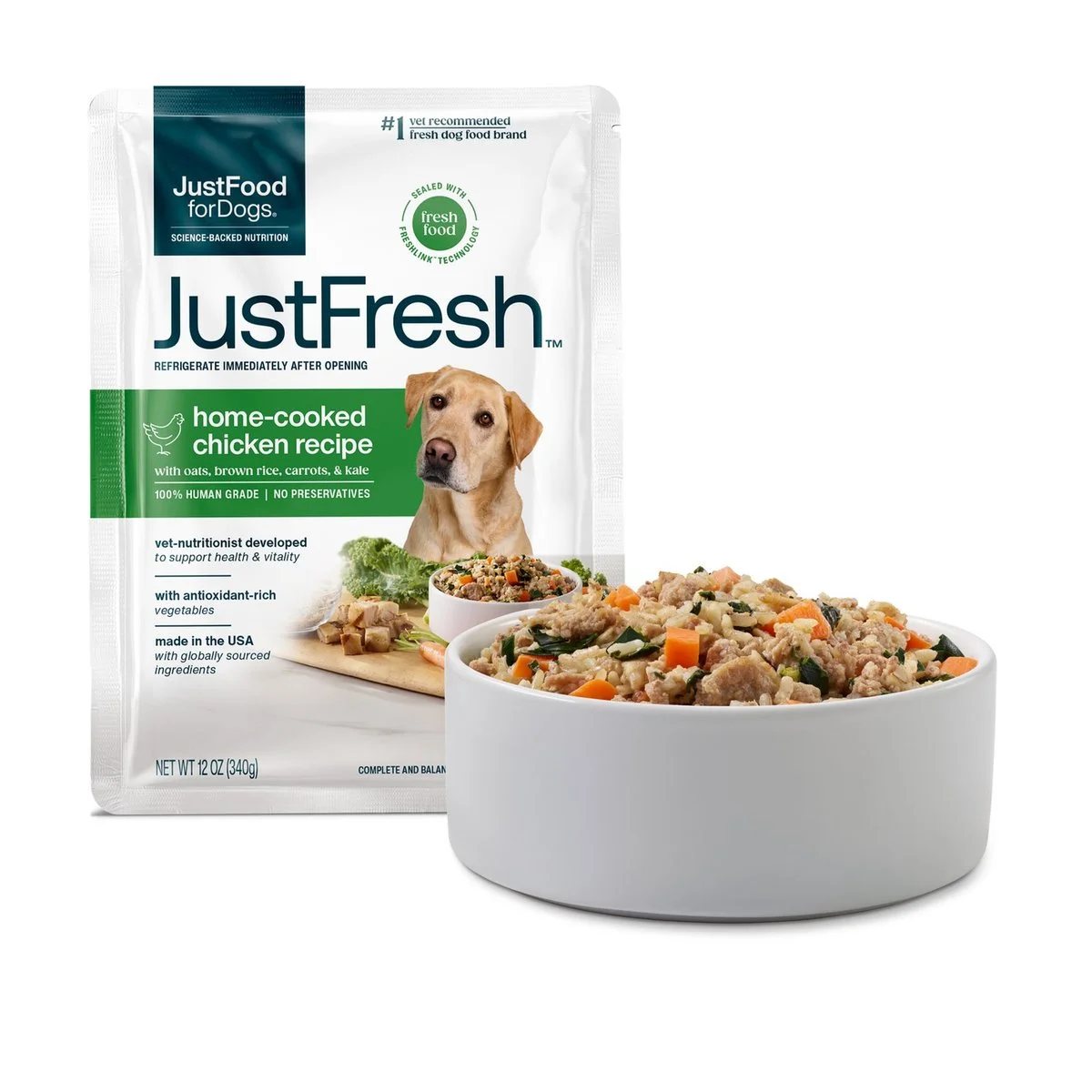
JustFresh Home-Cooked Chicken is an adult-maintenance food with unopened shelf-storage convenience. It includes oats and brown rice, and it’s distinct from fresh-frozen Chicken & Rice. Its listed calorie density is 1,254 kcal/kg, or 1.254 calories per gram. It is not a complete puppy diet.
Use its own calorie information to work out a portion. Once a package is open, follow the refrigeration and use instructions; unopened shelf storage doesn’t make leftovers suitable for an unrefrigerated bag. See product details
Vetstreet’s JustFoodForDogs review provides brand background. For current life-stage eligibility and portions, check the exact recipe information and label for the food you’re using.
Match food to the current activity level
“Active breed” is too broad to determine a feeding amount. A relaxed walk, a training class with frequent rewards and sustained physical work place different demands on a dog’s day. Start with the measured amount the dog currently eats and the condition that amount maintains. If activity changes, look for a sustained shift in routine and results before changing the food or portion.
Describe the routine concretely: typical walking time and pace, regular play or training, physical work where applicable, quieter weeks and rest days, and the food used during activities. Training rewards count toward daily calories. An occasional long outing also doesn’t establish a new everyday baseline.
| Change to the routine or dog | Record | Useful next step |
|---|---|---|
| Longer regular outings | Intake, workload, weight trend and condition | Review whether the current amount maintains appropriate condition |
| More training rewards | Rewards used and meals served afterward | Include rewards in the daily plan |
| A quieter routine | How long the change has lasted and whether intake is unchanged | Review portions if the shift persists |
| A higher scale reading | Measured food, extras and body condition | Assess whether the trend reflects excess fat or another change |
| Lower weight or apparent muscle loss | Appetite, actual intake, activity and other signs | Seek veterinary assessment rather than simply increasing the portion |
| Different grooming or shedding | Weight and physical condition beneath the coat | Don’t change food based on coat fullness alone |
The double coat isn’t a body-condition score. A Samoyed that looks larger after grooming hasn’t necessarily gained fat, and a flatter coat doesn’t establish weight loss. Compare measured intake, activity, weight trend and physical condition together. One busy day or a change in coat appearance doesn’t show that the daily calorie requirement has changed.
Keep a short record of the food amount during an ordinary week, including rewards, the usual activity, the latest weight and the veterinarian’s body-condition assessment. Use consistent units, record what the dog actually eats, note unexpected extras and date any recipe or portion changes. These notes make it easier to explain a sustained shift, such as longer walks, more training rewards or meals left unfinished.
Change one part of the routine at a time when practical. If you alter the recipe, portion, treats and workload all at once, it’s harder to tell which change affected the result.
Calculate portions by calories
A food chart should convert an appropriate calorie allowance into a measurable amount. A fixed number of cups won’t work equally well for recipes with different energy densities. Set a starting allowance for the individual dog; WSAVA’s guidance for healthy adult dogs is a starting reference for adults in ideal condition, not a puppy chart or a prescription for every working dog.
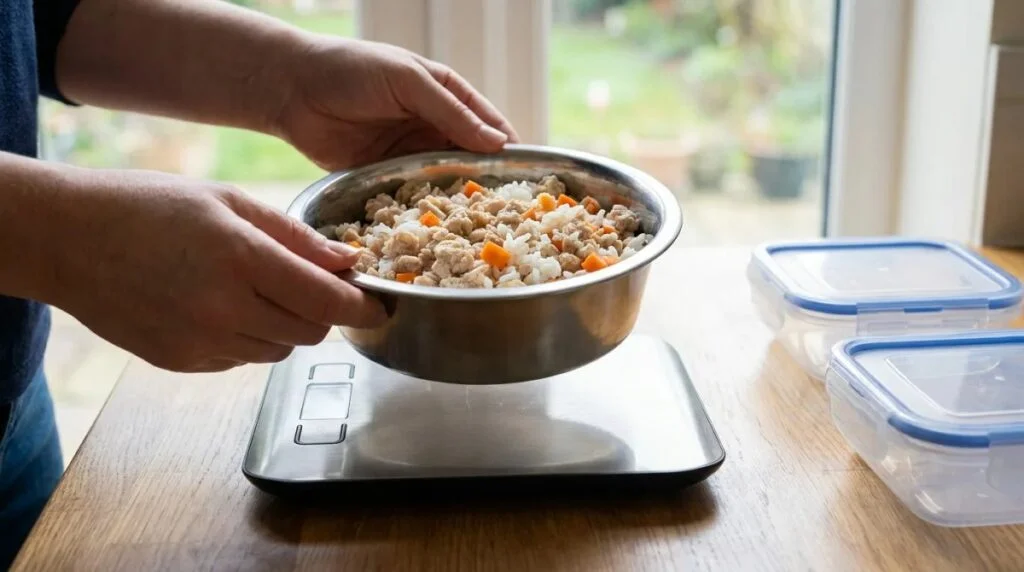
Daily grams of a recipe = daily calories assigned to that recipe ÷ calories per gram.
The following example assigns 900 calories to one complete recipe. It’s a calculation demonstration, not a recommendation that every Samoyed needs 900 calories.
| Recipe | Calculation | Approximate grams for 900 calories |
|---|---|---|
| Chicken & Rice | 900 ÷ 1.530 | 588 g |
| Fish & Sweet Potato | 900 ÷ 0.922 | 976 g |
| Beef & Russet Potato | 900 ÷ 1.559 | 577 g |
| JustFresh Home-Cooked Chicken | 900 ÷ 1.254 | 718 g |
These are alternatives, not portions to combine. They show why equal weights of different recipes can supply different calories.
Build the whole day’s calculation before preparing meals:
- Write down the dog’s established daily calorie allowance.
- Set aside calories for treats and other incomplete extras.
- Assign the remaining calories to complete foods.
- Convert each recipe’s share into grams using its own calorie density.
- Divide the amounts among meals and complete-food rewards.
- Record leftovers when actual intake differs from the plan.
For general feeding, treats, chews, table food and other incomplete extras together should remain within 10% of daily calories; an individual plan may allow less. AAHA identifies larger contributions as a nutritional risk. Complete food used for training can come from the usual ration, provided its calories are included in the calculation.
Account for mixed foods and rewards
Suppose a hypothetical adult has a 900-calorie complete-food allowance, with 600 calories assigned to Chicken & Rice and 300 to a suitable dry food. The fresh portion would be about 392 grams. If the hypothetical dry food contains 4 calories per gram, its portion would be 75 grams.
- Chicken & Rice: 600 ÷ 1.530 = approximately 392 grams.
- Hypothetical dry food: 300 ÷ 4 = 75 grams.
- Combined complete-food calories: 600 + 300 = 900.
The dry food’s calorie density is only an illustrative figure, not a specification for an unnamed product. Use the actual label. Also say whether a “half fresh, half dry” plan means half by calories, weight or volume. Splitting by calories makes each food’s energy contribution clear; equal scoops or equal weights won’t do that.
Keep the chart straightforward enough for every caregiver to follow. Include the full recipe name, calories per gram, daily grams, amount per meal, food set aside for rewards and the date of the current instructions. When the recipe changes, update the calorie density before reusing the calculation. A familiar measuring container doesn’t show that a new food supplies the same energy.
Check puppy growth requirements
A Samoyed puppy needs a complete and balanced food for growth. Serving more of an adult-maintenance food doesn’t make it suitable for a growing puppy. Ask your veterinarian about the puppy’s expected adult size and the right point to reassess the growth plan. If the puppy is expected to reach 70 pounds or more, the adequacy statement needs to include growth of large-size dogs. The explanation of nutritional adequacy describes these life-stage statements.
Of the four recipes discussed here, Chicken & Rice and Fish & Sweet Potato include growth, including growth of large-size dogs. Beef & Russet Potato and JustFresh Home-Cooked Chicken are for adult maintenance. Even with an eligible recipe, the amount must keep pace with the puppy’s changing needs.
Keep the recipe, daily amount, meal schedule, training calories, growth observations and next reassessment current. Don’t add calcium or other supplements to a complete growth food solely because the puppy is expected to become a substantial adult. Supplement decisions should address an identified need within a veterinary plan.
When a puppy comes home, get the current food name and feeding instructions, and keep enough on hand while planning any transition. A move already changes the puppy’s routine; changing several feeding variables at once makes the response harder to interpret. Ask when growth should be reassessed before changing to adult-maintenance-only food. Use development and individual needs to guide the timing.
Assess condition beneath the coat
A Samoyed’s thick coat can make visual estimates misleading. Learn to feel the ribs and assess the underlying body with your veterinarian rather than relying only on photographs or the dog’s outline from across the room. The WSAVA body-condition chart describes features of ideal condition, including readily felt ribs, a waist and an abdominal tuck. Your veterinarian can show you how to assess your dog.
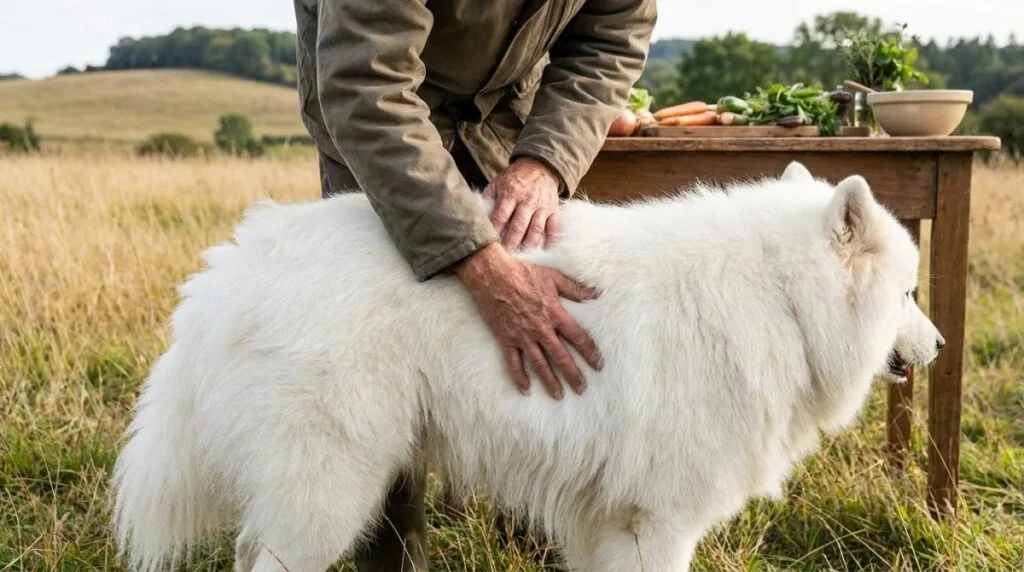
Keep several observations distinct: weight is the scale reading; body condition assesses body fat; muscle condition looks at whether muscle is being maintained; food intake records what the dog consumes; and activity describes the demands of the current routine. A stable scale reading doesn’t automatically establish ideal body composition, and a lower number isn’t always desirable.
Use the same scale and assessment method when possible. Record whether the portion or appetite has changed, how the ribs feel compared with the last check, whether activity or willingness to exercise has shifted, and any change your veterinarian identifies in muscle condition. If the trend supports a portion adjustment, date the new amount and note the reason.
Don’t assume repeated weight loss proves the dog is simply a highly efficient worker. Nor should every increase lead to a drastic cut in food. Unexpected weight change or apparent muscle loss calls for veterinary assessment, especially when it occurs alongside changes in appetite or activity.
Plan storage and travel around the portion
Once you have a daily amount, calculate how much food the household will use between deliveries and how many packages to keep available. Larger daily portions can help use an opened package sooner while requiring more refrigerator or freezer space. For any feeding period, calculate daily grams × number of feeding days = food needed. If you feed more than one recipe, calculate each separately and count food reserved for training once.
For opened packages, divide the package’s net weight by the daily grams taken from that package, then compare the result with the manufacturer’s use instructions. This estimates when the package will run out; it doesn’t extend the recommended storage period.
Current JustFoodForDogs guidance specifies opened refrigerated use within five days for thawed non-fish fresh-frozen meals, three days for fish recipes and three days for JustFresh. The same guidance gives refrigerator-thawing estimates of up to 24 hours for an 18-ounce pack and up to 48 hours for a 72-ounce pack.
A repeatable preparation routine helps: work out the next day’s needs, move sealed food to the refrigerator with enough time to thaw, mark opening and thawing dates, use clean utensils, and refrigerate unused portions as directed. Bowl cleaning belongs in the same routine. Food storage guidance recommends refrigeration at 40°F or below and prompt refrigeration or disposal of unused moist pet food.
Travel also needs an opened-food plan. An unopened shelf-stable option still requires suitable storage after opening; a fresh-frozen plan needs reliable cold storage during transport and the stay. Follow the product’s instructions about thawed food and refreezing rather than assuming every commercial meal can be refrozen. If the trip means changing formats, check life-stage suitability and calculate the new portions before leaving.
Don’t infer allergies from coat color
A white coat doesn’t diagnose a food allergy, and coat appearance alone isn’t a reason to switch foods. Persistent itching or digestive symptoms deserve an individual assessment. Changing ordinary recipes repeatedly because each has a different main protein won’t establish which ingredient, if any, is responsible. The recipes in this comparison aren’t treatment diets.
VCA’s guidance on food allergies describes controlled dietary trials and food challenges as part of diagnosis. Before an appointment, list meals, rewards, chews and supplements; record when symptoms appeared and when foods changed; and include food given during classes, outings or with medication.
If a veterinarian prescribes a dietary trial, give every caregiver the exact instructions. A reward that fits the ordinary calorie budget may still be unsuitable during a diagnostic trial. Ask which foods are allowed and keep the instructions consistent among everyone who feeds the dog.
Common feeding questions
Does every Samoyed need high-energy food?
No. A dog doing sustained work may need a different plan from a companion taking ordinary walks, but breed history alone doesn’t establish that need. Calorie density can affect how comfortably an appropriate allowance is served; it doesn’t replace assessing the whole recipe and the individual dog.
Should a quieter routine mean less food?
A sustained drop in activity is a reason to review the feeding plan, not to apply an automatic percentage cut. Consider the current amount, extras, weight trend and body condition. If you adjust, write down the new portion and check the result rather than changing it by eye again and again.
Can an older Samoyed keep eating the same recipe?
Possibly, if the recipe continues to meet the dog’s individual needs. Reassess appetite, condition, muscle and health as the dog ages. The amount can change even when the food remains suitable, and an age label alone doesn’t establish that a new formula is needed.
Should I add supplements to keep the coat white?
Don’t alter a complete diet or add supplements solely to meet an unsupported coat-whitening claim. Discuss a meaningful coat change with your veterinarian, especially if it occurs alongside skin symptoms, reduced appetite or another health change.
A reliable Samoyed feeding plan connects the exact recipe to measured calories, a realistic activity record and condition checks beneath the coat. Keep the instructions and storage routine current, and ask your veterinarian to assess unexpected weight, appetite or muscle changes.


