Sample No. 0197
Greyhound Feeding Guide: Choosing Food, Measuring Portions, and Tracking Condition
Compare four foods, calculate portions from calorie density, and use a simple record to guide feeding changes and monitor your Greyhound’s condition.
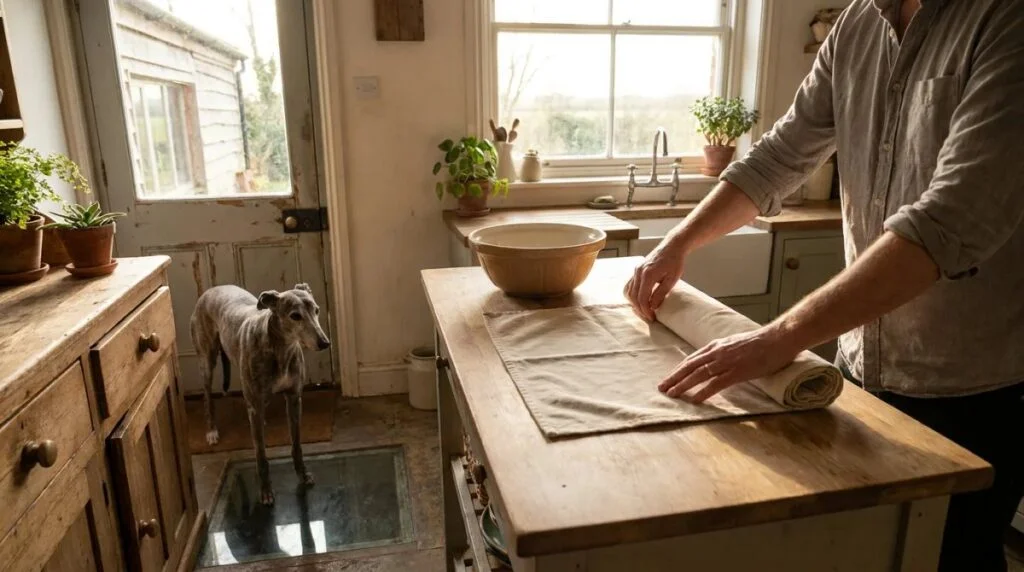
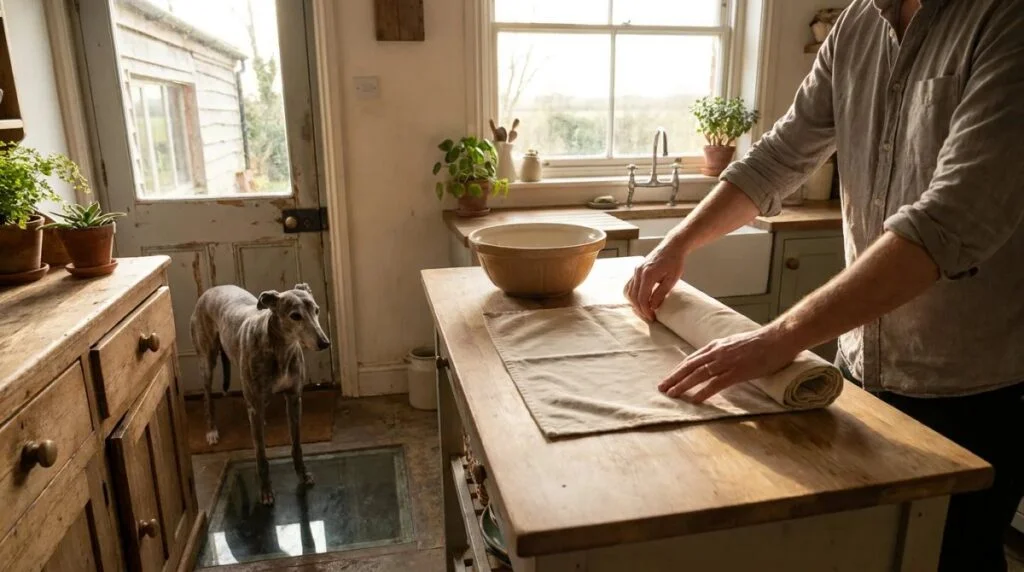
For a Greyhound, a useful feeding plan connects the food’s calorie density with the dog’s current condition, activity, and actual intake. A retired racing dog’s feeding history can help establish a starting point, but its old ration doesn’t automatically suit life at home.
Start by recording what the dog eats now, including treats and leftovers. Check body condition and muscle condition separately, then calculate measured portions using the chosen recipe’s calorie information. The four JustFoodForDogs recipes below differ in life-stage eligibility, calorie density, and storage needs; none is the right choice for every Greyhound.
What to look for in Greyhound food
Choose a complete and balanced food that suits the dog’s life stage, health, and routine. Greyhounds don’t automatically need racing food, a raw diet, or a fixed number of cups. A food that suits one dog may not suit another, and products from the same brand can differ in calories and life-stage claims.
Check the exact recipe’s nutritional adequacy statement and calorie information. The ingredient list alone doesn’t tell you whether a food is appropriate for a particular life stage or how much to serve. Vetstreet’s guide to understanding dog food labels explains how these details help evaluate a food.
Before choosing a recipe, consider:
- Life stage: Does the label cover growth, adult maintenance, or the relevant stage for this dog?
- Calorie density: How many calories does the recipe provide per gram?
- Current condition: What weight and body-composition goals have been discussed with the veterinarian?
- Actual intake: How much food is eaten, including treats, chews, and other extras?
- Household routine: Can everyone measure, store, and serve the food consistently?
This guide covers full-sized Greyhounds, including retired racers. The Greyhound breed profile offers broader background, but a general breed description can’t replace an assessment of the individual dog.
Four food options and their practical differences
The manufacturer’s current information lists two recipes as suitable for all life stages, including growth, and two for adult maintenance. Their calorie densities also vary. That affects the weight of food needed to provide the same number of calories.
| Recipe | Life-stage fit | Calories per gram | Practical consideration |
|---|---|---|---|
| Chicken & Rice | All life stages, including growth | 1.530 | Fresh-frozen, grain-inclusive option |
| Fish & Sweet Potato | All life stages, including growth | 0.922 | Lower calorie density means more grams for the same calories |
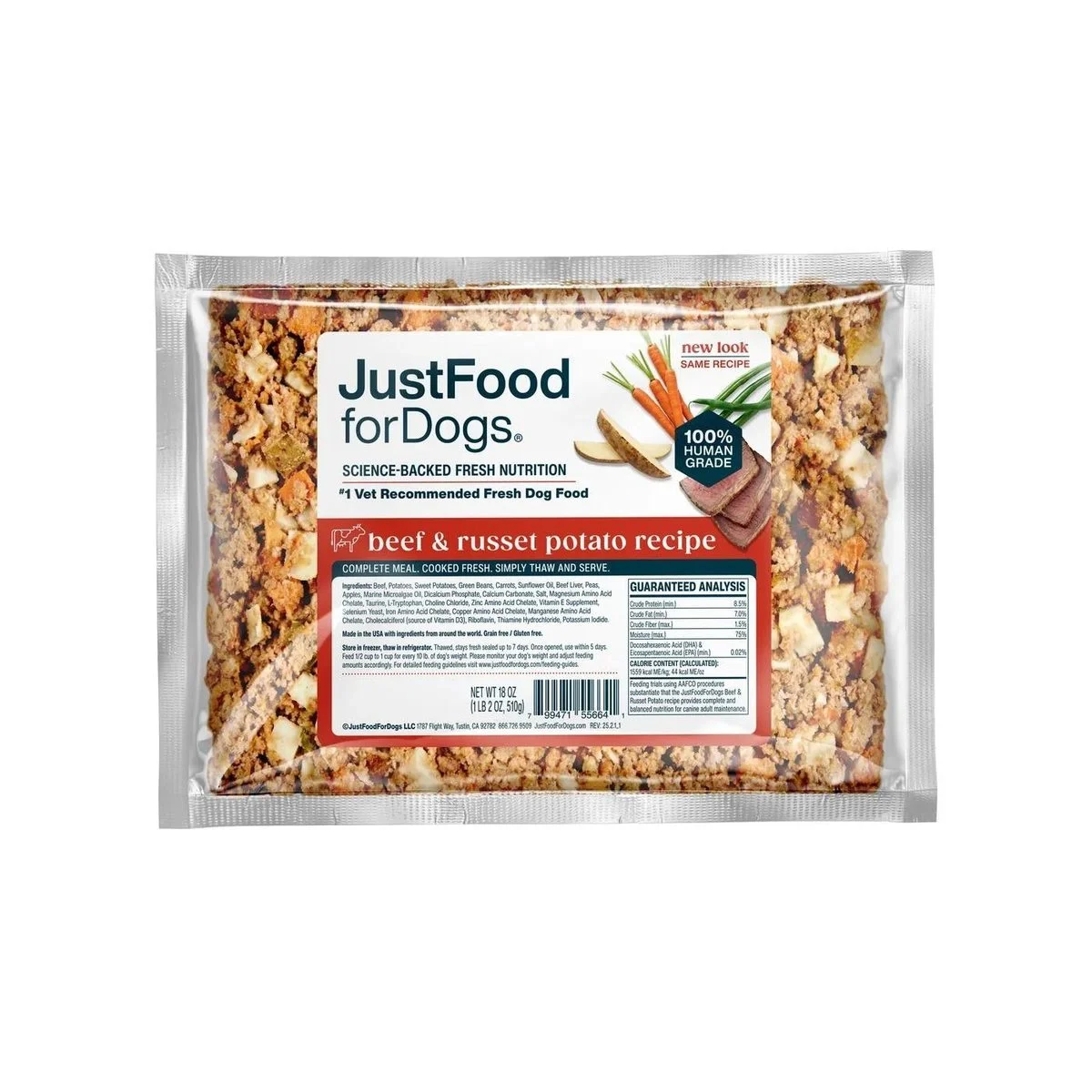
| Beef & Russet Potato | Adult maintenance | 1.559 | Complete fresh recipe for adults |
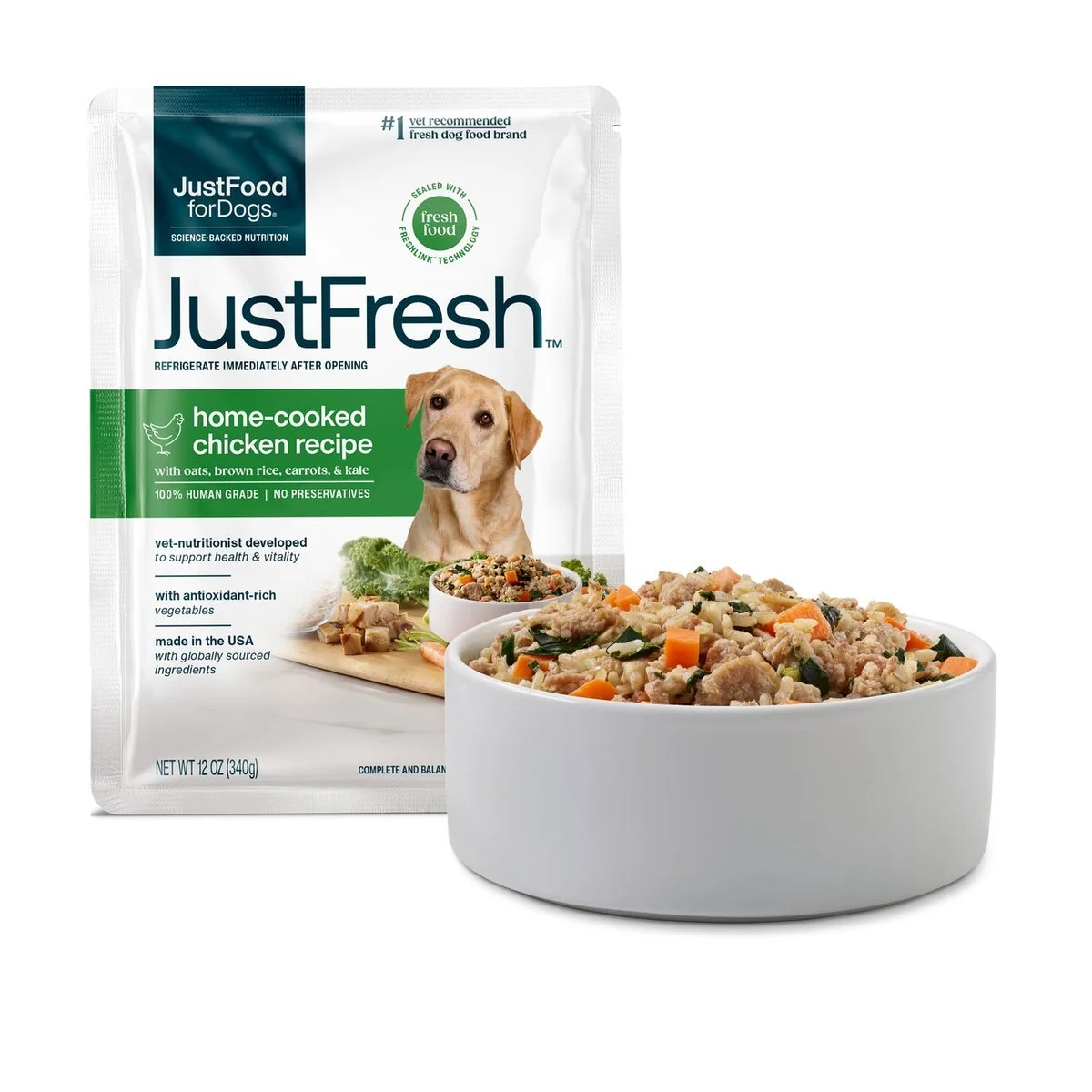
| JustFresh Home-Cooked Chicken | Adult maintenance | 1.254 | Unopened shelf storage can simplify supply planning |
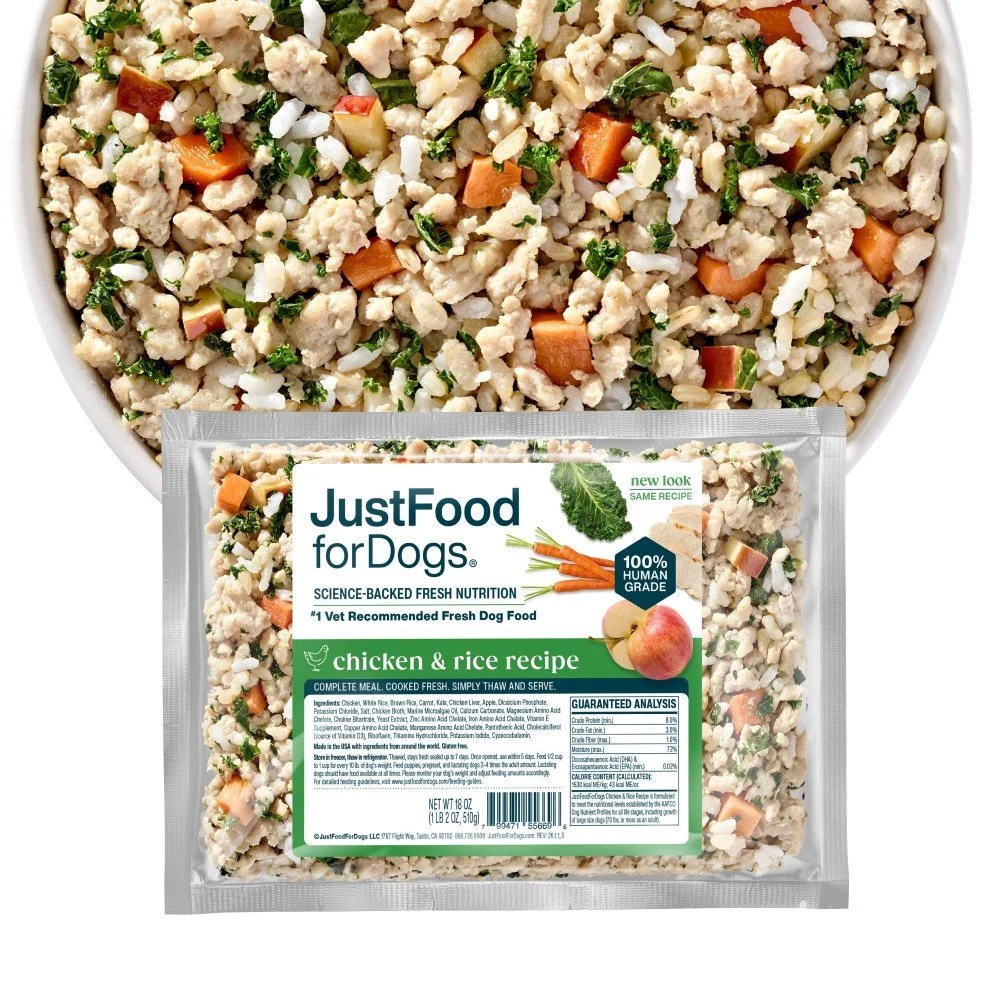
Chicken & Rice
Chicken & Rice is a fresh-frozen recipe with chicken, white rice, and brown rice. The manufacturer lists 1,530 kcal/kg, or 1.530 calories per gram, and states that it is suitable for all life stages, including growth of large-size dogs expected to reach at least 70 pounds as adults. See the current recipe information for details.
That growth statement makes the recipe an option for puppies as well as adults; it doesn’t mean an adult should receive a puppy-sized ration. Calculate the amount for the dog’s own calorie plan, and revisit the portion when activity or condition changes.
It’s a formulated complete food. A homemade bowl of chicken and rice doesn’t provide the same nutrient balance just because it uses similar main ingredients. For a fresh-frozen food, include thawing time and refrigerator space in the household plan.
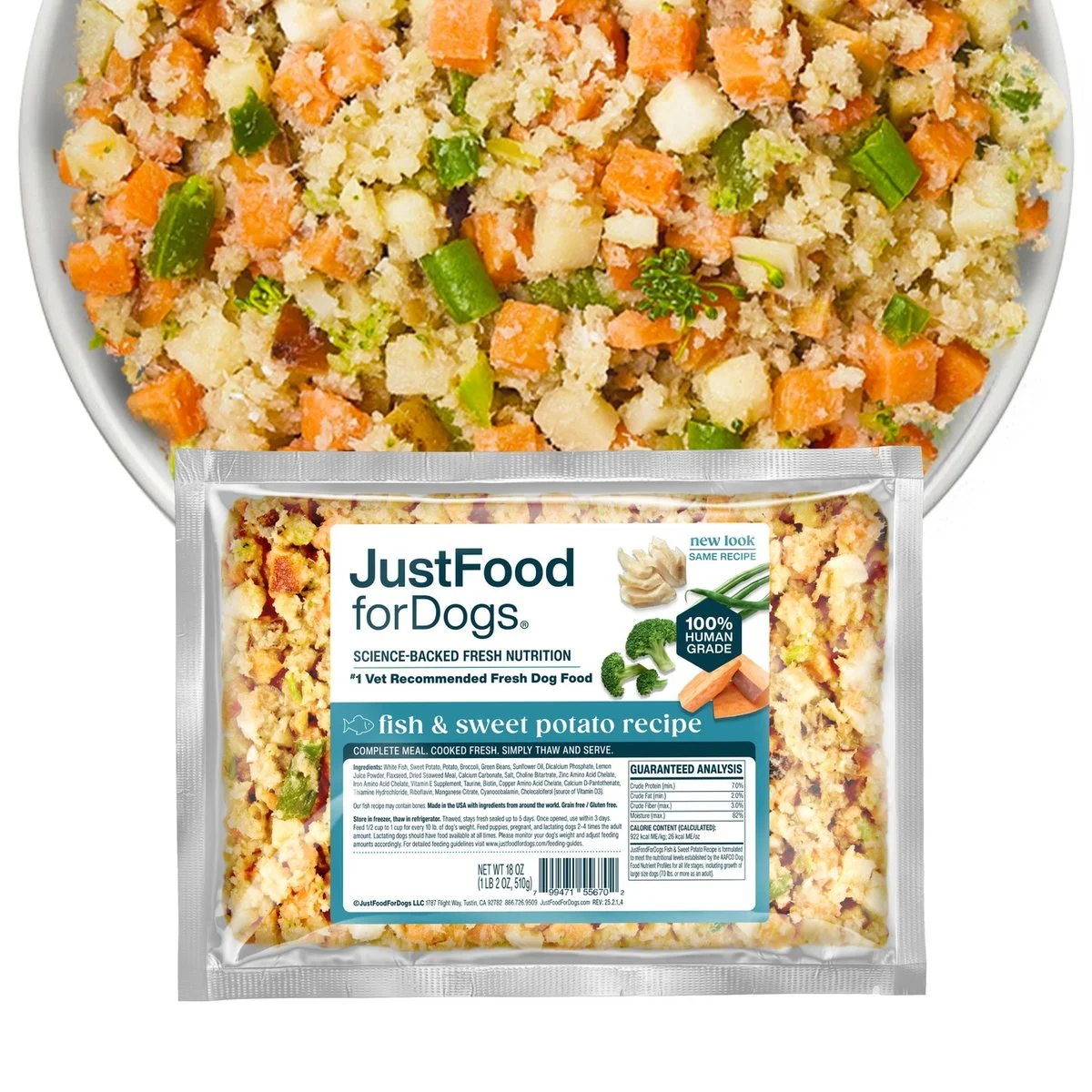
Fish & Sweet Potato
This recipe is another option listed for all life stages, including growth. Its current fish blend contains cod, pollock, and haddock. The manufacturer lists 922 kcal/kg, equivalent to 0.922 calories per gram; see the recipe information.
Among these four foods, it has the lowest calorie density. A dog assigned the same calorie allowance would eat more grams of it than of the other recipes. That affects meal size, package use, and preparation, but it doesn’t mean the food is nutritionally weaker. Lower calorie density alone also doesn’t make it a weight-loss food.
A fish ingredient doesn’t make this regular recipe a treatment for a diagnosed food allergy. For a dog with a suspected or confirmed food reaction, base decisions on the dog’s needs and veterinary advice.
Beef & Russet Potato
Beef & Russet Potato is listed for adult maintenance, not as a complete diet for a growing Greyhound puppy. Its calorie density is 1,559 kcal/kg, or 1.559 calories per gram. The manufacturer says adult-maintenance adequacy is supported by feeding trials using AAFCO procedures. Current details are available from the recipe information.
This is the highest-density option in this comparison, but that doesn’t establish it as a racing or performance food. A retired racer’s current needs depend on its present condition, activity, and health. If the dog is already doing well on an appropriate complete food, switching to a beef recipe isn’t a required part of adapting to retirement.
JustFresh Home-Cooked Chicken
JustFresh Home-Cooked Chicken is an adult-maintenance food designed for unopened shelf storage. The current formulation contains oats and brown rice. The manufacturer lists 1,254 kcal/kg, or 1.254 calories per gram; check its current recipe information for details.
It’s distinct from the fresh-frozen Chicken & Rice recipe and isn’t listed as a complete puppy diet. Pantry storage can help when freezer space is limited, but opened food still needs refrigeration and timely use. Use this recipe’s own calorie density when measuring. For more brand background, see Vetstreet’s JustFoodForDogs review, and refer to the current product label for feeding decisions.
Build a feeding baseline for a retired racer
A retired Greyhound’s recent feeding routine is a useful starting point. Ask the rescue, foster caregiver, or previous owner for the exact food and serving instructions before making changes. The dog may already be eating successfully in a home routine, and a racing history alone doesn’t tell you what it eats now.
Ask about:
- Full food names and specific recipes.
- Amounts offered and amounts usually eaten.
- How portions are measured.
- Meal times and number of meals.
- Treats, chews, table food, and food used with medication.
- Recent weight records and veterinary observations.
- Any existing transition or medical feeding instructions.
Racing history isn’t a current calorie requirement. Some dogs have already spent time in foster care with a household routine; for others, activity may change substantially after adoption. Record the recent situation instead of assuming an old racing ration remains appropriate.
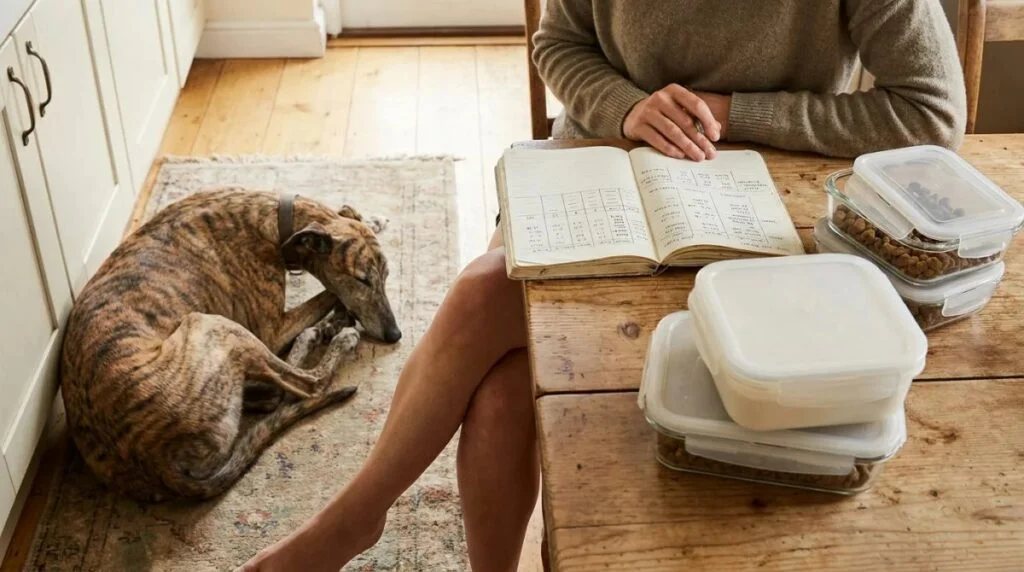
Use a shared feeding record
A single card or shared note can connect the previous routine with the new one. Record what’s known, label estimates, and leave unknowns blank rather than filling them with guesses.
| Record field | What to write down | Why it helps |
|---|---|---|
| Date and source | Who supplied the information and when | Shows whether instructions are current |
| Previous food | Full product and recipe name | Similar names can have different calorie densities |
| Previous amount | Grams, weight ounces, or actual volume measure | Makes the starting ration repeatable |
| Actual intake | Finished, partly eaten, or variable | Food offered isn’t always food consumed |
| Extras | Treats, chews, medication food, and table food | Captures calories outside meals |
| Weight | Measurement date and scale, if known | Establishes a reference point |
| Body and muscle condition | Veterinary assessment or observations to discuss | Keeps the two assessments distinct |
| Activity | The recent routine | Describes current life, not past work |
| New food and plan | Recipe, life-stage statement, calories per gram, grams per day | Supports accurate portions |
| Review point | When or why the plan will be reassessed | Prevents an initial estimate becoming permanent |
If the previous amount is unknown, mark it as unknown and establish a starting plan with the adoption organization and veterinarian. “A scoop twice daily” can’t be converted into a reliable calorie amount without knowing the scoop, food, and serving size.
Informal instructions such as “one bowl,” “a heaped cup,” or “a little meat” may have been clear to one caregiver but hard to reproduce in another kitchen. Ask for a demonstration or measured equivalent when possible. If the old food is available, weigh the serving the caregiver means and save its calorie information.
- Clarify whether “ounces” means food weight or a volume measure.
- Write whether a cup is level, heaped, or a particular scoop.
- Record additions separately from the complete food.
- Distinguish the amount per meal from the daily total.
- Check whether treats are already included in the instructions.
A previous weight and calorie intake are part of the dog’s history, not automatically a permanent target. Ask the veterinarian to interpret the record alongside an examination. That helps set a current goal without assuming every retired racer should gain weight or that every change in muscle definition is harmless.
Assess body condition and muscle separately
Greyhounds can have a naturally lean outline, but that doesn’t make individual assessment unnecessary. Body condition concerns body fat; muscle condition concerns whether muscle is being maintained. A scale reading can’t fully describe either one.
The WSAVA nutrition resources provide separate assessment tools. Keep weight, body condition, muscle condition, actual intake, activity, and health as distinct entries in the feeding record.
Ask your veterinarian to show you how to assess your own dog. The WSAVA canine body-condition chart considers rib coverage, waist, and abdominal tuck. A hands-on method learned from a veterinarian is more useful than following a fixed rule about how many ribs should show.
At home, write down observations without turning them into a diagnosis. “Ribs feel more prominent than last month” gives the veterinarian a concrete point to assess. A photograph of a different Greyhound or a breed weight range can’t establish an individual dog’s ideal condition.
- Use the same scale when practical and record each date.
- Note recent changes in food, treats, and activity.
- Have caregivers learn the same hands-on assessment method.
- Raise persistent or unexpected changes with the veterinarian.
A review is appropriate when appetite changes persist, weight shifts without an obvious explanation, muscle seems to be decreasing, or digestive signs continue. A feeding record can help the veterinarian see whether the dog’s response changed or the household’s actual portions changed.
Don’t add food automatically because a Greyhound looks lean. Don’t dismiss progressive weight loss as normal either. For an older dog, age alone doesn’t determine a calorie or protein change. Some senior dogs remain on an appropriate complete food with a different portion; others need a change based on an identified health or nutritional need. Bring current recipes, portions, weight records, appetite observations, treats, and muscle concerns to a senior feeding review.
Calculate portions from calories
The appropriate daily amount depends on the dog’s calorie plan and the foods actually served. There isn’t one cup limit that works across recipes. The WSAVA healthy-adult calorie guide can offer a starting reference for adults in ideal condition, but it isn’t a universal ration or a prescription for weight change or illness.
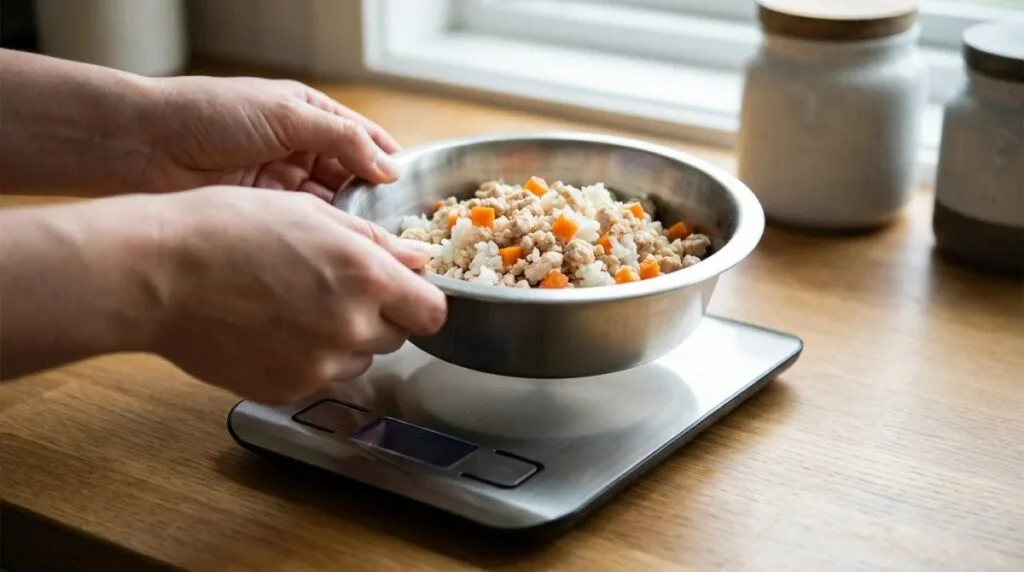
Once an appropriate calorie allowance has been established, use this calculation:
Daily grams = calories assigned to the recipe ÷ calories per gram.
If a label gives kcal/kg, divide that number by 1,000. For Chicken & Rice, 1,530 kcal/kg equals 1.530 kcal/g.
Equal calories can mean different food weights
The table shows how much of each recipe would provide an illustrative 1,000 calories. This is a math example, not a daily recommendation for a Greyhound.
| Recipe | Calculation | Approximate grams |
|---|---|---|
| Chicken & Rice | 1,000 ÷ 1.530 | 654 g |
| Fish & Sweet Potato | 1,000 ÷ 0.922 | 1,085 g |
| Beef & Russet Potato | 1,000 ÷ 1.559 | 641 g |
| JustFresh Home-Cooked Chicken | 1,000 ÷ 1.254 | 797 g |
These are alternatives for the same illustrative calorie amount, not portions to combine. The difference shows why a new recipe shouldn’t inherit the old food’s gram weight or bowl level. Recalculate whenever the recipe changes.
A kitchen scale helps make the plan repeatable. Set the scale to grams, place the bowl on it, and tare the bowl before adding food. For a meal with two recipes, measure them separately. Keep the full recipe name and calorie density beside the portion instructions, and state whether each amount is per meal or per day.
Count treats and other extras
The daily food plan includes more than meals. Training rewards, chews, and food used with medication all contribute calories. For general feeding, keep noncomplete extras within 10% of daily calories, unless the dog has stricter individual instructions. AAHA’s nutrition guidance identifies larger contributions from noncomplete foods as a nutritional risk.
Use this sequence to plan the day:
- Establish the total daily calorie allowance.
- Set aside calories for noncomplete extras, if any.
- Subtract those calories from the total.
- Assign the remainder to complete foods.
- Convert each food’s calories into grams.
- Divide the food among meals and any complete-food rewards.
- Record leftovers.
The 10% figure is a ceiling, not a target. It applies to all noncomplete extras together across the day, not to each treat or caregiver separately.
For example, imagine an adult with an established allowance of 1,100 calories a day. If 50 calories are reserved for noncomplete extras, 1,050 calories remain for complete food. A hypothetical plan could assign 650 calories to Chicken & Rice and 400 to a suitable complete dry food. At 1.530 calories per gram, the fresh recipe amount would be about 425 grams. If the actual dry food provides 4 calories per gram, its 400-calorie portion would be 100 grams.
The dry-food density in this example is illustrative; use the product’s actual label. This plan divides the complete-food allowance between two foods. It doesn’t add dry food on top of an already complete 1,100-calorie ration. Both foods also need to suit the dog’s life stage and health.
Compare daily costs fairly
Calorie-based portions can also help compare food costs. Package weight alone doesn’t show how many days a package will last, because recipes differ in calories per gram.
Cost per day = package price × daily grams ÷ net package grams.
Use the current price and package weight for the exact food, along with the dog’s measured daily amount. If food is discarded because an opened package can’t be used in time, the actual cost per fed day will be higher. No price comparison can substitute for checking package size, recipe, daily ration, and storage instructions.
Set a clear meal routine
For an adult Greyhound, at least two meals a day is a practical starting point unless the veterinarian recommends a different schedule. Divide the daily allowance between meals; don’t multiply the allowance each time you feed. Cornell’s GDV guidance supports two or more meals rather than one large feeding. Meal frequency doesn’t eliminate bloat risk.
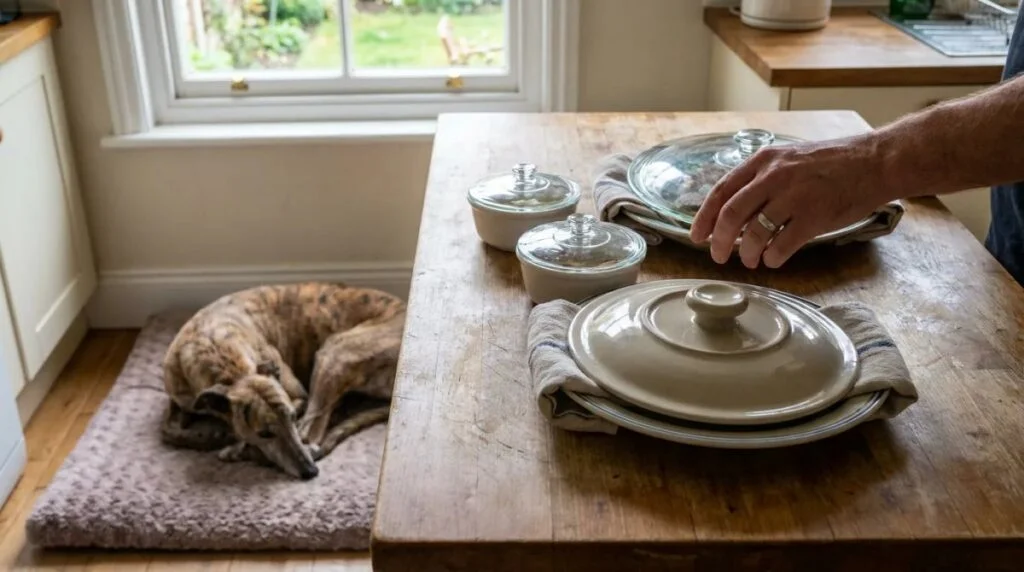
A visible schedule helps the household track what has been served, what remains, and whether the dog’s appetite differs between meals. If different people feed breakfast and dinner, make the daily totals and any rewards visible to everyone.
A simple record can include the time, exact amount, feeder’s initials, leftovers, and extra food. An empty bowl doesn’t tell the next caregiver whether the dog has eaten already. If the dog often leaves part of a meal, record the pattern before changing the full ration.
Discuss meal timing around vigorous exercise with your veterinarian, particularly if the dog’s activity changes. A fixed waiting period can’t guarantee that bloat won’t occur. Nonproductive retching, abdominal swelling, marked restlessness, or collapse may signal GDV and need immediate veterinary attention. Don’t wait for the next meal or try to manage these signs by changing food.
Use a stable, clean bowl the dog can reach comfortably. A raised bowl shouldn’t be chosen as a bloat-prevention measure. Cornell’s GDV guidance identifies raised bowls as a possible risk factor. If a medical or mobility issue affects feeding position, ask the veterinarian for individual advice.
Change food while keeping intake clear
Before a change, confirm the current food and amount, the new recipe’s life-stage fit, and its calorie density. Follow transition instructions from the adoption organization, manufacturer, or veterinarian. If a veterinarian has directed an urgent diet change, follow that advice.
Keep other parts of the routine as steady as practical while introducing a new food. Changing the main food, treat supply, meal schedule, and several supplements at once makes it harder to understand what the dog responds to.
When a transition divides calories between foods, calculate each food’s weight separately. “Half old food, half new food” could mean half by weight, volume, or calories, and those are not necessarily equivalent.
For illustration, a transition stage assigning 500 calories to Chicken & Rice would use about 327 grams of that recipe: 500 divided by 1.530. Calculate the old-food portion using its own calorie density. This example explains the arithmetic; it doesn’t set a transition schedule, duration, or daily calorie target.
Record observations without assigning a cause too quickly. “Left about a quarter of breakfast” is more useful than “doesn’t like fresh food.” Note food offered and left, treats, stool changes, vomiting or other illness signs, the timing of recipe changes, and whether activity and behavior seem usual.
Persistent reduced intake or digestive symptoms deserve veterinary advice. A regular complete recipe isn’t a treatment for every digestive problem or suspected food reaction, and repeated food switching shouldn’t replace assessment when a dog seems unwell.
Plan storage before opening food
Portion calculations also show how much food the household needs to prepare and store. Daily grams multiplied by feeding days estimates the amount needed; package weight divided by daily grams estimates how long a package may last. Follow the specific package instructions for thawing, refrigeration, and use after opening.
According to JustFoodForDogs’ current FAQ, opened refrigerated non-fish fresh-frozen meals should be used within five days, fish meals within three days, and JustFresh within three days. The FAQ gives refrigerator-thawing estimates of up to 24 hours for 18-ounce packs and up to 48 hours for 72-ounce packs. Follow the package’s sealed-thawed limits as well; opening a container doesn’t reset the time it has already spent thawed.
The FDA storage guidance recommends keeping the refrigerator at 40°F or below and promptly refrigerating or discarding unused moist food. Clean bowls and utensils, and plan package use around the dog’s real daily portion.
When the plan changes, update the shared feeding record. Keep dated older entries for context, but make the current recipe, daily grams, meal amounts, reward allowance, and storage instructions easy to find.
Common Greyhound feeding questions
What foods should Greyhounds avoid?
Greyhounds need the same protection from toxic foods as other dogs. The FDA guide to potentially dangerous foods covers common hazards. If you suspect your dog has eaten something harmful, contact a veterinarian or pet poison service promptly. A diagnosed food reaction or prescribed diet may call for specific restrictions; it doesn’t establish breed-wide bans on ordinary ingredients.
Can a Greyhound have banana?
A small piece of plain, peeled banana may be an optional treat for a dog that tolerates it and whose individual diet allows it. UC Davis includes banana in its dog-treat guidance. Count it with other noncomplete extras. A complete diet doesn’t require fruit, and a large dog doesn’t automatically need a large treat.
Does visible rib definition mean my Greyhound needs more food?
Not by itself. Ask your veterinarian to assess body condition, muscle condition, weight trend, and health history. Don’t use a fixed visible-rib count or another dog’s photograph as a feeding target. At the same time, don’t dismiss progressive weight loss as ordinary Greyhound leanness.
Should a retired Greyhound eat racing food?
Choose food based on the dog’s current activity, condition, life stage, and health. A past racing routine doesn’t set today’s nutritional needs. Bring the current food and portion record to a veterinary assessment, then decide whether to continue the recipe, adjust the amount, or choose another suitable complete food.
The most useful routine is one the dog can follow comfortably and the household can repeat accurately. Record the starting point, measure portions from the recipe’s calorie density, and review the plan when the dog’s condition, appetite, health, or activity changes.


