Sample No. 0199
Jack Russell Terrier Food: Match Portions, Training Rewards, and Activity
Compare four recipes by life stage, calories, and storage, then use a simple food and activity record to keep portions and training rewards on track.

A Jack Russell’s energy level doesn’t tell you how much food to serve. The useful guide is the dog in front of you: their life stage, measured intake, typical activity, body condition, and how many rewards land in the training pouch.

Four JustFoodForDogs recipes offer different calorie densities, life-stage statements, and storage needs. Comparing those details can help you decide whether a food fits your household. None is automatically right for every Jack Russell, and an energetic temperament alone isn’t a reason to change diets.
Start with a record of what your dog eats and does during an ordinary week. Then check the exact recipe’s nutritional adequacy statement, convert the intended calories into grams, and count treats as part of the daily plan. If weight, appetite, digestion, or activity changes, review the plan with your veterinary team.
Let the individual routine guide the food choice
Jack Russells are known for enthusiasm. Vetstreet’s Jack Russell Terrier breed profile describes the lively companion many owners recognize, but breed character can’t tell you how much energy a particular dog uses in a week.
A dog eager to play may spend much of the day resting between brief bursts of activity. A training class can involve short exercises and long waits, while sustained work may demand considerably more effort. Feeding decisions should reflect what the dog actually does, not what the breed is reputed to do.
- Household companion: Regular walks and play, with plenty of rest between activities.
- Frequent learner: Classes or training sessions that may involve many food rewards but little continuous exertion.
- Dog doing sustained demanding activity: Repeated periods of substantial effort that call for closer monitoring and an individualized feeding plan.
These descriptions help organize observations. They don’t supply calorie multipliers, prove that a performance food is needed, or replace a body-condition assessment.
If your dog eats comfortably, maintains an appropriate weight and condition, and receives complete nutrition for their life stage, being lively doesn’t by itself create a reason to change recipes. When the routine changes, record what changed before adjusting meals. A new weekly class, a demanding work schedule, and one longer weekend walk are different situations.
Use this order to compare foods:
- Read the nutritional adequacy statement for the exact recipe.
- Check whether it suits growth or adult maintenance.
- Find its calorie content and calculate a practical portion.
- Plan how meals and training rewards will share the daily allowance.
- Consider storage, preparation, and household cost.
The package front and ingredient list can’t answer all five questions. Vetstreet’s guide to ingredients versus nutrition on dog-food labels offers context for looking beyond marketing language.
Four recipes, with different feeding considerations
The options below include three Fresh Frozen foods and one shelf-stable product for adult dogs. Chicken & Rice and Fish & Sweet Potato have statements covering all life stages, including growth of large-size dogs. Beef & Russet Potato and JustFresh Home-Cooked Chicken are for adult maintenance. Check that distinction before comparing protein sources or convenience.

| Recipe | Life stage | Calories per gram | Planning point |
|---|---|---|---|
| Chicken & Rice | All life stages, including growth of large-size dogs | 1.530 | Freezer space and advance thawing |
| Fish & Sweet Potato | All life stages, including growth of large-size dogs | 0.922 | Larger weighed portions and shorter refrigerated limits |
| Beef & Russet Potato | Adult maintenance | 1.559 | Adult-only use and measured portions |
| JustFresh Home-Cooked Chicken | Adult maintenance | 1.254 | Refrigerate after opening; use within three days |
Chicken & Rice
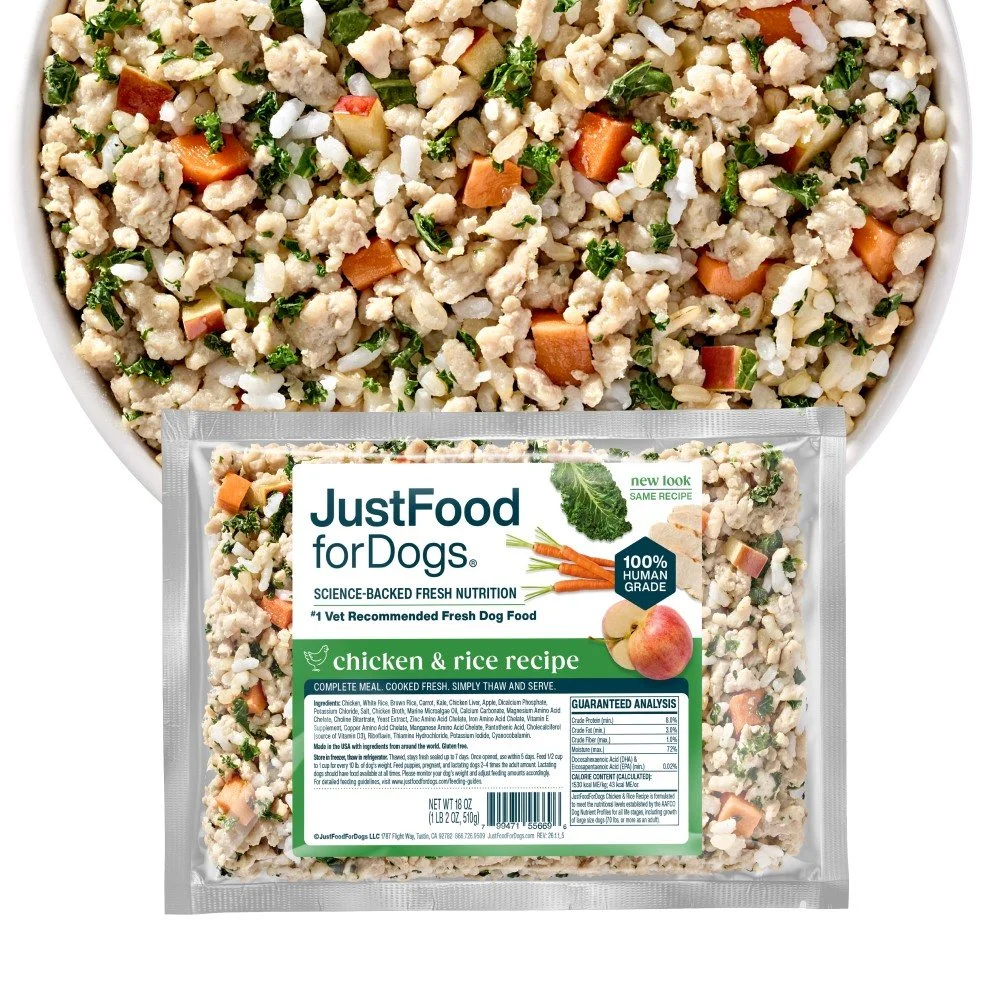
This grain-inclusive Fresh Frozen recipe contains white and brown rice. Its nutritional adequacy statement covers all life stages, including growth of large-size dogs, so it can be considered for a puppy as well as an adult. That doesn’t mean they should receive the same amount or follow the same schedule. Growth and adult maintenance require separate feeding plans.
The food supplies 1,530 calories per kilogram, or 1.53 calories per gram. Once an appropriate calorie allowance has been established, this figure makes it possible to weigh the daily food and set aside some for training.
It may fit a household that wants a fresh meal containing rice, can store food in a freezer, and is comfortable weighing portions. The storage routine matters: according to the JustFoodForDogs handling FAQ, non-fish Fresh Frozen meals can be refrigerated for up to seven days sealed after thawing and five days after opening. Follow the directions on the package in hand if they differ.
Label thawing and opening dates. Check how many portions a package supplies, and make the intended amount clear to other caregivers. A measured meal in a labeled container can help prevent an extra serving after a walk or class.
Chicken & Rice isn’t automatically a performance diet because it contains chicken. Its potential fit rests on the complete nutrition statement, life-stage suitability, and a portion that works within the dog’s daily plan.
Fish & Sweet Potato
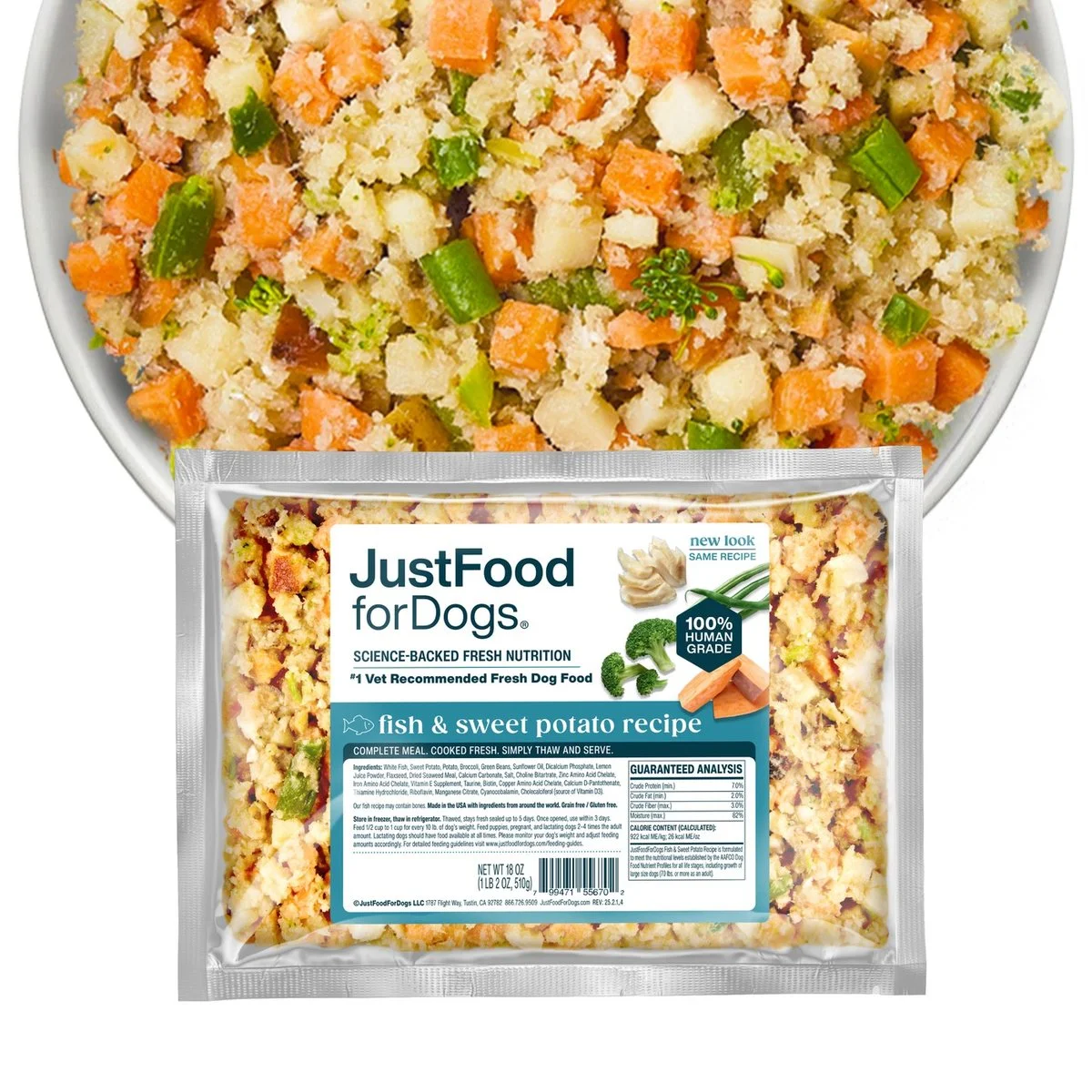
At 922 calories per kilogram, or 0.922 calories per gram, this recipe is less calorie-dense than the other three. A dog needs a greater food weight to receive the same energy. That difference can matter when planning portions, but it doesn’t make the food a weight-loss treatment or mean it’s unsuitable for an active dog.
The fish ingredients are a blend of cod, pollock, and haddock. It isn’t a cod-only food, and the presence of fish doesn’t establish that it is appropriate for investigating a suspected allergy.
The recipe’s all-life-stages statement includes growth of large-size dogs. Its practical considerations include a relatively large serving weight and shorter refrigerated limits than non-fish Fresh Frozen meals. JustFoodForDogs gives limits of up to five days sealed after thawing and three days after opening.
Before choosing it, compare the intended daily amount with the package size. A dog eating it as a main food will use an opened package at a different pace from one receiving a small portion alongside another complete diet. If your dog regularly leaves food, record what was actually eaten; weighing what you offer doesn’t tell the whole story. Ongoing reduced intake deserves attention rather than an assumption that a large serving explains it.
Beef & Russet Potato
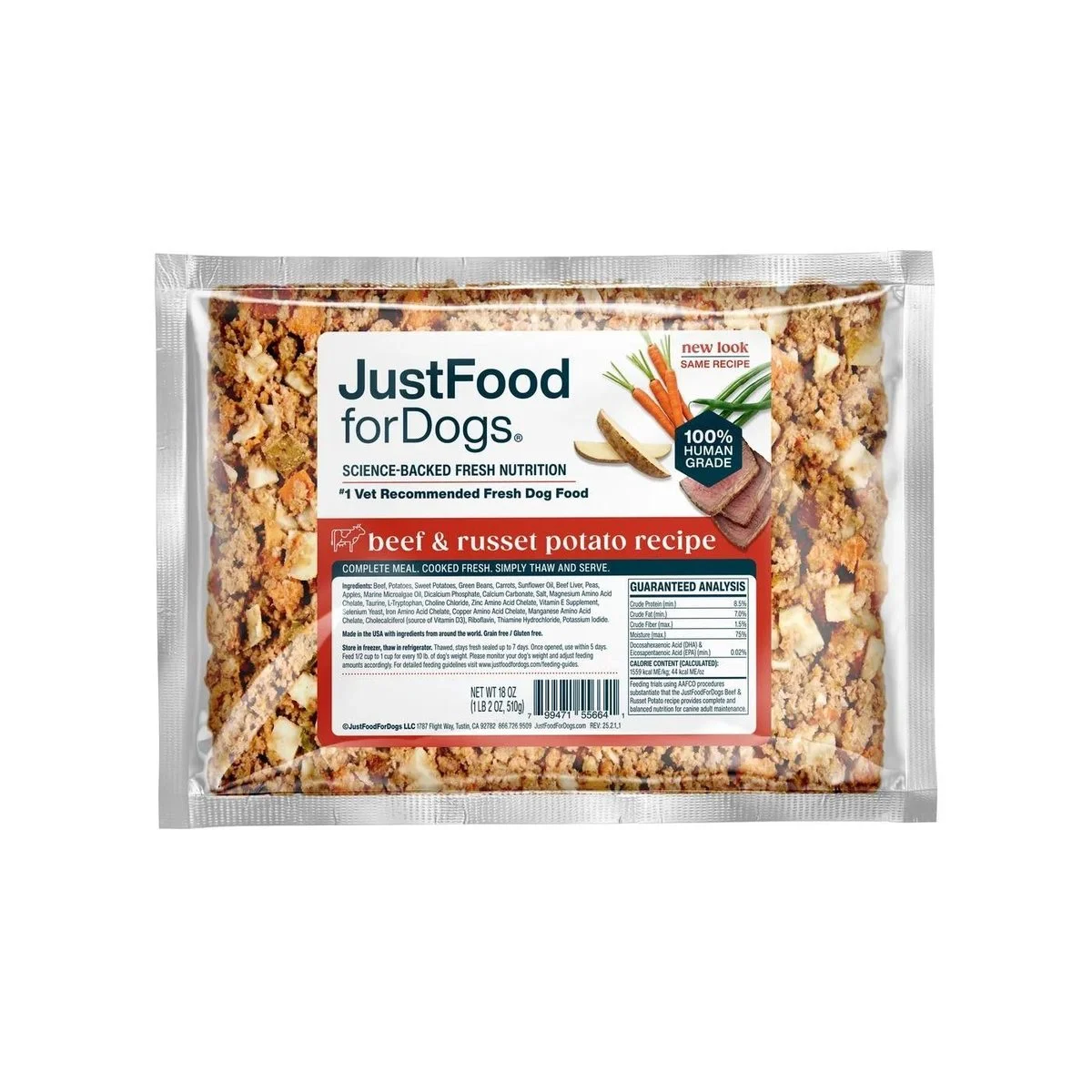
This Fresh Frozen recipe is for adult maintenance. Its nutritional adequacy statement is supported by feeding tests using AAFCO procedures for adult maintenance; it isn’t intended as a complete diet for growing puppies.
At 1,559 calories per kilogram, or 1.559 calories per gram, it’s the most energy-dense of these four options. Its calorie density is close to Chicken & Rice and considerably higher than Fish & Sweet Potato. For a fixed calorie allowance, it produces a relatively compact weighed serving.
That doesn’t mean an adult Jack Russell needs it because they chase a ball or attend classes. It may suit a household looking for a beef-based fresh frozen meal for an adult dog, provided there is freezer capacity and portions are measured. If a puppy lives in the home too, keep meals clearly identified.
When changing recipes, don’t copy the gram amount from a less calorie-dense food. The new portion could contain more calories even if it looks similar in the bowl. Use the current product information, track thawing and opening dates, and include training food in the day’s total.
In a multi-dog household, mark both the recipe and the dog’s name on prepared containers. Similar-looking meals aren’t interchangeable when one dog needs growth nutrition and another eats an adult-maintenance diet.
JustFresh Home-Cooked Chicken
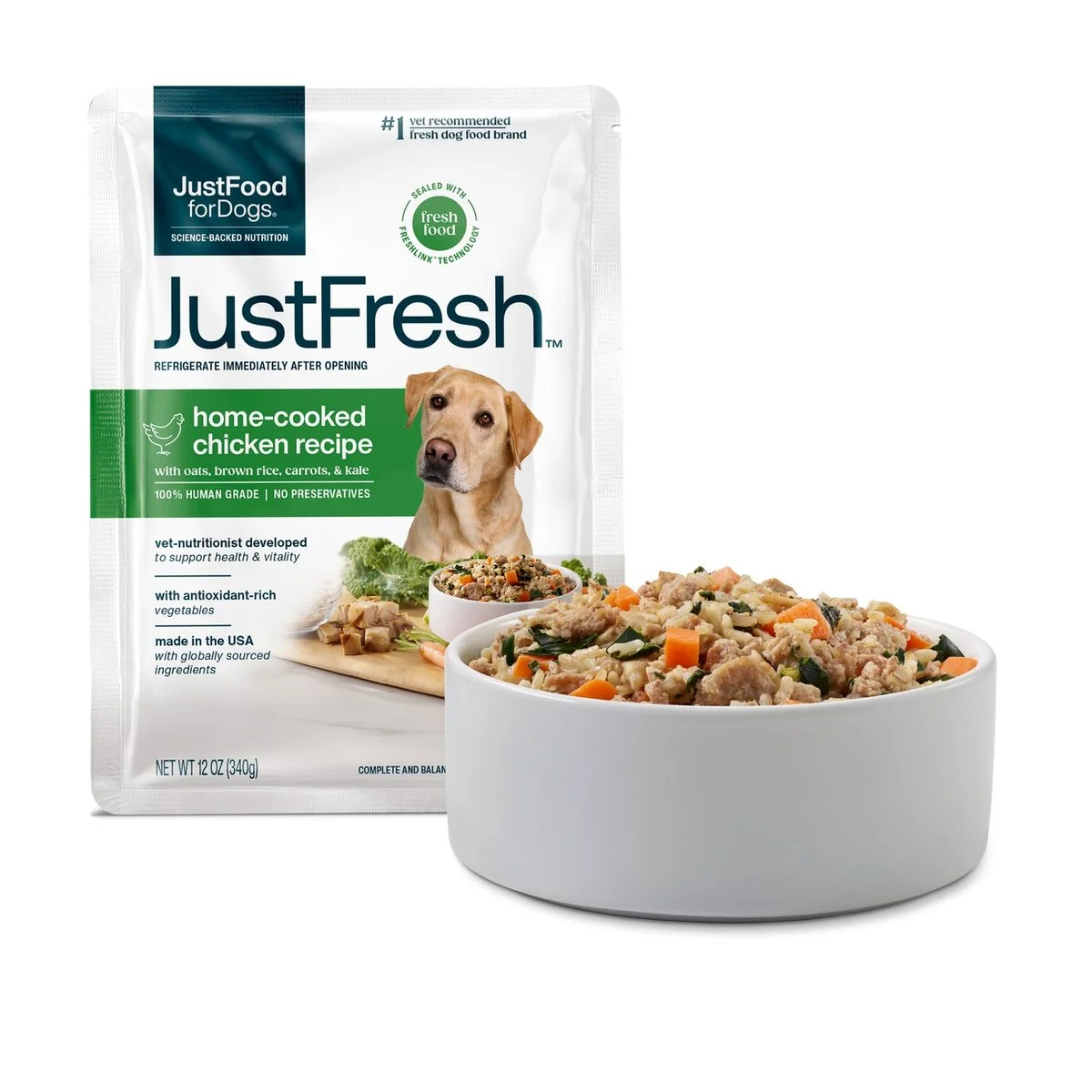
JustFresh Home-Cooked Chicken is shelf stable before opening and formulated for adult maintenance. It contains oats and brown rice, and provides 1,254 calories per kilogram, or 1.254 calories per gram. Don’t assume it has the same life-stage statement or calorie content as Fresh Frozen Chicken & Rice simply because both include chicken.
Unopened, the product has a stated shelf life of up to two years from manufacture. After opening, refrigerate it and use it within three days. Room-temperature storage before opening can simplify travel or feeding arrangements, but an opened package still needs refrigeration and timely use.
For a trip or sitter, plan where opened food will be chilled and how portions will be served. Taking an unopened package answers only part of the storage question; clean bowls and careful handling of leftovers remain part of the routine.
Convenience is a reasonable selection factor when it helps a household serve a suitable meal consistently. For this recipe, use the current label and manufacturer instructions for calories, life-stage suitability, and storage. Vetstreet’s earlier JustFoodForDogs review offers historical context about the brand.
Convert calories into a measured portion
The appropriate daily amount depends on the individual dog’s calorie needs. A breed-wide scoop recommendation skips both the dog’s needs and the recipe’s energy density. Weighing makes a portion repeatable, but it can’t correct an unsuitable calorie target.
Use the food’s guide, the dog’s current intake and condition, and advice from your veterinary team to establish a starting allowance. The WSAVA calorie estimates for healthy adult dogs are starting points for appropriate adults, not fixed requirements for every terrier.
If your dog maintains an appropriate weight and body condition on a measured diet, document that intake before assuming a new calculator offers a better answer. A useful review includes:
- Current weight and date measured.
- Exact recipe and calories per kilogram.
- Grams offered and any consistent leftovers.
- Treats, chews, rewards, and food used with medication.
- A description of the usual week’s activity.
- Meaningful changes in appetite, digestion, or weight.
Puppies, dogs with medical conditions, and dogs who need to gain or lose weight need plans suited to those circumstances. Don’t apply a healthy-adult example just because the dog is a Jack Russell.
Use the calories-per-gram calculation
Divide calories per kilogram by 1,000 to find calories per gram. Then divide the calories assigned to that food by its calories per gram.
For Chicken & Rice, 1,530 calories per kilogram equals 1.53 calories per gram. If 450 calories are allocated to the food, 450 ÷ 1.53 gives approximately 294 grams for the day.
The table applies the same example to each recipe. It assumes an established daily allowance of 500 calories, with 50 calories set aside for noncomplete extras and 450 supplied by complete food. These figures demonstrate the calculation; they are not feeding recommendations for all Jack Russells.
| Recipe | Calories per gram | Calculation for 450 food calories | Approximate daily amount |
|---|---|---|---|
| Chicken & Rice | 1.530 | 450 ÷ 1.530 | 294 g |
| Fish & Sweet Potato | 0.922 | 450 ÷ 0.922 | 488 g |
| Beef & Russet Potato | 1.559 | 450 ÷ 1.559 | 289 g |
| JustFresh Home-Cooked Chicken | 1.254 | 450 ÷ 1.254 | 359 g |
These serving weights differ substantially while supplying roughly the same calories. Bowl size and appearance alone can mislead. Use the current label if its calorie information differs from these figures, place the empty bowl on the scale, zero it, and check that the display is set to grams.
Split meals and training food in advance
Once you have a daily amount, decide what belongs in meals and what may be used as rewards. This helps prevent measuring full meals and then adding a separate supply for class.
In the Chicken & Rice example, about 294 grams provides 450 calories. If 52 grams are set aside for rewards, approximately 242 grams remain for meals. Two meals would be about 121 grams each, allowing for rounding.
- Prepare a breakfast portion.
- Prepare a dinner portion.
- Identify the training allocation.
- Track any noncomplete extras separately.
This makes the plan visible to everyone who feeds the dog. A reward from another person then comes from an existing allocation rather than silently increasing the daily total. Keep moist food stored according to its handling instructions until needed.
Calculate mixed meals by calories
If you feed two complete foods, calculate each one separately. Equal weights don’t necessarily provide equal calories, and “half fresh, half dry” is unclear unless you specify whether the split is by calories, weight, or volume.
If the example’s 450 food calories are split evenly between Chicken & Rice and Fish & Sweet Potato, each supplies 225 calories. That works out to about 147 grams of Chicken & Rice and 244 grams of Fish & Sweet Potato. The combined serving weighs roughly 391 grams, while the calorie allocation remains 450.
Both foods still need to suit the dog’s life stage. When transitioning between recipes, record the proportions and calculate calories at each stage. Follow the manufacturer’s transition guidance or your veterinary team’s instructions so the change doesn’t unintentionally increase intake.
Track activity, meals, and body condition together
An activity record doesn’t need to estimate calories burned on every walk. Its job is to connect what the dog does with what they eat and how their condition changes. Start with an ordinary week that includes weekdays and the weekend; mark any unusual week as such.

Record the activity, approximate duration, intensity, and pauses. “An hour outside” could mean gentle sniffing, a class with long waits, or sustained physical work. Separate active periods from long rests where possible. Note whether the day was typical, unusual, restricted, or part of a new routine.
Put food beside activity in the same log. Include food actually eaten, rewards, chews, scraps, supplements, and food used with medication. If an amount is unknown, mark it as unknown rather than guessing.
| Record | What to note | Why it helps |
|---|---|---|
| Main meals | Recipe and grams eaten | Documents the measurable foundation of intake |
| Training food | Product, amount, and calories if available | Makes rewards visible |
| Other extras | Chews, scraps, supplements, medication foods | Captures calories outside meal bowls |
| Activity | Type, duration, intensity, and pauses | Distinguishes ordinary movement from sustained work |
| Appetite and digestion | Meaningful changes or repeated problems | Adds context for a veterinary review |
| Weight and condition | Dated measurements and periodic observations | Shows longer-term results |
A blank entry doesn’t mean zero. A dog walker’s rewards or a chew from another family member may be the least measurable part of the plan. Finding that gap can be more useful than changing the food immediately. For classes, ask what rewards the instructor supplies and agree on how to track them.
Read patterns, not single busy days
An enthusiastic companion whose weight and condition stay stable on a measured allowance may simply need a consistent routine. Keep measuring, maintain the reward budget, and review the plan when activity changes. Readiness to play doesn’t prove a calorie deficit.
A beginner attending frequent classes may receive many rewards while spending much of each session waiting. Before increasing meals, check the calories in rewards, whether some can come from the complete-food ration, and whether instructor-provided treats are being counted. More training doesn’t automatically mean a larger daily allowance.
For a dog beginning sustained demanding work, repeated exertion may make maintaining condition more challenging. Bring the record to your veterinary team before choosing a feeding strategy based on a performance label. Discuss whether the calorie allowance remains suitable, whether the current recipe works in a practical portion, and how to monitor the dog as the workload continues.
Don’t assume unexpected weight loss, poor appetite, or other changes are explained by exercise alone. They need assessment. One unusually active afternoon also doesn’t establish a need for a new formula or an automatic increase at dinner; one quiet day doesn’t justify a sharp reduction.
Review the plan when demanding activity becomes a regular part of the week, activity drops substantially, rewards increase, weight or body condition moves away from the agreed target, or appetite changes. For a healthy adult, use the same weighing method where possible and record the date and context. Ask your veterinary team how often to reassess your dog.
Body-condition assessment adds detail beyond the scale. The WSAVA dog body-condition chart describes an ideal adult condition around four to five on a nine-point scale, with ribs readily felt beneath appropriate covering, a visible waist, and an abdominal tuck. Ask for a hands-on demonstration if you’re unsure; coat can obscure the outline.
Check muscle condition separately. A stable weight doesn’t prove muscle is being maintained, particularly in an older dog or one with illness. Take the food label, measured intake, reward totals, activity record, and dated weight observations to a feeding review. If a change is agreed, write it down so every caregiver follows the same plan.
Meal frequency depends on age and household routine
For many healthy adult Jack Russells, two measured meals make a workable schedule. VCA’s guidance on feeding times and frequency discusses regular meal schedules. The number of meals doesn’t set the daily allowance: a ration split into three meals shouldn’t become three times the previous two-meal portion.
For example, a 300-gram daily ration could be divided into two 150-gram meals or three 100-gram meals. That only demonstrates allocation; it doesn’t establish that 300 grams suits a particular dog or recipe.
Puppies need a schedule suited to development. Texas A&M’s puppy timeline describes four to five small meals around weaning at five to six weeks, moving toward three meals around eight to nine weeks. Don’t turn those milestones into a rule that every Jack Russell should move to two meals at the same later age. Get an individual plan and review it as growth progresses.
When a puppy joins the household, record the exact food, daily amount, meal times, treats, and planned growth checks. A puppy’s lively behavior doesn’t make adult-maintenance food or adult portioning suitable.
Choose feeding times the household can maintain. Label containers when another person feeds the dog, and note what has already been served. Clear instructions can prevent a repeated meal or a missed one, particularly when part of the ration is used during training. Provide fresh drinking water and take persistent appetite changes seriously.
For puppies, check growth suitability first
Fresh, wet, and dry formats can all differ within their categories. The format doesn’t answer whether a food is suitable for growth. The explanation of complete-and-balanced pet food describes why the adequacy statement matters; check the exact recipe rather than assuming all foods from one brand share it.
- Chicken & Rice: All life stages, including growth of large-size dogs.
- Fish & Sweet Potato: All life stages, including growth of large-size dogs.
- Beef & Russet Potato: Adult maintenance.
- JustFresh Home-Cooked Chicken: Adult maintenance.
The large-size growth wording describes the scope of the statement; it doesn’t restrict the first two foods to large breeds. A Jack Russell puppy still needs an individual portion and growth-monitoring plan. Don’t make an adult-maintenance food the puppy’s main diet because it’s soft, appealing, or already fed to another dog in the home.
Consider storage, measuring, serving, and training alongside nutritional suitability. Fresh Frozen food requires freezer space, thawing, and refrigeration. Shelf-stable food is convenient before opening but needs refrigeration and timely use afterward. Dry food may be easy to portion for rewards, but cups measure volume and can be inconsistent across different shapes and densities. A scale makes grams easier to reproduce.
For rehydrated foods, check whether calorie and portion information refers to the dry product or prepared meal. Water changes weight and volume but adds no food calories. Also confirm whether the product is a complete diet, a base mix that requires additions, or a topper.
Choosing a dry food
The right dry food is a complete diet suited to the dog’s life stage, needs, calorie allowance, and eating habits. This comparison doesn’t identify a winning kibble, and the four JustFoodForDogs recipes above aren’t dry foods. For any option, check the adequacy statement, calories per kilogram or serving, whether the dog can comfortably eat the pieces, and whether feeding and storage directions are clear.
A breed illustration or small kibble size doesn’t substitute for nutritional suitability. Grams can be more useful than cups: a measuring cup describes volume, and the same scoop may hold different weights of different foods. If kibble works for training, set aside a suitable portion from the daily ration.
Don’t rank fresh and dry foods by comparing printed protein percentages without accounting for moisture. Tufts’ explanation of guaranteed analysis describes why minimum and maximum guarantees have limits. A prominent percentage alone doesn’t establish nutritional quality or athletic suitability. Start with life stage and complete nutrition, then use calorie information to plan portions.
Count training rewards as part of the food plan
Training calories belong in the daily total. Repeated small rewards can add up, so decide in advance which rewards come from the complete ration and which are extras.

AAHA’s nutritional-risk guidance identifies excess treats and extras as a concern. As a general ceiling, keep noncomplete extras together within no more than 10 percent of daily calories unless your veterinary team advises otherwise. That’s a ceiling, not a target that must be filled.
Count biscuits, soft rewards, edible chews, table food, cooking scraps, food used to hide medication, and any other calorie-containing additions. If fewer treats suit the dog, there’s no need to add more.
Set the reward amount before a session
Choose the day’s reward supply before a walk or class. Use product calorie information to estimate it. For illustration, if a dog’s established allowance is 500 calories and each treat supplies two calories, 20 pieces provide 40 calories. If a chew adds another 20, the 60-calorie total exceeds a 50-calorie ceiling.
That example doesn’t establish the calories in any particular treat. Check the product information or ask the manufacturer rather than guessing. To keep rewards within the plan, use fewer extras, divide suitable treats into smaller pieces, reserve appropriate complete food for rewards, or reduce another extra.
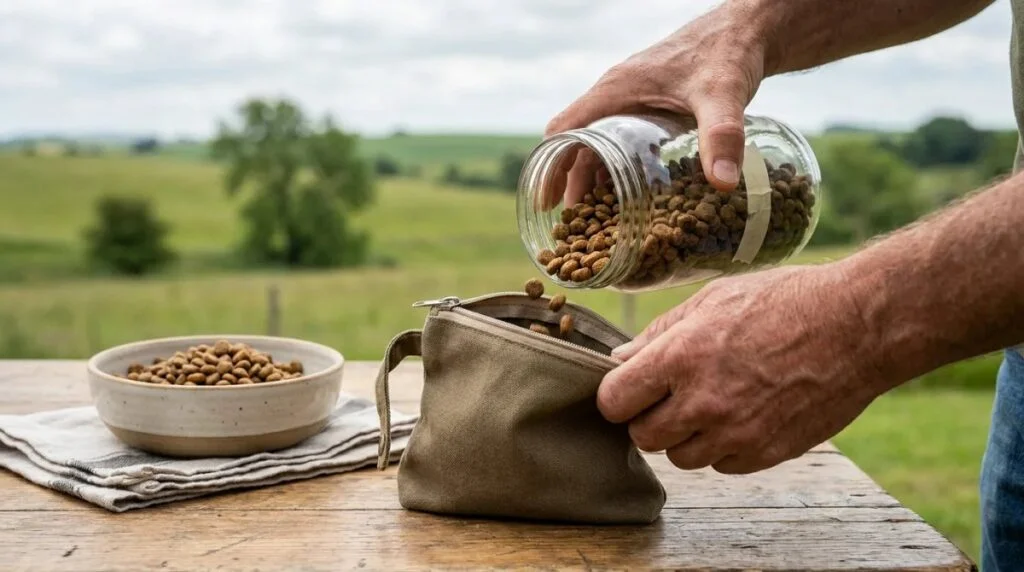
Dry food may be simple to carry in a pouch. Moist food needs a suitable delivery method and careful temperature control. Keep it refrigerated until needed and follow the product’s handling instructions. The pet-food storage guidance advises promptly refrigerating or discarding unused canned and pouched food and washing bowls and utensils.
At the end of a session, record what was actually used and include rewards from other people. For dry food, weighing the pouch before and after can help estimate the amount taken. Tell the next caregiver whether the training allocation or daily chew has already been used.
When training becomes more frequent, review the reward plan promptly. A log may show that meals are measured while treats are repeatedly replenished. Clear allocation and communication can address that gap while supporting learning.
Suspected allergies need an individual assessment
Breed identity doesn’t establish a food allergy. Recurrent itching, ear problems, or digestive signs can have several causes and deserve assessment. Choosing fish, avoiding grain, or buying a food labeled “sensitive” doesn’t provide the same answer as a controlled dietary trial. The recipes compared here aren’t treatment diets.
VCA’s food-allergy guidance explains controlled trials. If your veterinarian recommends one, record all foods, treats, chews, and supplements, including medication foods and rewards from instructors. Ask which rewards are allowed and give the same instructions to everyone handling the dog. A general reward budget tracks calories; it doesn’t decide which ingredients are permitted during a trial.
Common Jack Russell feeding questions
What foods should Jack Russells avoid?
Jack Russells share major food-toxicity risks with other dogs. Keep chocolate, grapes and raisins, alcohol, onions and garlic, and products containing xylitol out of reach. Check ingredients in training foods, spreads, and baked goods. The guide to potentially dangerous items for pets lists examples. If you suspect exposure, contact your veterinarian or an animal poison-control service promptly with the product, estimated amount, and time. Don’t wait for symptoms or attempt home treatment without guidance.
Does an energetic Jack Russell need performance food?
Not automatically. Enthusiasm, quick movements, and a desire to play don’t prove a need for a performance diet. Consider the duration and intensity of actual work, food intake, and trends in weight and body condition. A class may add rewards while involving substantial waiting; sustained demanding work is a different situation. Use the record to discuss meaningful changes with your veterinary team.
Can I prepare homemade food?
Yes, but an everyday homemade diet needs a complete formulation for the dog’s life stage and individual needs. Meat, vegetables, and rice don’t become nutritionally balanced just because the ingredients are safe. Use a properly formulated recipe from a qualified veterinary nutrition professional or a complete system with explicit preparation instructions. Weigh ingredients, include specified supplements, and avoid unapproved substitutions. The plan also needs calorie-based portions and safe storage.
Can my dog keep usual training treats during a food trial?
Only if the veterinarian directing the trial permits them. Confirm the exact reward and any food used with medication. Give instructors the approved supply and ask them to record anything else offered.
Should an older Jack Russell automatically eat less?
No. Review activity, appetite, weight, body condition, muscle condition, and health rather than making an automatic age-based reduction. Some older dogs are less active; others still follow demanding routines. A stable scale reading doesn’t show every change in muscle. Bring measured intake and recent observations to your veterinary team, especially if you notice unexplained weight loss, reduced appetite, difficulty eating, or a change in stamina. Keep counting rewards even if formal exercise becomes less frequent.
A useful feeding decision joins the food label to the dog’s real routine: measured meals, rewards, activity, storage, and changes in condition. Keep that record current, and use it to guide the next review with your veterinary team.


