Sample No. 0194
Pup Labs Review: Ingredients, Serving Directions, and Everyday Value
Compare Pup Labs’ digestive, dental, and joint supplements by checking their labels, dog-specific directions, and cost per day.
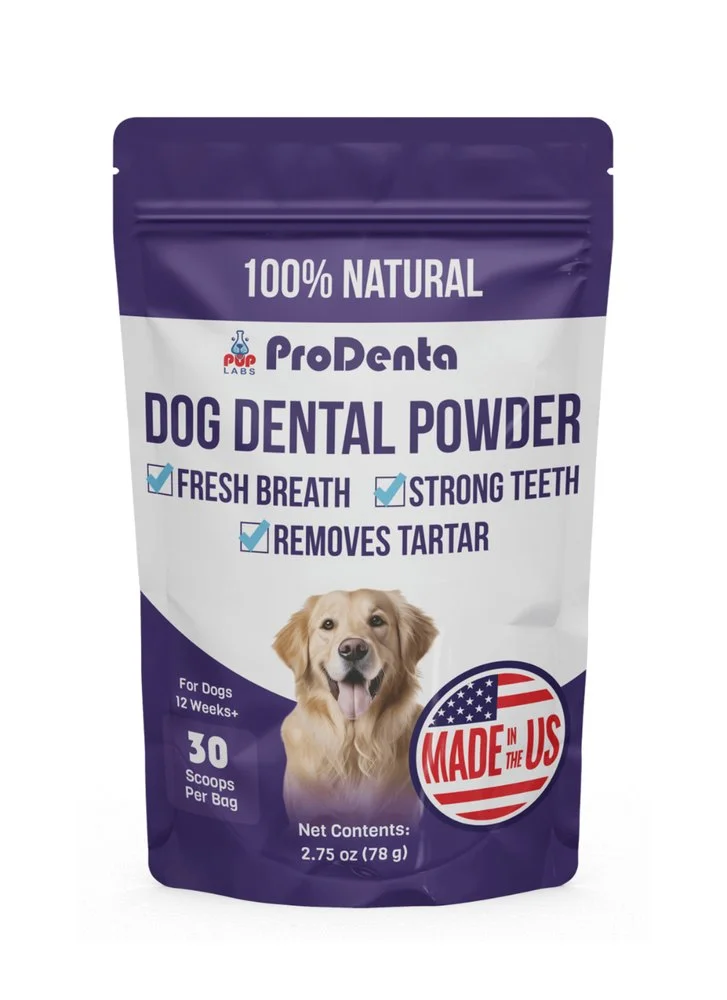
Pup Labs’ three products serve different roles and come in different forms: K9 Belly Bliss is a digestive-support powder, ProDenta is a dental powder, and Freedom Joint Drops is a liquid marketed for joint support. That variety can make it easier to fit a product into a feeding routine. The useful question is whether the formula, directions, and ongoing cost make sense for your dog.
The available product information offers some concrete details, especially for ProDenta, but the labels don’t answer every practical question. Package weight, scoop weight, bottle volume, and daily serving are different measures. Read each in context before comparing products or estimating how long a container will last.
Start with the product and its purpose
Pup Labs’ range offers more than one way to administer a supplement: K9 Belly Bliss and ProDenta are powders, while Freedom Joint Drops comes in a dropper bottle. A familiar format can help with consistency, but it doesn’t establish that a product suits a particular dog or care goal. Check the name, package, complete formula, and current directions for the item you’re considering.
The review’s overall impression of the range was positive after sample testing. That impression isn’t a measured result for every formula, and it doesn’t tell you how an individual dog will respond. Product descriptions can help identify what a supplement is intended to do; ingredient amounts and clear serving directions help you evaluate what’s in the container and how it’s meant to be used.
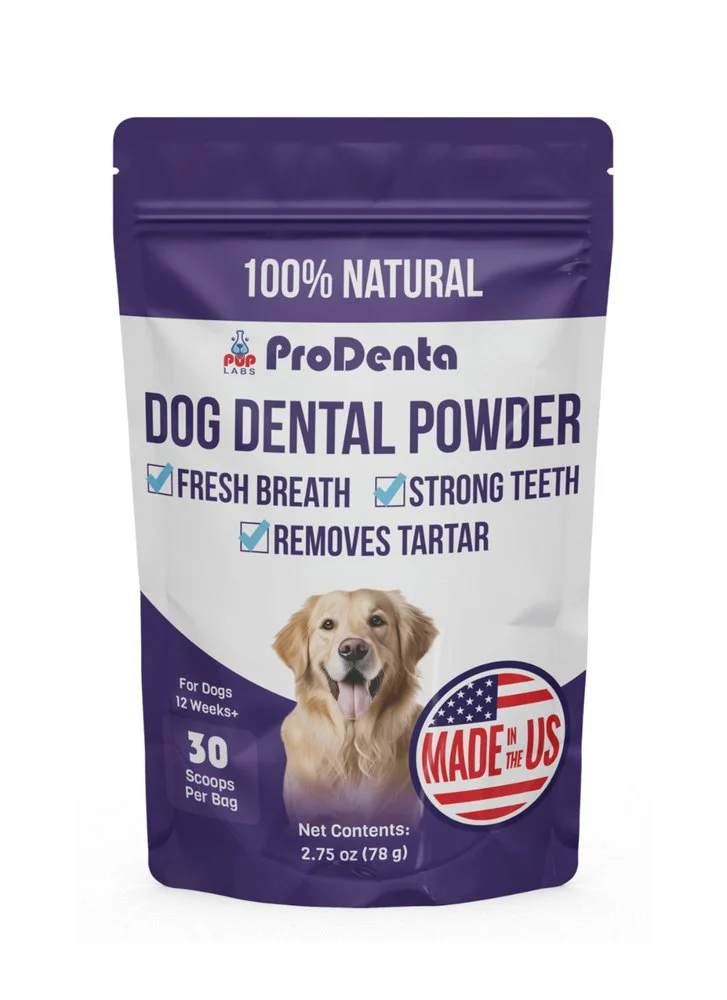
Each product has its own page on the Pup Labs site. Match reviews and product descriptions to the exact product name and package: an account of using a digestive powder can’t answer the same questions as one about a dental product. When the package and online directions appear to differ, ask the company to clarify before you decide how to use it.
K9 Belly Bliss: what the listed ingredients tell you
K9 Belly Bliss is a powder intended to be added to food for digestive support. The product page names L-glutamine, N-acetyl D-glucosamine, reishi, lion’s mane, turkey tail, and Cordyceps. These names describe the highlighted ingredients, but they don’t by themselves show the amount of each ingredient your dog would get in a serving.
The pictured package states 30 scoops and 60 g. Those are useful facts about the container and its contents; they don’t establish that every dog should receive one scoop per day or that the package will last 30 days. Follow the current package directions for your dog. If the online serving information is unclear or inconsistent with the label, ask Pup Labs to explain the intended amount and frequency.
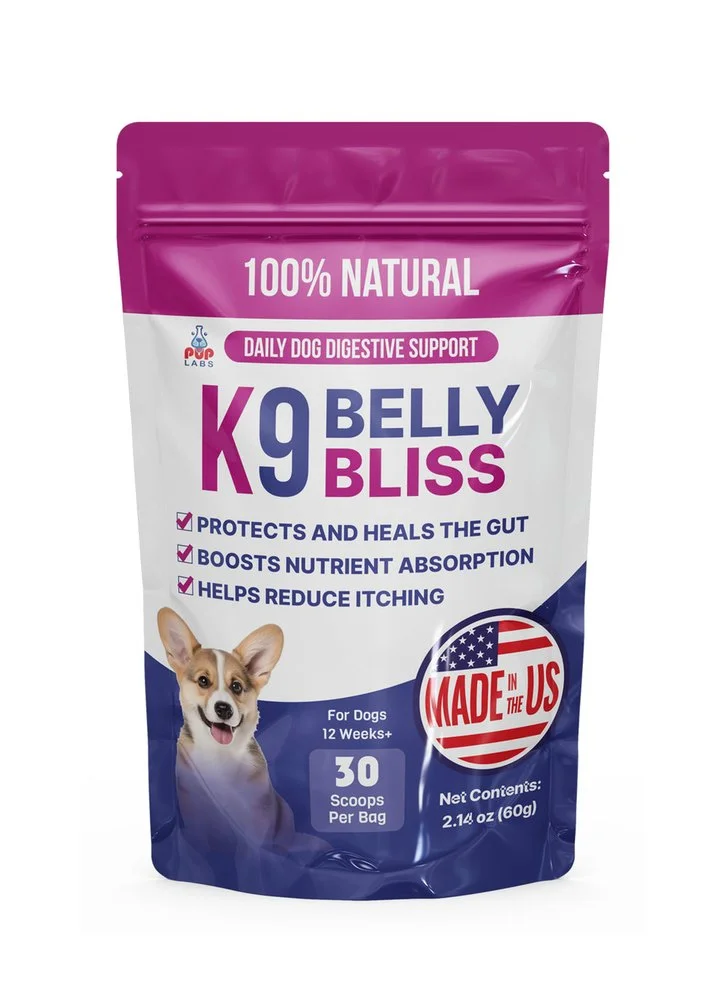
Don’t assume a digestive-support product is a probiotic. The information reviewed here doesn’t establish a formula containing live organisms with named strains and a guaranteed CFU count. Probiotics contain live microorganisms, and CFU refers to their viable count. Cornell’s probiotic guidance explains why organism identification and label guarantees matter. Assess K9 Belly Bliss using its own current formula rather than applying expectations for a different kind of digestive supplement.
ProDenta: separate scoop weight from ingredient amounts
ProDenta has a visible Product Facts panel that lists 2.56 g per scoop. It names spirulina, pumpkin seed, fennel seed, peppermint, oregano, and a proprietary flavonoid mix at 60 mg each. Whole oats are also listed in the formula.
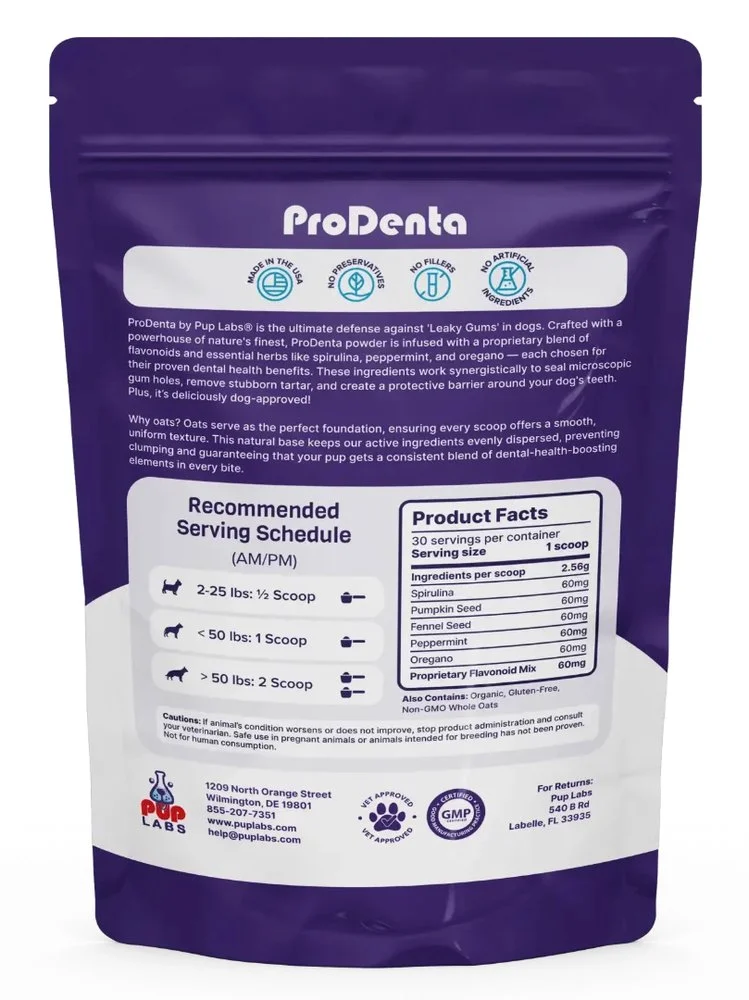
The six amounts of 60 mg add up to 360 mg. The 2.56 g figure describes the entire scoop of powder, which includes the rest of the formula as well as those listed ingredients. So the scoop’s full weight shouldn’t be mistaken for the combined weight of the six highlighted ingredients.
The distinction between a named ingredient and a blend matters, too. The label’s 60 mg for peppermint describes that ingredient. Its 60 mg for the proprietary flavonoid mix describes the mix as a whole; it doesn’t mean that every component in the mix is present at 60 mg. If you’re comparing labels or reviewing the formula with your veterinarian, keep the amount attached to exactly what it describes.
Whole oats and other ingredients beyond the highlighted list may also matter to a dog with dietary restrictions. Read the full label, not only the front of the pouch. Keep it available when you discuss a supplement with your veterinarian, particularly if you’re managing your dog’s diet closely.
The package serving schedule and the Product Facts panel answer separate questions. The panel gives a one-scoop basis for ingredient amounts; the directions describe how much to administer and how often. The pictured schedule refers to weight bands and AM/PM wording. Confirm which band applies and whether the stated amount is for each administration or for the whole day. Don’t guess if weight bands overlap or the frequency is unclear.
What dental powder can and can’t tell you
ProDenta’s meal-based powder format may suit owners who want to add a step to an existing feeding routine. The visible panel supplies specific formula amounts, which is useful when assessing what’s in a serving. Those numbers don’t, on their own, establish how well the exact product controls plaque or tartar.
Use a supplement as one part of dental care rather than as a substitute for other care. AAHA’s home oral-care guidance explains that daily brushing removes soft plaque, while hardened calculus requires a different approach. To check a claim about plaque or tartar control, look up the exact product and accepted claim on the VOHC accepted-product list. A customer’s comment about acceptance isn’t a substitute for checking the listing.
Brushing and veterinary dental care have their own roles in a dog’s routine. A powder may be convenient for a particular household, but convenience and an ingredient panel aren’t proof of a specific dental outcome. Consider whether the product fits your broader plan and whether its directions are clear enough to follow consistently.
Freedom Joint Drops: confirm the formula and serving
Freedom Joint Drops is the range’s liquid option for joint support. A dropper may suit an owner who prefers adding a liquid to food or water, as the product information allows. Follow the current instructions for the method and amount.
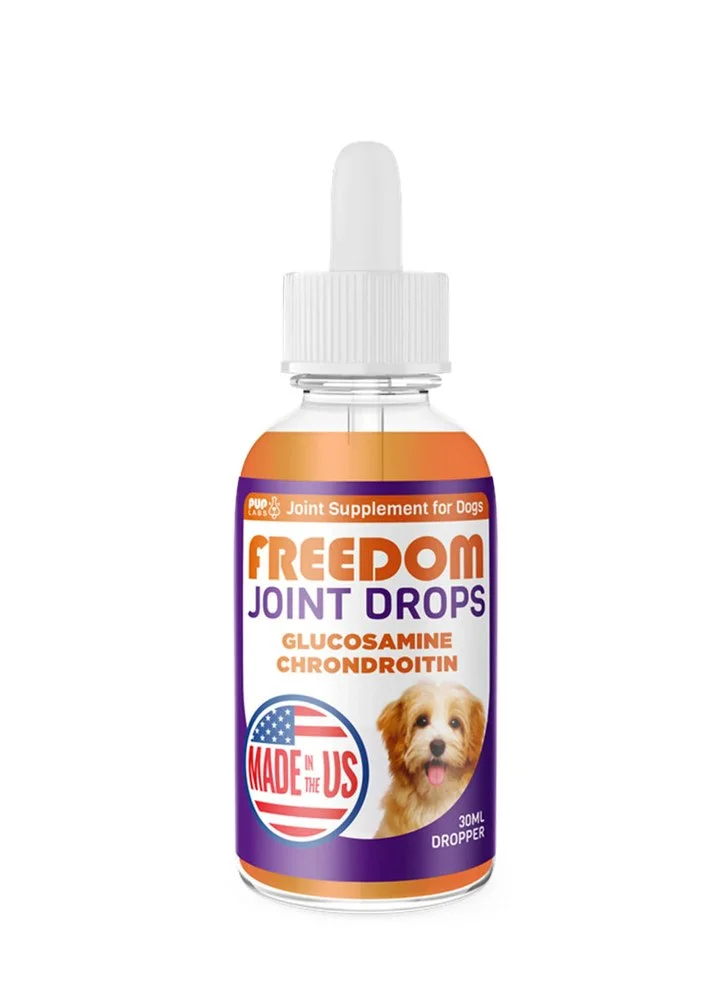
The product page highlights hyaluronic acid, a flavonoid blend, MSM, vitamin B12, and magnesium. The pictured bottle front names glucosamine and chondroitin. These descriptions come from different visible product information. Don’t combine them into an assumed complete formula or infer ingredient amounts from the bottle’s front. Check the current Product Facts panel for the package you’re considering.
The bottle is labeled 30 mL. That number gives the total liquid volume, but it doesn’t tell you the amount of an ingredient per serving, how much liquid fills the dropper, or the daily amount for your dog. Those details are needed to understand the directions and work out the cost of use.
Before calculating or starting a serving routine, confirm the current ingredient list and amounts per labeled serving, how to measure a serving with the supplied dropper, and the amount and frequency specified for your dog. If your dog takes other products or has health needs that could affect the choice, discuss the label with your veterinarian.
Customer reviews on the product page include positive reports about movement and continued use. Such accounts can show what individual owners noticed; they don’t provide a timeline or forecast for another dog. A testimonial may suggest a question to raise, but the decision should account for your dog’s full routine and the product’s current label.
For joint-related concerns, look beyond the supplement format. AAHA’s pain-management guidelines describe care and monitoring tailored to the individual animal. Vetstreet’s guide to nutrition and joint health offers more context for discussing diet alongside other care. If you notice a new problem after starting a supplement, contact your veterinarian with the product label, amount given, and timing. Don’t increase the amount or try to identify the cause on your own.
Further reading includes Petful’s owner-experience Pup Labs review, its comparison of dog dental powder and dental chews, and WebVet’s guide to prebiotics for dogs.
Calculate value from the confirmed daily amount
The package price alone can make comparisons misleading. First establish how much your dog is meant to receive each day, then use the container quantity and price to estimate days of use and cost per day. A printed scoop count isn’t automatically a count of daily servings: one dog may use a different amount or frequency from another.
Use three inputs: the price for the purchase option you’ve selected, the usable quantity in the container, and the confirmed daily amount. Keep units consistent. For a liquid, compare milliliters with milliliters; for a powder, make sure the quantity and daily amount use the same measure.
Read frequency and amount together. If directions give an amount per administration, multiply it by the number of administrations each day to find the daily total. If they already state a total daily amount, don’t multiply it again. If morning and evening wording leaves that unclear, ask the company for the total daily amount in writing. For a liquid, request the daily amount in milliliters and directions for measuring it with the supplied dropper.
| Question | Check |
|---|---|
| How long will the container last? | Divide usable container quantity by confirmed daily amount, using matching units |
| What will it cost per day? | Divide container price by the calculated number of days |
| Is a bundle lower in unit cost? | Divide the bundle total by its number of containers |
| Does the displayed price have conditions? | Check package quantity, one-time or recurring purchase, renewal timing, and shipping |
For illustration, a container costing $60 with 60 measured portions would cost $1 per day if the confirmed directions called for one portion daily. At two portions daily, the container would last 30 days, or $2 per day. These hypothetical figures demonstrate the arithmetic; they aren’t directions or prices for a Pup Labs product.
If you have more than one dog, calculate each dog’s use from their own confirmed directions. Their amounts may differ, and sharing a container doesn’t make their instructions interchangeable.
Compare the order as well as the formula
A lower unit price may be useful, but check what the purchase includes. Confirm how many packages you’ll receive, what you’ll pay now, and whether you’ve selected a one-time or recurring order. For a recurring order, check the renewal interval against your calculated use so the next delivery suits your household.
For bundles, divide the total order price by the number of containers to get the unit cost. Then apply the same daily-use calculation to each option. Include shipping consistently when comparing orders; mixing a price that includes shipping with one that doesn’t can distort the difference. Consider how much product you’re ordering and how long you expect to use it. For a first purchase, the ability to confirm that a formula suits your routine may matter alongside a lower unit price.
Questions about Pup Labs products
Is Pup Labs a company with named products?
Yes. Pup Labs has product pages for K9 Belly Bliss, Freedom Joint Drops, ProDenta, and other products. Use the product name and package to confirm you’re reading information about the item you’re considering. When label images or online descriptions differ, ask for the current formula rather than assuming they refer to the same version.
Does one scoop mean one serving for every dog?
No. ProDenta’s 2.56 g per scoop is the basis for the listed ingredient quantities. It doesn’t tell you how much a particular dog should receive each day. Use the current serving schedule, confirm the weight band and frequency, and ask whether an amount applies to each administration or to the whole day when that isn’t clear.
How do I compare a liquid dropper with a powder scoop?
Milliliters measure liquid volume; grams measure mass. Neither a scoop nor a dropper is a universal unit. To compare ongoing cost, use each product’s confirmed serving amount and the number of servings needed daily. Compare relevant ingredient quantities only when the labels provide them on a clear, matching basis.
What should I know about side effects of Freedom Joint Drops?
The information reviewed here doesn’t establish a reliable product-specific side-effect rate. Check the current label, and ask your veterinarian whether the product fits your dog’s health needs and other products. If a new problem appears after use, contact your veterinarian with the label, amount given, and timing.
Can a Pup Labs supplement replace dog food?
No. These products are presented as supplements for particular care goals; they aren’t a replacement for a complete diet appropriate for your dog. Keep your dog’s main diet in place unless your veterinarian recommends a change, and discuss supplements together when reviewing the overall feeding routine.
Pup Labs offers powders and a liquid that may suit different household routines, with some useful label details available for evaluating the formulas. The practical next step is to check the exact package, confirm how much your dog should receive, and compare the resulting cost per day. Clear directions and a routine you can follow consistently make a more useful basis for a decision than the package price or format alone.


