Sample No. 0147
False Gaboon Viper Sighting Highlights the Need to Verify Snake Reports
A reported Gaboon viper in Santa Ana was traced to an AI-generated image. The case also offers useful context on this African species.
A reported Gaboon viper in a Santa Ana, California, tree turned out not to be a wildlife discovery but an AI-generated image. The episode began on September 29, when a person reported seeing the large African viper. Santa Ana Police investigated the claim, brought in herpetology specialists, and searched the area for a snake matching the image and description. They found no evidence that a Gaboon viper was present.
The case matters for two reasons. First, a convincing image can trigger a real-world response before anyone has established that the animal exists. Second, the species involved is distinctive enough that a genuine sighting would deserve careful handling. Gaboon vipers are highly venomous, heavy-bodied snakes, and an unverified report can create unnecessary fear among neighbors while drawing people toward an animal they should never approach.
How the reported sighting was resolved
Investigators followed up with the person who submitted the report. He then acknowledged that the image had been generated with artificial intelligence and that the sighting itself was false. Online observers had already questioned the image, with some pointing out that the snake’s position in a tree did not fit the species particularly well. Still, those doubts couldn't replace a direct check of the area.
CBS News identified the person as Joel Ciprian. At the time of the report, he had not been charged. Santa Ana Police were preparing a case for the Orange County District Attorney’s Office and recommending a charge related to making a false emergency report. The report said the response consumed officer time and required reptile experts to search the neighborhood. A misdemeanor conviction could carry a sentence of up to one year in jail.
That legal process is separate from the animal-care lesson. A questionable photograph should not be treated as proof, but a potentially dangerous snake report shouldn't be dismissed casually either. The sensible response is to keep people away from the area, avoid touching or cornering any reptile, and provide the image and location details to the appropriate local service or a qualified wildlife professional.
What makes a Gaboon viper distinctive
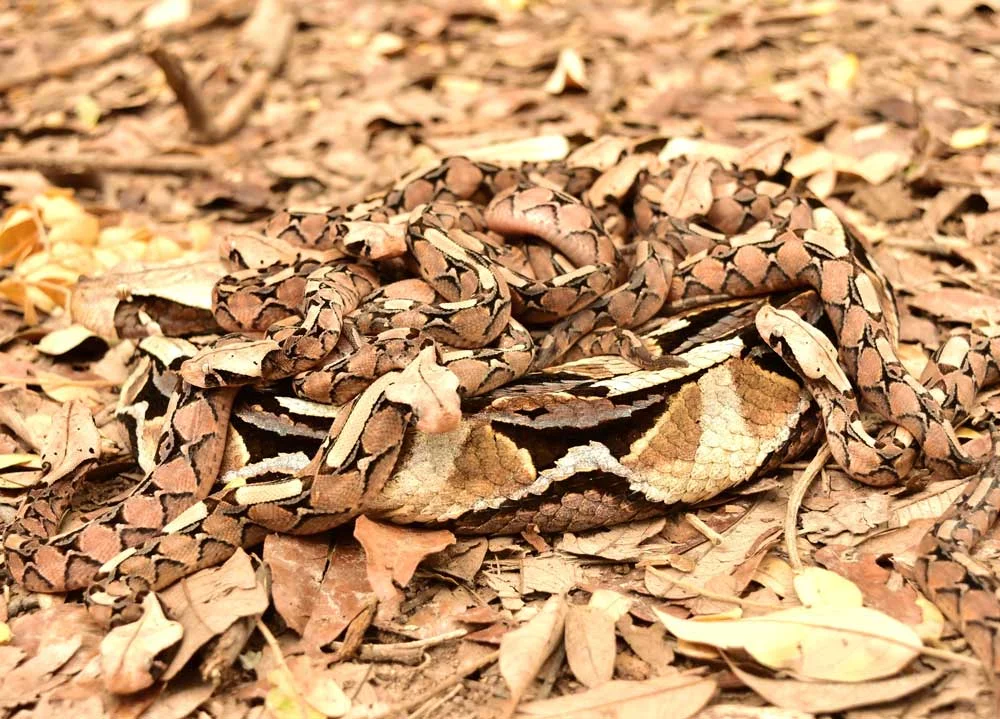
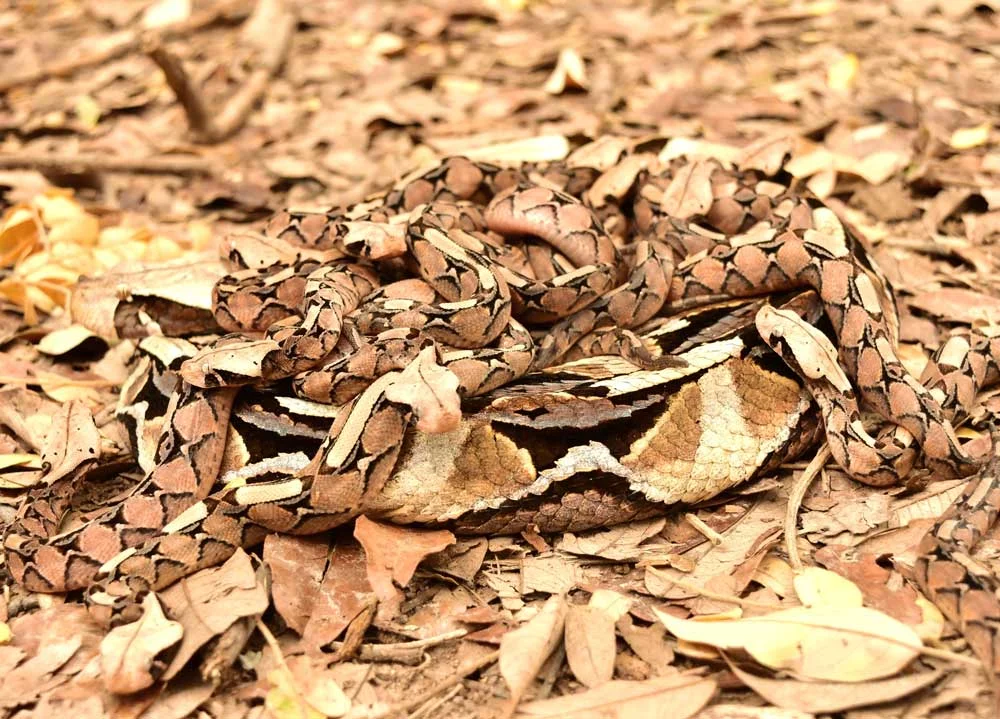
Gaboon viper and babies. Photo by Paul Lloyd/Shutterstock
Bitis gabonica is native to central, eastern, and parts of southern Africa. It is among the largest and heaviest vipers, with adults commonly reaching about four to five feet in length. Some individuals can weigh as much as 20 pounds. Its broad body, patterned scales, and large head make it visually striking, but those features also make a reliable identification important when a photograph is being assessed.
The species eats rodents and other small mammals, birds, and additional vertebrate prey. Its venom has hemotoxic and cytotoxic effects, and the snake is known for having the longest fangs of any snake. Those traits are why even experienced reptile keepers use strict separation, secure enclosures, and trained handling practices with this species.
Gaboon vipers are not regarded as especially capable tree climbers, which became one of the details questioned in the Santa Ana image. That doesn't mean a snake of this type could never be found above ground. Reptiles can move into positions that surprise observers, and a single behavior detail shouldn't decide an identification. The stronger warning sign was the combination of an unusual setting, a digitally altered image, and the lack of physical evidence in the reported area.
Better ways to assess a snake image
People who encounter a suspected venomous snake should focus on distance and documentation rather than capture. A safe photograph taken from far away, a precise location, the time of day, and a description of the animal’s movement can help a specialist assess the report. Nobody should place a hand, tool, or camera near the snake to obtain a closer view.
Image quality alone isn't proof of authenticity. Viewers can look for repeated scale patterns, distorted edges, inconsistent shadows, mismatched body parts, and background details that appear to merge into the snake. Those clues may raise questions, but they aren't a substitute for expert review. A real animal report should be supported by a plausible location, consistent observations, and—when safe to obtain—more than one independent image or witness account.
The incident also shows why sensational reptile posts need restraint. A rare snake claim can spread quickly, yet sharing an unverified image may send curious people into a neighborhood or habitat to search for an animal that may not be there. For keepers, educators, and wildlife professionals, the practical takeaway is simple: verify first, maintain distance, and treat every credible venomous-snake report with care until specialists have checked the facts.
The post Gaboon Viper Sighting In Orange County CA Deemed False appeared first on Reptiles Magazine.


