Sample No. 0109
How the Tiger Moth Bertholdia trigona Disrupts Bat Echolocation
Bertholdia trigona sends ultrasonic clicks that blur a bat’s estimate of its distance, making this moth harder to catch in flight.

Many moths evade bats by reacting to the predator’s calls. The tiger moth Bertholdia trigona adds a rarer defense: its own ultrasonic clicks can interfere with a bat’s ability to judge where the moth is. The bat may detect that prey is nearby, yet struggle to locate it precisely enough for a successful strike.
A bat’s changing sonar calls
Bats hunt insects in darkness by echolocation. They send high-frequency sounds through the nose or mouth, then use returning echoes to estimate an object’s distance, size, and movement. As a bat closes in on prey, the pattern of calls changes to provide more frequent updates.
During the search phase, many species call about 7 to 12 times per second. After detecting prey, a bat increases its call rate as it approaches, tracking the insect’s position and speed more closely. In the final terminal buzz, some species can reach 160 calls per second. That rapid stream of information helps the bat guide its last move toward the target.

Bats use echolocation to hunt at night.
©BirdHunter591/iStock via Getty Images
That shift in call pattern also gives moths clues about the danger. Quiet, drawn-out calls can signal that a bat is still some distance away. A moth may respond by flying away, a relatively low-energy choice. Louder calls suggest a closer threat, when a moth may dive or spiral toward the ground.
Clicks that warn and clicks that interfere
Some tiger moths and other moths produce ultrasonic clicks when bats approach. These sounds can serve as acoustic aposematism: a warning that the moth is toxic and may be an unpleasant meal. Bats can initially react with surprise, but the warning often loses force after they encounter it repeatedly.
B. trigona has a different advantage. Its clicks can disrupt the bat’s processing of returning echoes. The effect is often described as biological sonar jamming, and the source reports this moth as the only animal known to defend itself by jamming a bat’s sonar. In experiments, bats took longer to adapt to its jamming clicks than to the warning sounds produced by other moths.
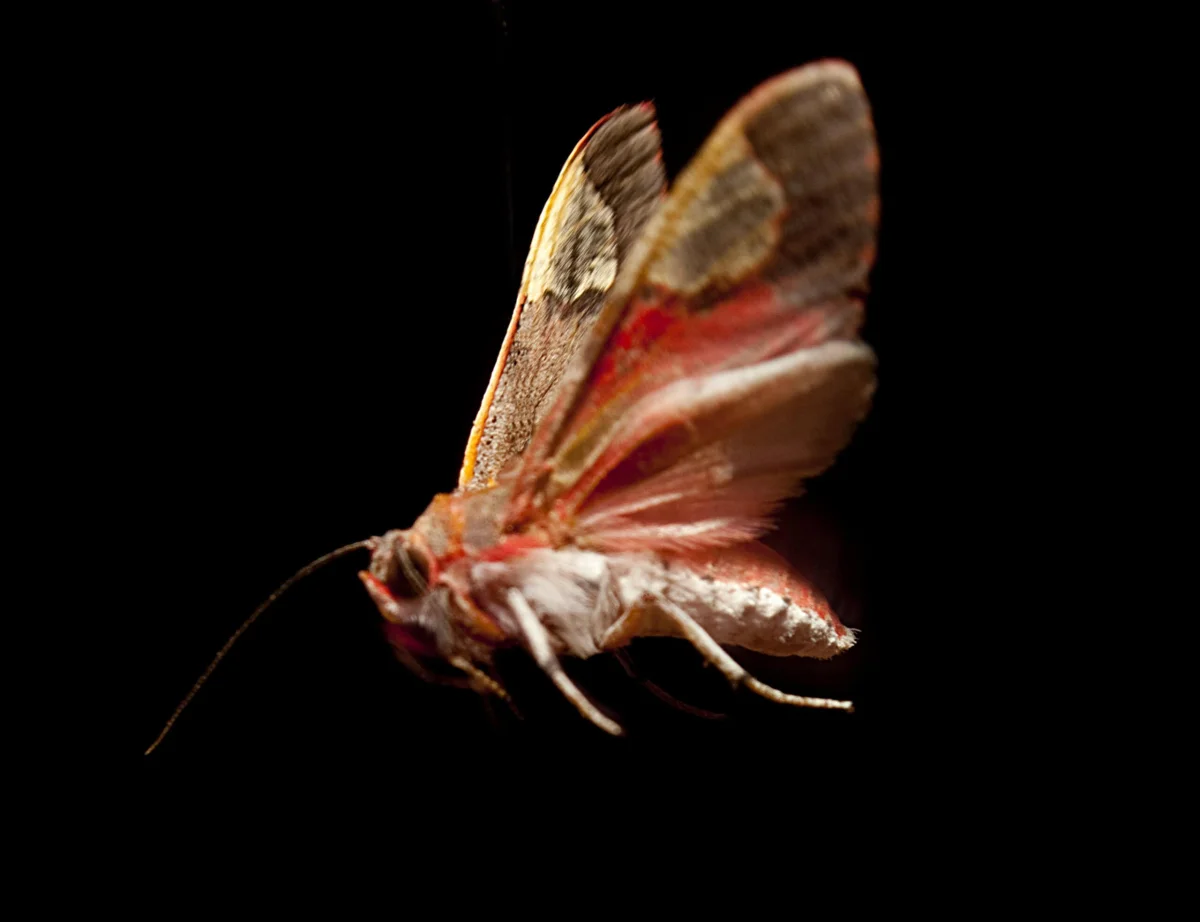
Bertholdia trigona can jam a bat’s sonic signals.
©Ajcoyote, CC BY-SA 3.0 , via Wikimedia Commons – Original / License
Researchers have proposed several explanations for how the clicks work. Experiments described in the source support ranging interference: the moth’s clicks overlap with, or arrive just before, a bat’s own calls. This can make it harder for the bat to calculate the moth’s distance accurately.
The interference doesn’t appear to erase the bat’s first sense of the moth’s position. Instead, as the bat gets closer, its estimate becomes less precise. That distinction matters during the final approach, when a small error in locating moving prey can spoil the capture attempt. A bat may know a moth is present without being able to aim accurately at it.
What the experiments suggest
Habituation—the process of becoming less responsive to a repeated sound—doesn’t seem to solve the problem for bats facing B. trigona. Even after bats had become accustomed to the clicks, the experiments found they still had difficulty catching the moths. Moths that produced more clicks were less likely to be attacked, according to the reported results.
That pattern points to a defense that works by disrupting the predator’s task, rather than simply warning it away. The clicks don’t need to make the bat abandon the hunt entirely. Making the final location estimate unreliable may be enough to give the moth a chance to escape.
Where and when to find this moth
Bertholdia trigona occurs in the southwestern United States, from Arizona to Texas, and north into mountainous areas as far as Wyoming and South Dakota. Adults are seen flying from mid-July through August. The moth has brown wings, a large pale-yellow translucent patch near the tip along the front edge, and two or three yellowish spots near the base along the inner edge.
Its defense is a useful reminder that predator and prey behavior can shape each other in highly specific ways. For B. trigona, survival may depend on timing its clicks as a bat closes in, when the predator needs the clearest possible echo to make its final move.



