Sample No. 0090
Large-Breed Adult Dog Food: Fresh, Wet and Dry Choices Compared
Compare adult food formats, recipe calories, portions, storage and costs to find a routine that fits your large dog and household.

For a large dog, choosing food is as much a practical calculation as a nutrition decision. The calorie density of a recipe affects how much goes in the bowl, while the format determines how you store and portion it. A Great Dane, Labrador, or Newfoundland may all eat an adult-maintenance diet, yet their individual calorie needs and household routines can differ widely.
Fresh, wet, and dry foods can each fit an adult dog’s plan. The useful starting points are the exact recipe’s nutritional adequacy statement, its calories, and the amount your dog needs—not a breed name or package image. JustFoodForDogs offers several fresh and shelf-stable recipes with published calorie figures, making it possible to compare meal weight and storage needs. Dry and canned alternatives provide a further point of comparison.
The examples below are based on current product information described in the source and are not results from hands-on feeding trials. Product details and prices can change, so check the package and manufacturer information when you order.
Start with the label and the individual dog
Read the nutritional adequacy statement before comparing ingredients or marketing language. It identifies the life stage for which a food is formulated to provide complete nutrition. For an adult dog, look for adult maintenance or an appropriate all-life-stages statement. The FDA’s explanation of complete-and-balanced claims describes substantiation through nutrient profiles and feeding trials using AAFCO procedures.
Then use the calorie information alongside your veterinarian’s guidance. Dogs of the same breed can differ in size, activity, body condition, and the amount of food that maintains them well. A breed-specific label cannot determine an individual serving. Measure meals and keep an eye on body condition, weight, appetite, and stool; discuss changes with your veterinarian.
For a German Shepherd, for example, the first questions are still whether the recipe suits the dog’s life stage, how many calories the individual needs, and whether the ingredients fit the household’s preferences. Chicken & Rice is a grain-inclusive fresh option, while Fish & Sweet Potato is fish-based and has a different calorie density. The breed alone doesn’t identify a winner.
Puppies need a separate check. Look for wording that supports growth, including large-size growth when the expected adult weight is at least 70 pounds. An adult feeding example is not a puppy portion plan.
- Life stage: Confirm the exact recipe is suitable for the dog’s current needs.
- Calories: Find calories per ounce, gram, cup, can, or package.
- Portion routine: Consider whether you can weigh, divide, and store the daily amount consistently.
- Handling: Check preparation, thawing, and storage instructions.
- Individual response: Track appetite, stool, weight, and body condition, and consult your veterinarian when concerns arise.
A complete fresh recipe doesn’t need the words “large breed” in its name to merit consideration for a healthy adult. The right decision depends on the life-stage statement, calories, and fit for the dog and household.
Four fresh and shelf-stable recipes compared
Fresh cooked meals are moist and generally require freezer planning. Shelf-stable wet food can be stored in the pantry unopened, then refrigerated as directed once opened. Kibble is straightforward to store and measure, but still needs a life-stage and calorie check.
The following JustFoodForDogs figures are rounded manufacturer calories per ounce. Use the current label for precise calculations and serving instructions.
| Recipe | Potential practical fit | Life stage | Calories per ounce | Storage note |
|---|---|---|---|---|
| Chicken & Rice | Everyday fresh meal with chicken and rice | All life stages, including large-size growth | 43 | Fresh Frozen; plan freezer space and thawing |
| Turkey & Whole Wheat Macaroni | More calories per ounce among these recipes | Adult maintenance | 49 | Fresh Frozen; contains wheat |
| Fish & Sweet Potato | Fish-based meal with a larger portion per calorie | All life stages, including large-size growth | 26 | Fresh Frozen; more ounces for the same calories |
| JustFresh Home-Cooked Chicken | Adult meal that is shelf-stable before opening | Adult maintenance | 36 | Refrigerate after opening; use within three days |

Chicken & Rice: a familiar fresh meal
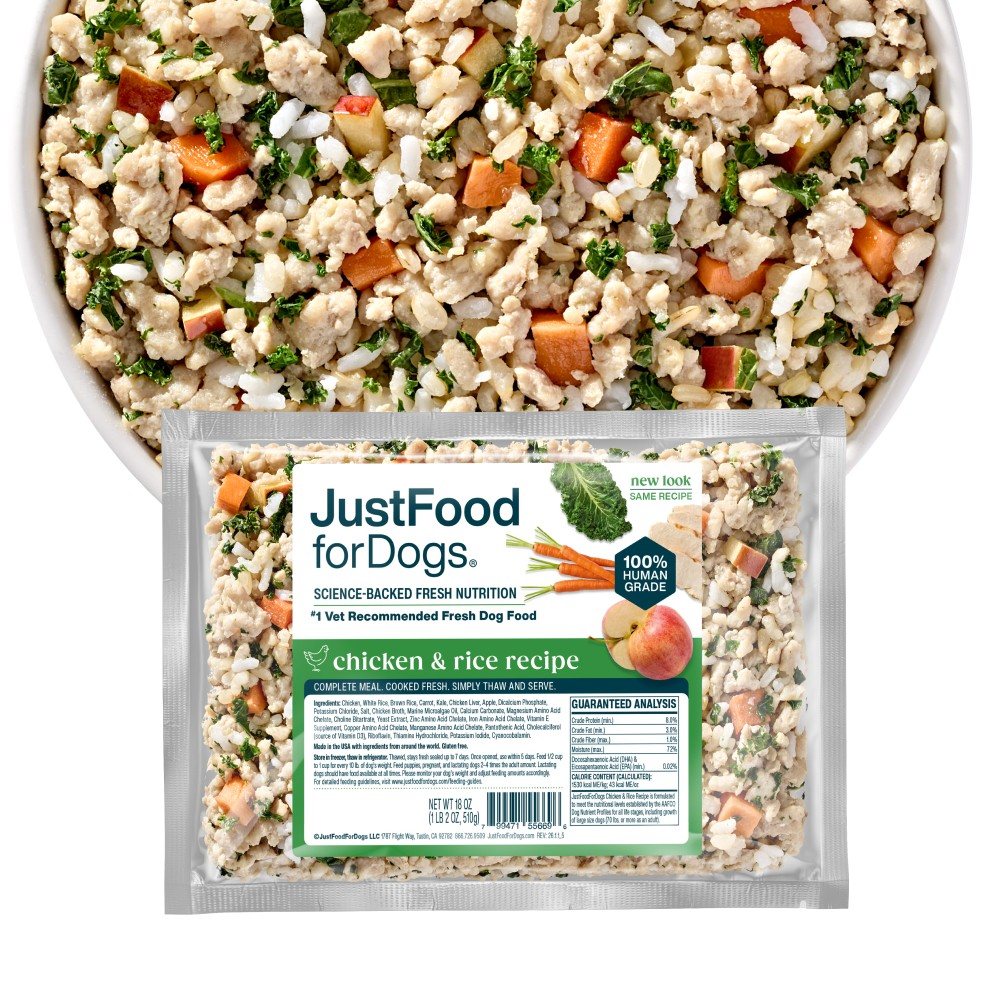
JustFoodForDogs Chicken & Rice combines chicken thighs and liver with white and brown rice, kale, carrots, apples, oils, and a nutrient blend. Its label states that it meets nutritional levels for all life stages, including growth of large-size dogs expected to weigh at least 70 pounds as adults.
That broad life-stage statement doesn’t mean an adult should eat a puppy-sized portion. It means the recipe’s stated suitability extends beyond adult maintenance; the amount still needs to match the dog.
- A familiar chicken-and-rice fresh option.
- About 43 calories per ounce, useful for calculating a weighed serving.
- An all-life-stages statement that may be relevant in a household with dogs of different ages, though each needs an appropriate portion.
Freezer capacity deserves attention before ordering a large supply. Build a repeatable routine around the package directions: thaw the next meal in time, measure the portion consistently, and store the rest as instructed.
Turkey & Whole Wheat Macaroni: a denser adult portion
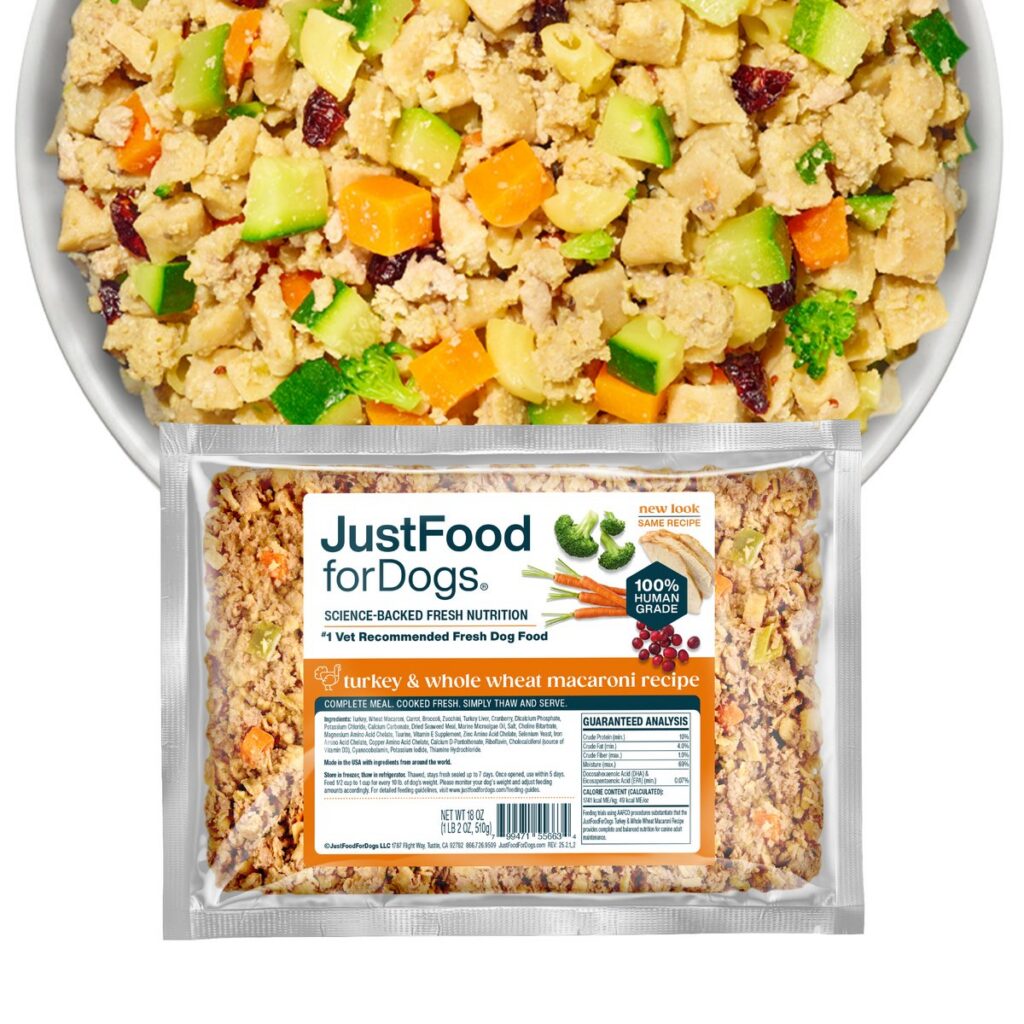
JustFoodForDogs Turkey & Whole Wheat Macaroni supplies about 49 calories per ounce, the highest calorie density of the four recipes compared here. For an equal calorie target, it takes less food by weight than the other fresh options in this group.
The recipe includes turkey, turkey liver, whole wheat macaroni, broccoli, zucchini, carrots, and cranberries. Its current adequacy statement is for adult maintenance, established through feeding trials using AAFCO procedures. Keep that distinction in mind if a puppy also lives in the home.
- A turkey-based choice for an adult dog that does well with its ingredients.
- A smaller food weight for the same calories than the other fresh recipes listed here.
- A clear adult-maintenance designation.
Higher calorie density isn’t automatically an advantage. Switching ounce-for-ounce from a less calorie-dense food could raise the daily calorie total. Recalculate the serving when changing recipes. This food contains wheat, so it isn’t grain-free, and its ingredient list alone can’t establish that it suits a dog with a diagnosed sensitivity.
Fish & Sweet Potato: a lower-calorie-per-ounce choice
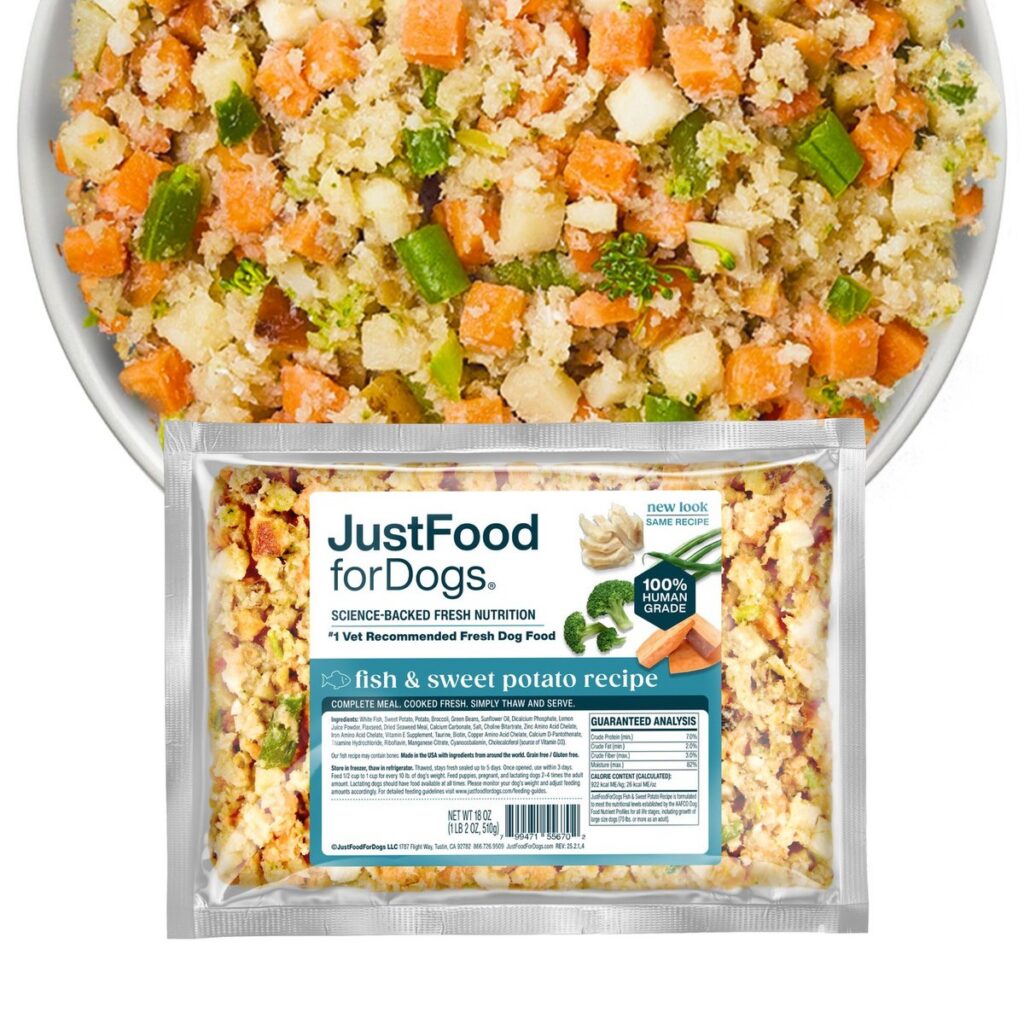
JustFoodForDogs Fish & Sweet Potato combines white fish with sweet potatoes, russet potatoes, green beans, broccoli, oils, and a nutrient blend. At about 26 calories per ounce, it provides fewer calories per ounce than Chicken & Rice or Turkey & Whole Wheat Macaroni.
For the same calorie target, the fish recipe requires more food by weight. Some households may prefer that serving size; others may find it harder to store and portion. Its lower calorie figure isn’t a weight-loss prescription and shouldn’t prompt an unsupervised reduction in a dog’s daily calories.
- A fish-based option in the fresh range.
- An all-life-stages statement that includes large-size growth.
- A distinct calorie density that makes portion size easy to compare.
The recipe is grain-free, which describes its formulation; it doesn’t establish an advantage over grain-inclusive food or make the recipe universally suitable for food allergies. Choose based on the verified formulation and serving plan, not on a category label alone.
JustFresh Home-Cooked Chicken: pantry storage before opening
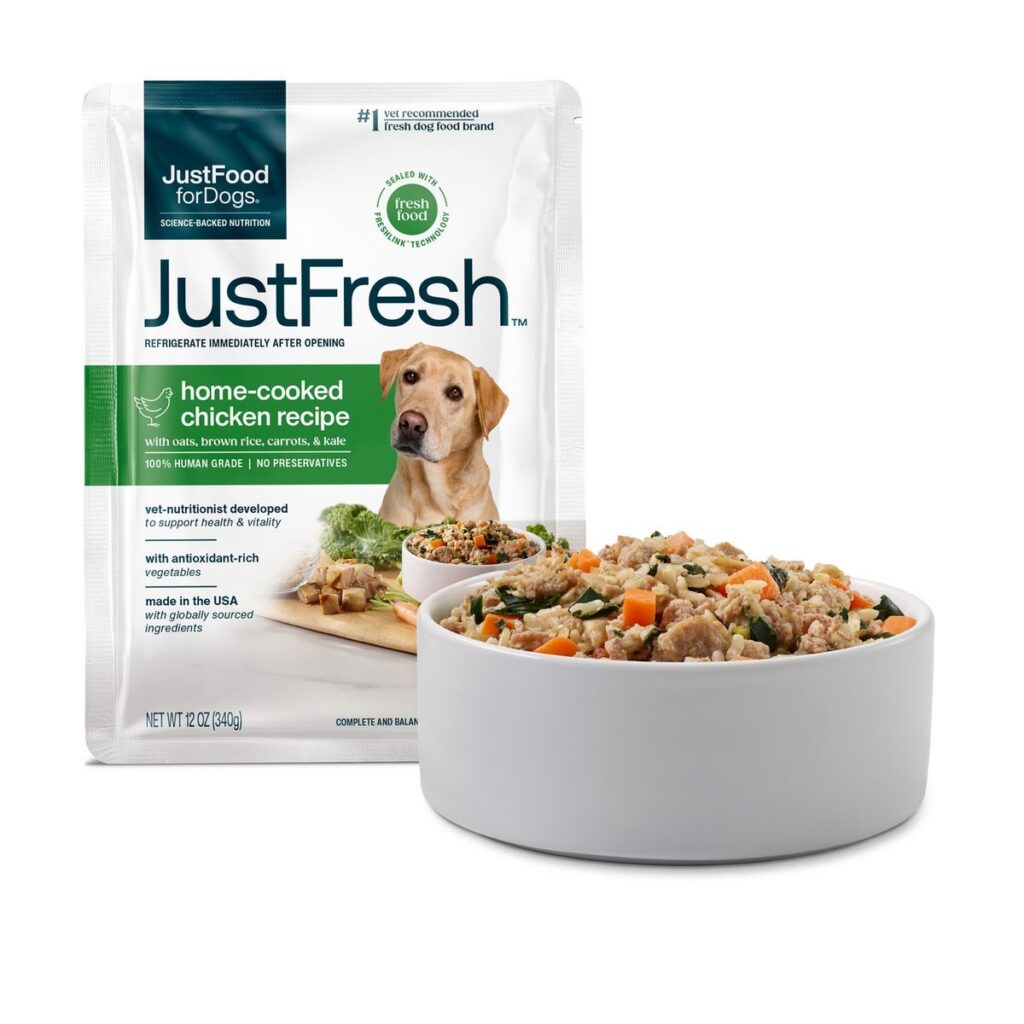
JustFoodForDogs JustFresh Home-Cooked Chicken may suit a household where freezer space is the main barrier to serving a moist meal. It’s shelf-stable unopened, has about 36 calories per ounce, and is labeled for adult maintenance.
Its ingredients include chicken thighs and liver, oats, brown rice, carrots, kale, oils, potato starch, and a nutrient blend. Once opened, the food needs refrigeration and should be used within three days under the current instructions.
- Unopened packs don’t require freezer space.
- A possible pantry backup for an adult dog’s meal routine.
- Calorie information supports calculations for full meals or a measured mixed plan.
Check the full product name. JustFresh and PantryFresh are separate lines, and their life-stage statements and opened-storage directions may differ. The adult-maintenance JustFresh Chicken described here isn’t a puppy food simply because it contains chicken.
Related breed guides apply the same label-first approach to Great Danes, Bernese Mountain Dogs, and Great Pyrenees, including the portion and storage demands common in giant dogs.
Dry and canned alternatives
Hill’s Science Diet Adult Large Breed Chicken & Barley is a dry adult-maintenance option. The current manufacturer page lists 365 kcal per cup and 3,675 kcal/kg. In a hypothetical plan assigning 1,200 calories to the food, that works out to about 3.29 cups, or 327 grams. Its concentrated format is convenient to store, and the manufacturer doesn’t intend this adult recipe for large-breed puppies.
Purina Pro Plan Complete Essentials Chicken & Rice Entrée Classic is a canned adult-maintenance pâté with 437 kcal per 13-ounce can. The same hypothetical calorie allowance would require about 2.75 cans per day. Cans may suit a household that prefers moist food without frozen packs.
For comparison, the 1,200-calorie example would require about 27.9 ounces of JFFD Chicken & Rice or 24.5 ounces of Turkey & Whole Wheat Macaroni. These examples show the different portions associated with fresh, dry, and canned formats; they aren’t recommendations for a particular dog.
Assessing dry food
Dry food can work well when storage, transport, or measured kibble fits the household. JustFoodForDogs doesn’t make dry kibble, so evaluate any dry recipe as its own food, whether it’s the main meal or part of a mixed plan.
- Large-breed adult formula: Check adult-maintenance wording, calories, feeding directions, and whether the kibble size works for your dog. The size phrase is useful context, not a replacement for those checks.
- All-size adult formula: This may also suit a healthy large adult if it’s complete and balanced and its calories, texture, and serving work for that individual.
Compare cost based on the calories your dog eats, not just the price of a bag. A lower shelf price doesn’t necessarily mean a lower daily cost if the serving differs. And protein percentages on dry food can’t be compared directly with those on moist food without accounting for moisture. The FDA’s food-comparison explanation outlines why an as-fed comparison can mislead.
Look for the right life-stage statement, calorie information, manageable texture, and a manufacturer able to answer questions about its food. Vetstreet’s dog food guide offers a broader starting point for exploring brands; no single option is right for every large dog.
Calculate portions and daily cost
Calorie density can create a large difference in food weight. Compare recipes at the same calorie target before judging which serving is larger, easier to store, or less expensive.
The table uses a hypothetical allowance of 1,200 calories per day from the main food. It’s a math example, not guidance for a specific breed or dog. Your dog may need a different amount, and treats or extras belong in the overall plan.
| Recipe | Calories per ounce | Ounces per day at 1,200 calories | Approximate ounces per meal if fed twice daily |
|---|---|---|---|
| Chicken & Rice | 43 | 27.9 | 14.0 |
| Turkey & Whole Wheat Macaroni | 49 | 24.5 | 12.2 |
| Fish & Sweet Potato | 26 | 46.2 | 23.1 |
| JustFresh Home-Cooked Chicken | 36 | 33.3 | 16.7 |
Use this calculation: daily calories assigned to the food ÷ calories per ounce = ounces per day. The table uses rounded figures, so use the current package and more precise calorie information when calculating a specific serving.

In this example, Fish & Sweet Potato takes about 21.7 more ounces a day than Turkey & Whole Wheat Macaroni to provide the same calories. That’s a difference in energy density, not evidence that one recipe is better. It affects what you carry, thaw, store, and serve. For a household feeding two large dogs, those practical details can matter as much as protein preference.
To compare daily costs, use the current price you would actually pay:
- Divide the package price by its net weight in ounces to find price per ounce.
- Multiply that figure by the ounces your dog needs from that recipe each day.
- Include applicable shipping and compare equivalent purchase terms.
- Separate a first-order discount from the price you’ll pay on later orders.
On September 28, 2026, the regular prices displayed were $153.99 for fourteen 18-ounce packs of Chicken & Rice and $167.99 for fourteen 18-ounce packs of Fish & Sweet Potato. Each order contains 252 ounces, but the recipes supply different calories per ounce.
| Recipe | Observed regular price per ounce | Daily cost at the example’s 1,200 calories | Approximate days in a 252-ounce order |
|---|---|---|---|
| Chicken & Rice | $0.61 | $17.05 | 9.0 |
| Fish & Sweet Potato | $0.67 | $30.77 | 5.5 |
These examples exclude tax and shipping and use rounded calorie values; prices may change. In this pair, Chicken & Rice provides the example calories at a lower daily cost, while Fish & Sweet Potato offers a different protein and larger serving weight. This comparison doesn’t establish which food costs least across brands and formats.
Make mixed feeding a measured plan
A fresh-and-dry routine can include both formats, but decide how many calories come from each food. Replacing part of a meal differs from adding another meal on top of the existing amount.
With the same hypothetical 1,200-calorie daily allowance, a half-and-half calorie split assigns 600 calories to each food. That doesn’t mean equal cups or ounces. Chicken & Rice would provide its half in about 14 ounces using the rounded 43-calorie-per-ounce figure. Calculate the kibble amount from its own label. At the observed regular price above, that fresh portion costs about $8.53 per day; add the cost of the dry portion to compare the whole plan.
- Measure each food separately.
- Confirm both foods suit the dog’s life stage.
- Include treats and extras in the total.
- Recalculate if either recipe or the calorie split changes.
The WSAVA nutrition resources offer tools for discussing feeding and body condition with your veterinary team. That conversation is particularly useful if your dog’s weight changes or its activity no longer matches its usual routine.
Storage is part of the feeding plan
Work from the daily portion to estimate how much food you need for the period between orders. For Fresh Frozen recipes, check both the order’s total weight and the packs’ dimensions against your usable freezer space. For shelf-stable meals, plan how many packs you’ll open and follow the refrigeration directions afterward.
A frozen meal may be easy to manage if you can thaw the next serving in time. A pantry option may help when freezer space is tight. Start with an order size you can store comfortably while establishing a new routine; a theoretically convenient product is only useful if the household can handle it consistently.
Puppies and senior dogs need individual checks
Choosing food for a large-breed puppy is a separate task from selecting an adult meal. A puppy needs a food appropriate for growth, and wording for large-size growth matters. Adult maintenance alone doesn’t establish puppy suitability, even if the puppy is already larger than many adult dogs.
Chicken & Rice and Fish & Sweet Potato have current all-life-stages statements that include large-size growth. Turkey & Whole Wheat Macaroni and JustFresh Home-Cooked Chicken are adult-maintenance recipes. The difference shows why it’s important to check the exact product rather than assume every recipe from one brand has the same life-stage coverage. For puppy guidance, see Vetstreet’s large-breed puppy food guide and consult your veterinarian.
Activity also affects feeding calculations. Petful’s guides to Dobermans and Cane Corsos discuss activity-level considerations for those breeds.
For an older large dog, reassess the plan as appetite, activity, or body condition changes. Age by itself doesn’t mean every dog needs the same calories, texture, or portion. Don’t automatically cut food or switch recipes solely because a product has a senior label. A dog that eats its complete adult food comfortably may continue with a suitable routine, whether that’s moist food or kibble. For more on this life stage, see Vetstreet’s senior dog food guide. Existing health concerns call for advice tailored to that dog.

Common questions about large-dog food
What is the healthiest food for a large dog?
There isn’t one recipe that suits every large dog. Look for complete nutrition for the right life stage, a suitable calorie allowance, and a routine the household can maintain. Manufacturer details, your dog’s response, and veterinary guidance are more useful than a protein number or appealing ingredient image. Check the formulation, ingredients, calorie density, and handling directions, and ask the manufacturer questions when details are unclear.
What is the best food for an adult large dog?
The right fit could be fresh, canned, dry, or a measured combination. Chicken & Rice is a fresh starting point; Turkey & Whole Wheat Macaroni is a more calorie-dense adult option; JustFresh Chicken offers pantry storage before opening. Your dog’s needs and your household routine determine which is most workable.
What foods should large dogs avoid?
A large body doesn’t make unsafe household foods appropriate. Vetstreet’s guide to foods you should not share with a dog covers that separate safety question. Treats, snacks, and toppers also shouldn’t be treated as a replacement for a complete main meal unless their nutritional statement supports that use.
Can I combine fresh food and large-breed kibble?
Yes, if each food suits the adult dog and both portions fit a single calorie plan. In the 1,200-calorie illustration, a half-fresh plan assigns 600 calories to each food. Work out each amount from its own label; equal volumes don’t necessarily provide equal calories.
Does an adult large dog need a food labeled for large breeds?
The complete adult-maintenance statement and suitability for the individual matter more than a size phrase on the package. An all-size adult recipe may be appropriate for a healthy large dog. Puppy growth is different, so don’t use this adult comparison to choose food for a growing dog.
Which featured recipes don’t list chicken?
The current ingredient lists for Fish & Sweet Potato and Turkey & Whole Wheat Macaroni don’t list chicken. Recheck the package when ordering. Ingredient lists aren’t a cross-contact guarantee or a substitute for a veterinary plan when a food reaction is suspected.
What if my large dog is picky?
Notice whether the dog avoids the food, struggles with the texture, or fills up on extras. Moist food has a different texture from kibble, and Chicken & Rice is one fresh option to compare. Change one planned part of the routine at a time, and measure what the dog actually eats rather than repeatedly adding toppers. No recipe is guaranteed to appeal to every dog. A sudden appetite change, repeated refusal, or difficulty eating warrants veterinary advice.
How much freezer space will fresh meals take?
Estimate the order’s weight from the daily serving, then check pack dimensions against your available space. In the example above, fourteen 18-ounce Chicken & Rice packs cover about nine days of main meals. More dogs or a longer period between orders changes the calculation. If freezer space is the limiting factor, consider a smaller frozen order, measured mixed feeding, or an eligible shelf-stable adult food such as JustFresh Chicken.
Choose a routine you can maintain
For an adult large dog, start with complete nutrition and then work out the portion, cost, and storage plan. Chicken & Rice offers a familiar fresh meal; Turkey & Whole Wheat Macaroni supplies more calories per ounce among the featured fresh recipes; Fish & Sweet Potato is a fish-based alternative; and JustFresh Chicken can be stored in the pantry unopened.
Compare those choices with the dry or canned routine that fits your home. Use the current label, calculate the amount your dog actually needs, and reassess the plan when the dog’s condition or activity changes. That approach is more useful than choosing by breed-size wording or package price alone.


