Sample No. 0084
Rottweiler Food Guide: Puppy Growth, Adult Portions and Fresh Meal Costs
Compare growth-suitable puppy recipes and adult meals, then use calorie density, storage needs and daily cost to plan portions that fit your Rottweiler.

For Rottweilers, the first food decision isn’t about flavor or package size: it’s whether the exact recipe is suitable for the dog’s life stage. A puppy needs food whose nutritional adequacy statement covers growth, including growth of large-size dogs when applicable. After that, calorie density, daily portions, storage and cost help determine whether a food will work in your home.
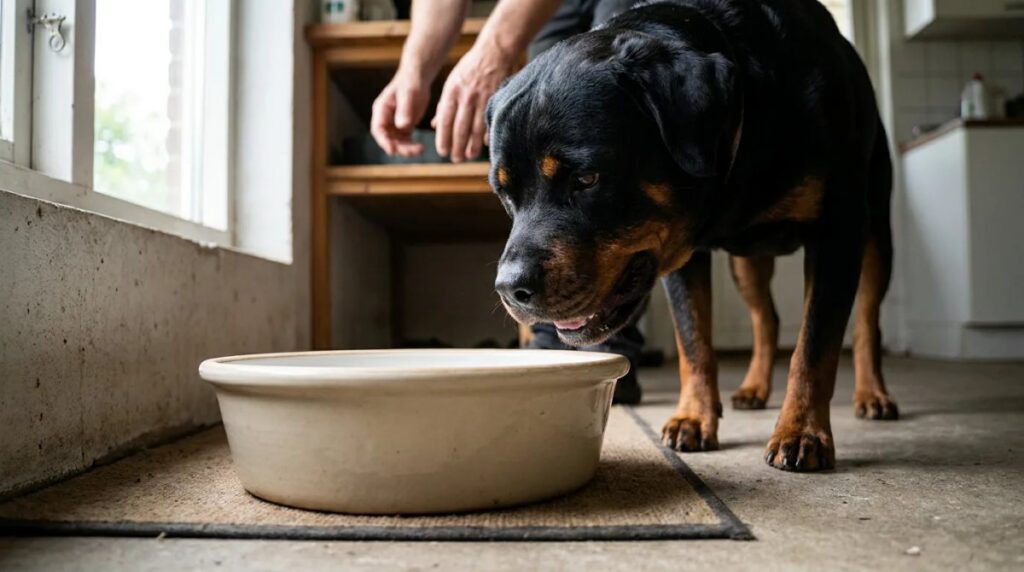
This guide compares four JustFoodForDogs recipes: two whose current labels include large-size growth and two formulated for adult maintenance. It also shows how to turn calorie information into a repeatable serving and a realistic cost estimate. The figures describe label-based comparisons, not the result of a feeding trial or a promise about growth, health or body shape.
Start with the nutritional adequacy statement
The adequacy statement identifies the life stage for which a food is complete and balanced. A product image, breed-focused label or phrase such as “all life stages” isn’t enough by itself: read the full statement on the exact recipe. The FDA’s explanation of complete and balanced pet food describes how growth and adult maintenance differ.
For a puppy expected to weigh 70 pounds or more as an adult, check whether the statement specifically includes growth of large-size dogs. The two growth-suitable recipes in this guide, Chicken & Rice and Fish & Sweet Potato, currently carry that wording. Turkey & Whole Wheat Macaroni and JustFresh Home-Cooked Chicken are adult-maintenance foods, so they aren’t the puppy choices here.
For an adult, a suitable adult-maintenance recipe may be considered alongside the dog’s individual needs. In either case, check that the product is intended as a complete everyday meal, then compare its calories and handling requirements. A useful shortlist answers five questions:
- Is the recipe a complete meal rather than a topper or treat?
- Does the full life-stage statement fit the dog?
- How many calories does a gram or ounce provide?
- What daily amount fits the individual feeding plan?
- Can the household store, prepare and purchase it consistently?
The practical starting point: Chicken & Rice is the grain-inclusive fresh option to compare first if you want a recipe whose current statement includes large-size growth. Fish & Sweet Potato offers a fish-based alternative with the same broad life-stage eligibility. For adults, Turkey & Whole Wheat Macaroni provides more calories per gram, while JustFresh Chicken offers unopened pantry storage.
Those are different useful fits, not a single best choice for every Rottweiler. A growing puppy, a quiet adult and a more active adult may need different daily amounts. If your veterinarian has given you a feeding plan, follow that individualized guidance rather than substituting a general food comparison.
Compare the four recipes
Calories per kilogram make it easier to compare energy density, while life-stage statements keep puppy and adult options distinct. Storage matters too: frozen fresh food and unopened shelf-stable food require different routines.
| Recipe | Why compare it | Current life-stage statement | Calories per kilogram | Storage |
|---|---|---|---|---|
| Chicken & Rice | Grain-inclusive fresh recipe | All life stages, including large-size growth | 1,530 | Fresh frozen |
| Fish & Sweet Potato | Fish-based fresh alternative | All life stages, including large-size growth | 922 | Fresh frozen |
| Turkey & Whole Wheat Macaroni | More calories in less food weight | Adult maintenance | 1,741 | Fresh frozen |
| JustFresh Home-Cooked Chicken | Unopened pantry convenience | Adult maintenance | 1,254 | Shelf-stable before opening |
Fresh options for puppies and adults
Chicken & Rice: a flexible grain-inclusive recipe
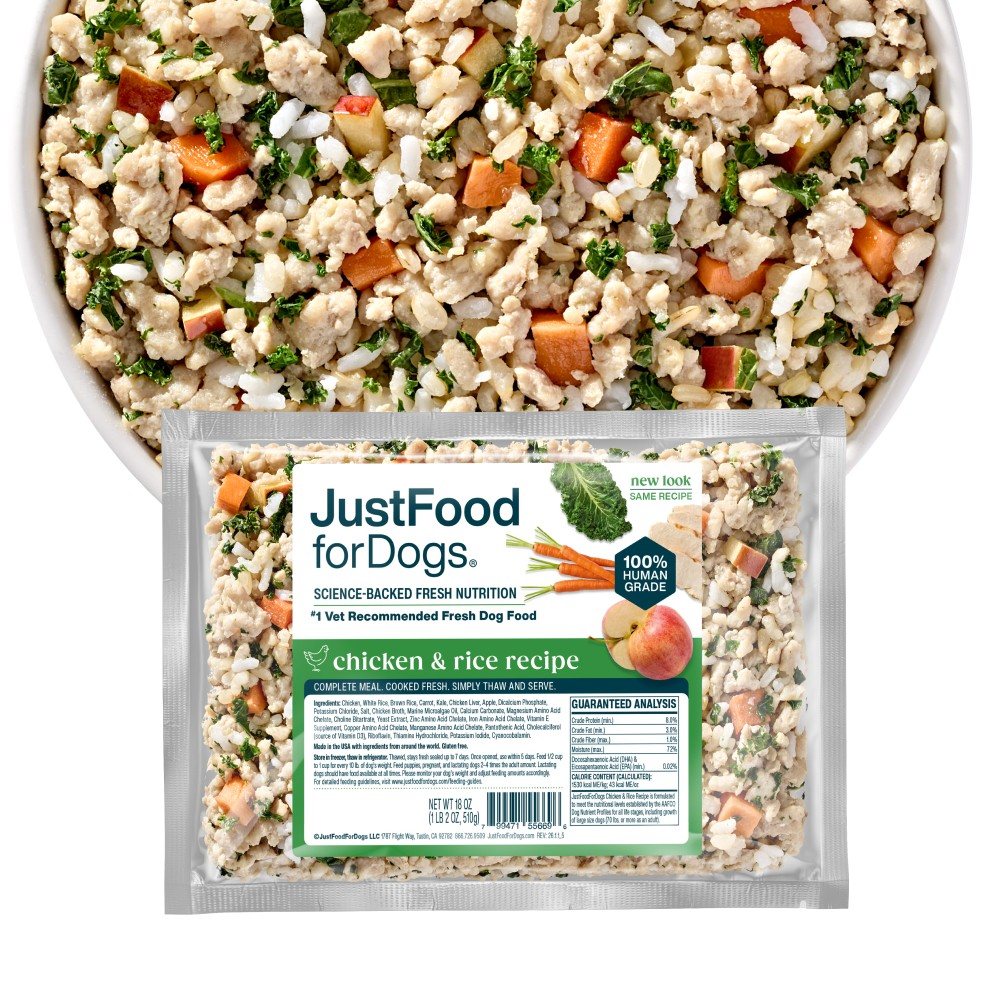
Chicken & Rice includes chicken thighs and liver, white and brown rice, vegetables, fruit, oils and a nutrient blend. Its current all-life-stages statement includes growth of large-size dogs, making it the first recipe here to consider for a Rottweiler puppy as well as an adult.
At 1,530 kcal/kg, it provides 1.530 calories per gram. That puts its energy density between the fish and turkey recipes in this comparison. The amount to serve still depends on the dog’s feeding plan; a standard scoop or bowl isn’t a reliable substitute for a measured portion.
This can suit households that want a complete grain-inclusive fresh meal and have freezer space. Work out how much food you’ll use before ordering, and follow the package’s thawing and storage directions. If a puppy and adult both eat it, write down each dog’s portion separately. Sharing a recipe doesn’t mean sharing a serving size.
Fish & Sweet Potato: a fish-based growth-suitable option
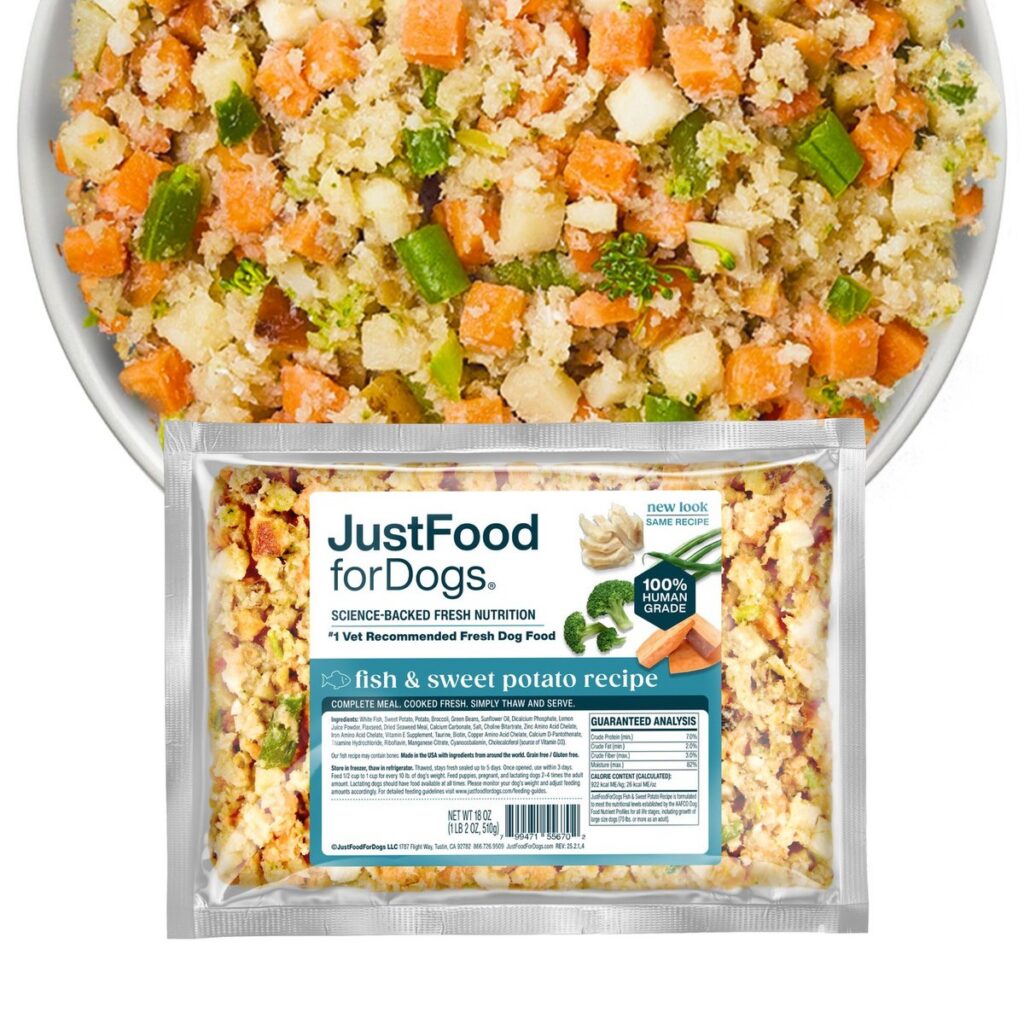
Fish & Sweet Potato combines white fish with sweet potatoes, russet potatoes, green beans, broccoli, oils and a nutrient blend. Its current statement also includes all life stages, including growth of large-size dogs. It’s the fish-based alternative among the two growth-suitable meals in this comparison.
The recipe supplies 922 kcal/kg, or 0.922 calories per gram. For the same calorie allocation, a dog will eat more of it by weight than Chicken & Rice or Turkey & Whole Wheat Macaroni. That difference affects the size of each serving, how quickly a package is used and how much storage space the food occupies.
The recipe is grain-free, which describes its ingredients; it doesn’t establish that Rottweilers generally need to avoid grains. If you’re considering a fish recipe because of a suspected food allergy, ask your veterinary team for individual guidance rather than treating an ingredient preference as a diagnosis.
Turkey & Whole Wheat Macaroni: a more compact adult serving
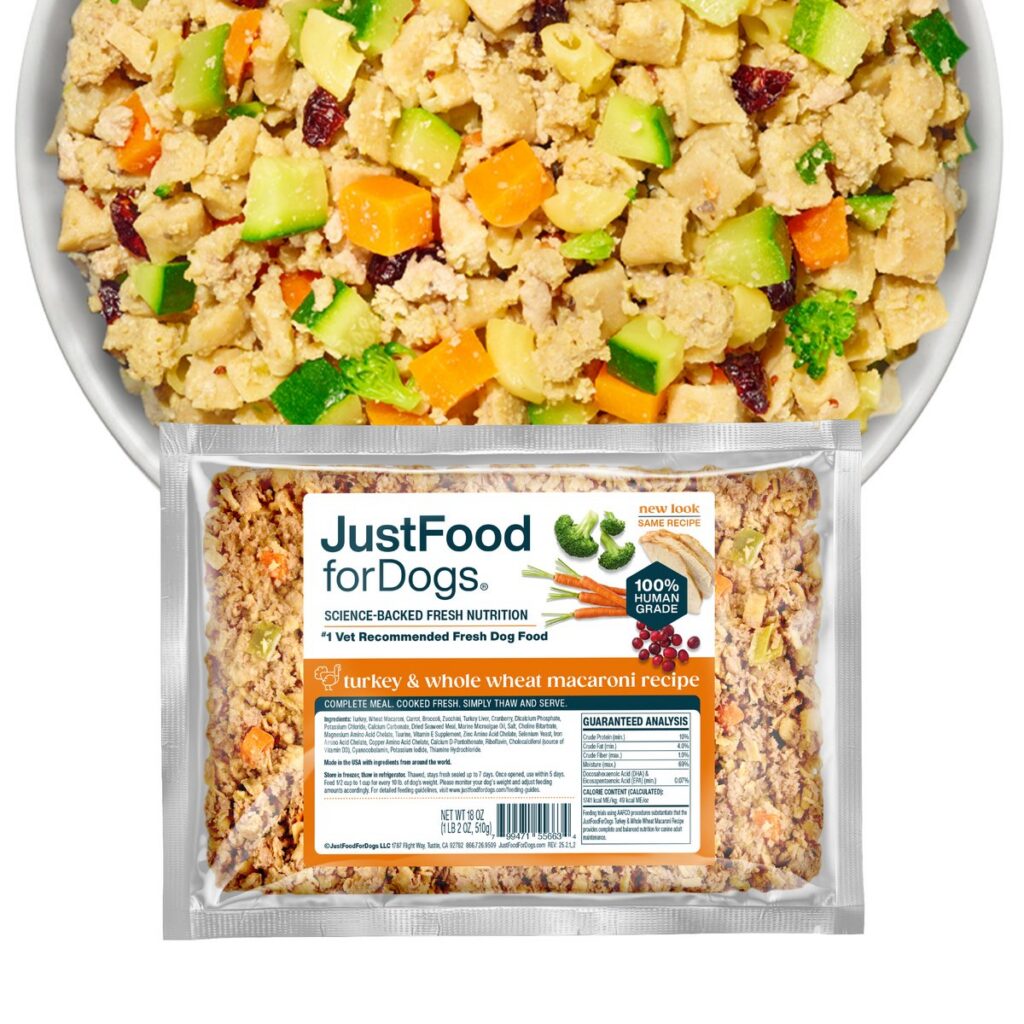
This adult-maintenance recipe contains turkey, liver, whole wheat macaroni, vegetables, cranberries and a nutrient blend. At 1,741 kcal/kg, or 1.741 calories per gram, it has the greatest energy density of the four foods compared here.
For an adult whose calorie plan is already established, its higher energy density can mean a smaller food weight than a lower-density recipe at the same calorie allowance. That may make serving or storage more manageable. It doesn’t mean the dog should receive extra calories, and it shouldn’t be used as a puppy food: its current statement is for adult maintenance.
View Turkey & Whole Wheat Macaroni
JustFresh Home-Cooked Chicken: adult meals without pre-opening freezer storage
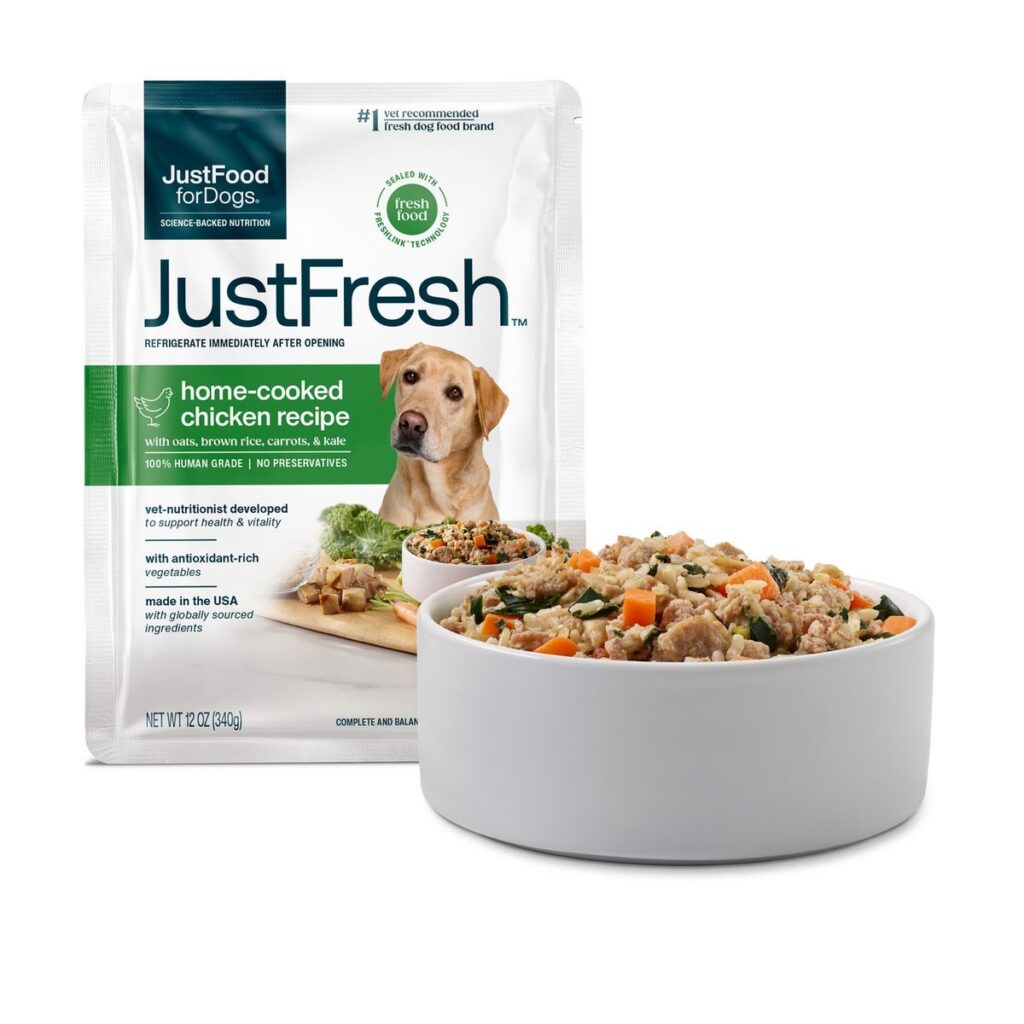
JustFresh Home-Cooked Chicken is formulated for adult maintenance and is shelf-stable before opening. Its ingredients include chicken thighs and liver, oats, brown rice, carrots and kale. The current label lists 1,254 kcal/kg, equivalent to 1.254 calories per gram.
Its practical distinction is unopened storage without freezer space. That may help when a freezer is already full or when you need an unopened supply for another caregiver. Once opened, refrigerate the food and use it within three days. Calculate how much a daily ration will use, and plan where any remainder will go; shelf-stable before opening doesn’t mean opened food can sit out through the day.
View JustFresh Home-Cooked Chicken
Rottweiler puppy food: match the recipe to growth

For the fresh foods covered here, compare Chicken & Rice and Fish & Sweet Potato first. Both currently carry adequacy statements that include growth of large-size dogs. Chicken & Rice provides more calories per gram; Fish & Sweet Potato offers a fish-based recipe and requires more food weight for the same energy.
Choose a food that fits the puppy’s growth stage before deciding based on flavor or convenience. Feeding a larger amount of an adult-maintenance food doesn’t change the life stage for which it was formulated. The full statement on the exact package is the key check, not the puppy’s current size or the picture on the front.
Read the whole statement, including any qualification about large-size growth. If the package you receive differs from the information you used when choosing the food, ask the manufacturer to clarify the exact recipe before carrying over your previous calculation. For broader context, see Vetstreet’s large-breed puppy food guide.
Keep a simple record of the puppy’s current weight, food name, daily amount, meal schedule and treats. Review it during routine veterinary visits, when you can discuss body condition and whether the portion still fits. Bring the package or a clear label photo: similar product names can refer to foods with different calorie densities or life-stage statements.
Useful questions for a feeding review include whether the exact statement suits the puppy’s expected adult size, whether the daily amount fits current growth and body condition, how to divide the ration into meals, and what allowance to make for training rewards. Ask when the plan should be reviewed again rather than assuming an old calculation will remain suitable.
Avoid choosing food to chase a particular size, appearance or faster growth. A complete growth diet is formulated for its stated use; unplanned supplements or added ingredients can change the overall diet. In a home with more than one dog, supervise meals and identify each portion. If dogs switch bowls, the amount offered no longer tells you how much each actually ate.
Turn calories into repeatable portions
The table below uses an illustrative adult allocation of 1,400 calories per day from the main food. It’s arithmetic, not a prescription for a Rottweiler of any particular age or weight. Turkey & Whole Wheat Macaroni and JustFresh Chicken are adult-maintenance recipes; puppy choices are covered separately above.
| Recipe | Calories per gram | Food for 1,400 calories | Approximate amount per meal, split in two |
|---|---|---|---|
| Chicken & Rice | 1.530 | 915 g | 458 g |
| Fish & Sweet Potato | 0.922 | 1,518 g | 759 g |
| Turkey & Whole Wheat Macaroni | 1.741 | 804 g | 402 g |
| JustFresh Home-Cooked Chicken | 1.254 | 1,116 g | 558 g |
The calculation is food calories divided by calories per gram. Convert kcal/kg to calories per gram by dividing by 1,000. A scale makes it easier to repeat the result than filling a bowl by eye. The sizeable gap between 804 grams of turkey and 1,518 grams of fish shows why package weight alone doesn’t reveal how much food a dog needs.
Use one calorie unit consistently. For a gram-based calculation, use the kcal/kg figure divided by 1,000. An ounce figure may be rounded, so converting that rounded number back to grams can produce a small difference. For example, the JustFresh label lists 1,254 kcal/kg and 36 kcal/oz. Use 1.254 calories per gram for a calculation in grams, and note the method so another caregiver can reproduce it.
Mathematical precision doesn’t establish a dog’s exact calorie requirement. Use the individual feeding plan, then review how the dog is doing with your veterinary team. Consistent measurement gives that discussion a better starting point than an estimate such as “about a bowl.”
Account for treats and mixed feeding
If the plan reserves calories for treats or other extras, subtract them before calculating the main meal. A hypothetical 1,500-calorie daily total with 100 calories set aside leaves 1,400 for the main food. Those numbers illustrate the method only; they aren’t a breed-wide feeding recommendation.
Track rewards shared by family members and during training. Small portions offered repeatedly can add up, and treats aren’t automatically complete nutrition. If you combine fresh and dry food, calculate each portion by calories rather than using equal cups or equal weights. Both foods must suit the dog’s life stage, and the combined amount should fit the established plan.
For example, half of the illustrative 1,400-calorie allowance is 700 calories. That’s approximately 458 grams of Chicken & Rice; the dry-food weight depends on that product’s own calorie label. Record how much of each food is served and when. Otherwise, a fresh meal can accidentally be added to a full day’s dry ration instead of replacing part of it.
For easier repeatability, place the bowl on a scale, reset it to zero and add the portion for that meal. If you prepare servings in advance, label them clearly as one meal or a daily total. Keep leftover amounts in the record when useful, and follow the product’s directions for unused food. Clean bowls and utensils after feeding, and leave instructions where other caregivers can find them.
Compare storage and daily cost, not just pack price
Fresh frozen food needs freezer space and thawing; JustFresh needs no freezer before opening, but opened food must be refrigerated and used within three days. Dry and canned foods bring their own measuring and opened-food routines. The most useful choice is one your household can handle reliably, including when someone else feeds the dog.
For a grain-free fresh option in this comparison, Fish & Sweet Potato has fewer calories per ounce than Chicken & Rice. At the same calorie allocation, that means more food weight and potentially more frequent purchases. Grain-free isn’t a general requirement for Rottweilers, and a lower package price or a particular ingredient label doesn’t by itself establish better value.
Regular prices observed September 28, 2026, were $153.99 for fourteen 18-ounce Chicken & Rice packs and $167.99 for fourteen 18-ounce Fish & Sweet Potato packs. Each order contains 252 ounces. Using rounded label values of 43 and 26 kcal/oz, respectively, the illustrative 1,400-calorie day costs about $19.90 for Chicken & Rice or $35.90 for Fish & Sweet Potato, before tax and shipping. Prices can change; these are comparisons between the selected recipes, not current checkout guarantees or a claim about the least expensive food available.
To estimate a household’s own daily cost, divide the order price by its total food weight in the same unit used for portions, then multiply by the daily amount of that recipe. Include delivery charges and any other complete food in a mixed plan. Compare equivalent regular purchase terms rather than treating an introductory offer as the ongoing cost.
At the illustrative 1,400-calorie allocation, Chicken & Rice uses about 32.6 ounces a day and Fish & Sweet Potato about 53.8 ounces. A 252-ounce order would last approximately 7.7 days or 4.7 days, respectively. That difference affects order frequency as well as freezer capacity. Work out how many feeding days an order covers before buying a larger supply, and check the exact pack size, recipe and storage directions.
For travel or a sitter, provide the food name, portion, meal split and storage instructions. Mark opened dates where relevant, and label food by dog as well as recipe in a multi-dog home. When changing foods, calculate the new portion using the new label; equal weights of two recipes may not provide equal calories. Follow the product’s transition directions and any individual veterinary advice. If persistent appetite or stool changes occur, seek veterinary guidance rather than repeatedly switching foods without a clear plan.
Adjust the routine as the dog changes
An older Rottweiler’s food and portions may deserve review as body condition, activity, eating comfort or veterinary instructions change. Age alone doesn’t identify one universally appropriate senior recipe. The adult-maintenance options here may suit an older adult when they fit the individual’s needs; Vetstreet’s senior dog food guide provides more context. Don’t replace a prescribed diet with a general selection from a buying guide.
Keep unsafe household foods out of every dog’s feeding plan, regardless of size. Vetstreet’s guide to foods not to share with dogs covers important exclusions.
Related breed guides include Cane Corsos, Dobermans, Great Danes, Bernese Mountain Dogs and Great Pyrenees. Their feeding guides also discuss life-stage and portion questions for large breeds. For meal frequency, see the AKC’s feeding-frequency guidance: adults commonly eat two meals daily, while young puppies generally need more frequent meals, often three to four during early months. Divide the daily amount among meals rather than increasing it each time you feed.
Frequently asked questions
Can a puppy and adult Rottweiler eat the same fresh recipe?
They can share a recipe whose adequacy statement fits both, such as Chicken & Rice or Fish & Sweet Potato as currently labeled. Each dog still needs an individually calculated portion. The adult-maintenance Turkey & Whole Wheat Macaroni and JustFresh Chicken aren’t substitutes for a puppy’s growth-suitable main food.
How should I choose between a smaller serving and a larger one?
Compare the weight needed for the same calorie allocation. Turkey & Whole Wheat Macaroni provides 49 kcal/oz for adults, while Fish & Sweet Potato provides 26 kcal/oz. The fish serving will weigh more for equal calories. Consider handling and storage, not bowl size as a measure of nutritional quality.
Does a Rottweiler need grain-free food?
The breed alone doesn’t establish a need to avoid grains. This comparison includes grain-containing meals and grain-free Fish & Sweet Potato. Consider life-stage suitability, complete nutrition, ingredients and any individualized veterinary instructions. A grain-free label isn’t a guarantee of greater quality or a treatment for a suspected allergy.
What should I do when a puppy grows or an adult’s routine changes?
Recheck the daily amount rather than assuming the previous calculation still fits. Keep the exact recipe label, weight, meals and extras in your record, and discuss body condition and feeding needs with your veterinary team. The key is a suitable recipe and a measured, practical routine that can be reviewed as the dog changes.


