Sample No. 0083
Beagle Food Guide: Life-Stage Choices, Portions, and Treat Planning
Compare complete Beagle food options by life stage, calories, ingredients, and storage, then plan meals and training rewards around your dog’s needs.

Choosing food for a Beagle comes down to two linked decisions: whether the recipe suits the dog’s life stage, and whether the household can measure and serve it consistently. A puppy needs food suitable for growth. An adult’s daily plan should also account for rewards used on walks, in scent games, and during training.
JustFoodForDogs offers four fresh options with different ingredients, calorie densities, and storage needs. Chicken & Rice is a grain-inclusive recipe suitable for growth and adult feeding. Fish & Sweet Potato is another all-life-stages choice. Turkey & Whole Wheat Macaroni and JustFresh Home-Cooked Chicken are adult-maintenance foods, each with a different practical advantage.
There is no need to find a package labeled specifically for Beagles. Start with the exact recipe’s nutritional adequacy statement, then compare its ingredients, calories, serving weight, and handling instructions. The amount in the bowl should come from an appropriate plan for the individual dog, not from breed assumptions or how quickly the bowl is emptied.
Start with life stage and the exact recipe
A nutritional adequacy statement tells you whether a food is intended as a complete diet for the life stage you need. Check the statement on the specific recipe, even if you know the brand: a company may sell complete meals, adult-only foods, treats, and products meant only for supplemental feeding. Those products are not interchangeable.
The FDA’s explanation of complete and balanced pet food describes two ways a food may support that claim: meeting the relevant nutrient profile or substantiating adequacy through feeding trials using AAFCO procedures. The statement also identifies the life stage covered. It answers a specific feeding question; it does not establish that one food is right for every dog.
Once you have found a suitable recipe, locate its calorie information and choose a unit you can measure. Calories per kilogram can support weighing food in grams; calories per ounce work with ounce-based portions. A fraction of a pouch or a scoop has little meaning without its weight and calorie content. Consistent units are particularly helpful when several people feed the same dog.
The ingredient list can narrow the choices further. You may prefer a grain-inclusive chicken recipe, want fish as the main named animal ingredient, or need to follow a specific feeding instruction. Read the full current list rather than relying only on the protein named on the front of the package.

Before ordering, collect the dog’s life stage and current feeding instructions, the proposed food’s calorie information, the storage space available, and the names of everyone who gives meals or treats. If you don’t have a daily calorie target for your dog, ask your veterinarian to set one. The calculations below are examples of how to use a target, not prescribed amounts for Beagles by age or weight.
A household routine matters as much as the product. One written serving instruction can help different caregivers serve the same amount. Someone with little freezer space may value unopened shelf-stable food for an adult. A family that trains throughout the day needs a visible plan for rewards. Pick a recipe whose instructions and storage fit a routine you can maintain.
Comparing the four fresh recipes
The table compares the recipe details provided in the source: practical fit, published calories per ounce, and stated life-stage suitability. Product formulas, package sizes, calorie figures, and serving directions can change, so check the current package before ordering.
| Fresh food | Practical fit | Published calories per ounce | Life-stage fit |
|---|---|---|---|
| Chicken & Rice | Grain-inclusive starting choice | 43 | All life stages |
| Turkey & Whole Wheat Macaroni | More calories in less food weight | 49 | Adult maintenance |
| Fish & Sweet Potato | Fish-based fresh alternative | 26 | All life stages |
| JustFresh Home-Cooked Chicken | Unopened pantry storage | 36 | Adult maintenance |
These calorie figures help with portioning; they do not rank nutritional quality. A lower food weight can supply the same calories as a larger portion of a less calorie-dense recipe. That difference affects how much food you prepare, how long a package lasts, and how much storage space you need.
Chicken & Rice: A grain-inclusive option for puppies and adults
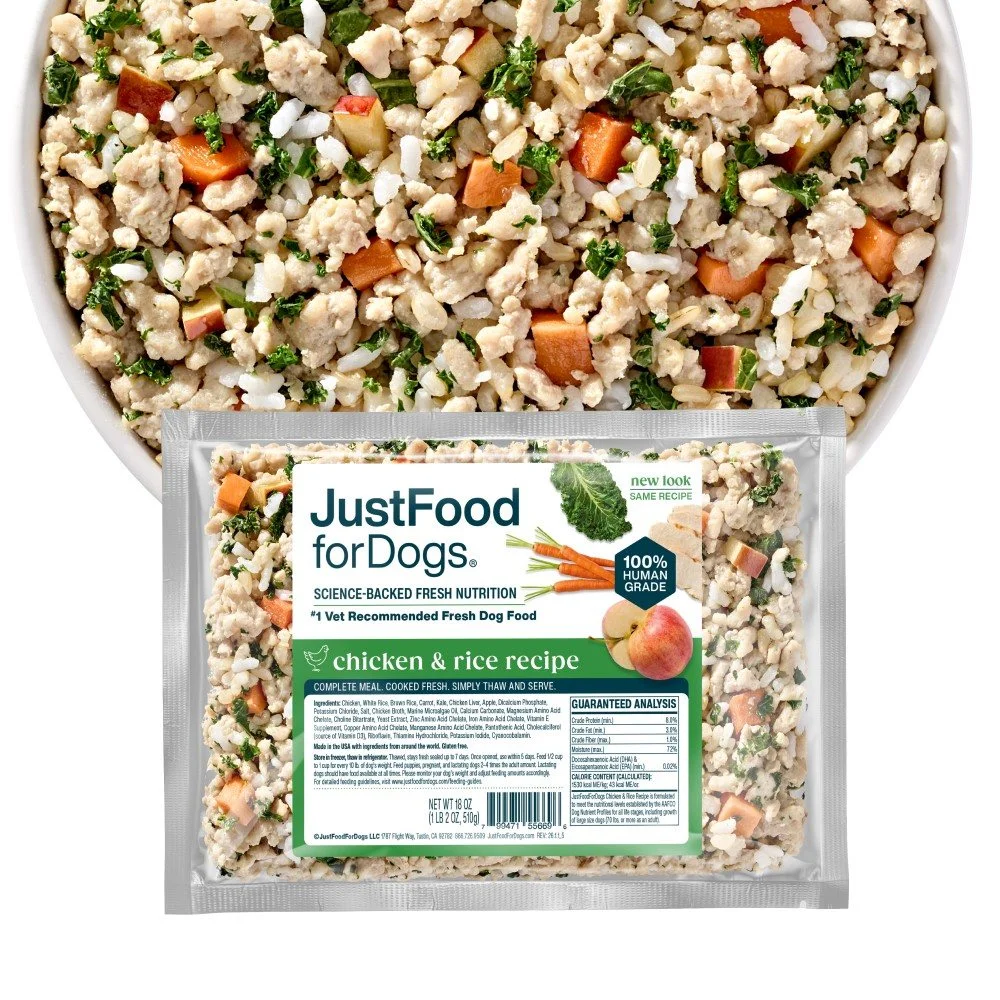
JustFoodForDogs Chicken & Rice is a useful starting point for owners seeking a complete fresh meal with grains. Its listed ingredients include chicken thighs and liver, white and brown rice, kale, carrots, and apples. The manufacturer’s product information lists 1,530 calories per kilogram, or about 43 calories per ounce, and says the recipe is suitable for all life stages, including growth.
At an illustrative 500 calories from the main food, the ounce-based calculation is about 11.6 ounces per day. That figure can help you estimate freezer space and how much to thaw. It does not mean that 500 calories is the right allowance for your Beagle.
The recipe’s growth suitability makes it relevant to a puppy-food comparison as well as to adult feeding. Even so, the amount and schedule need to match the individual dog. If training rewards come from the complete food, reserve them from the measured daily portion before serving the rest.
Turkey & Whole Wheat Macaroni: A compact adult portion
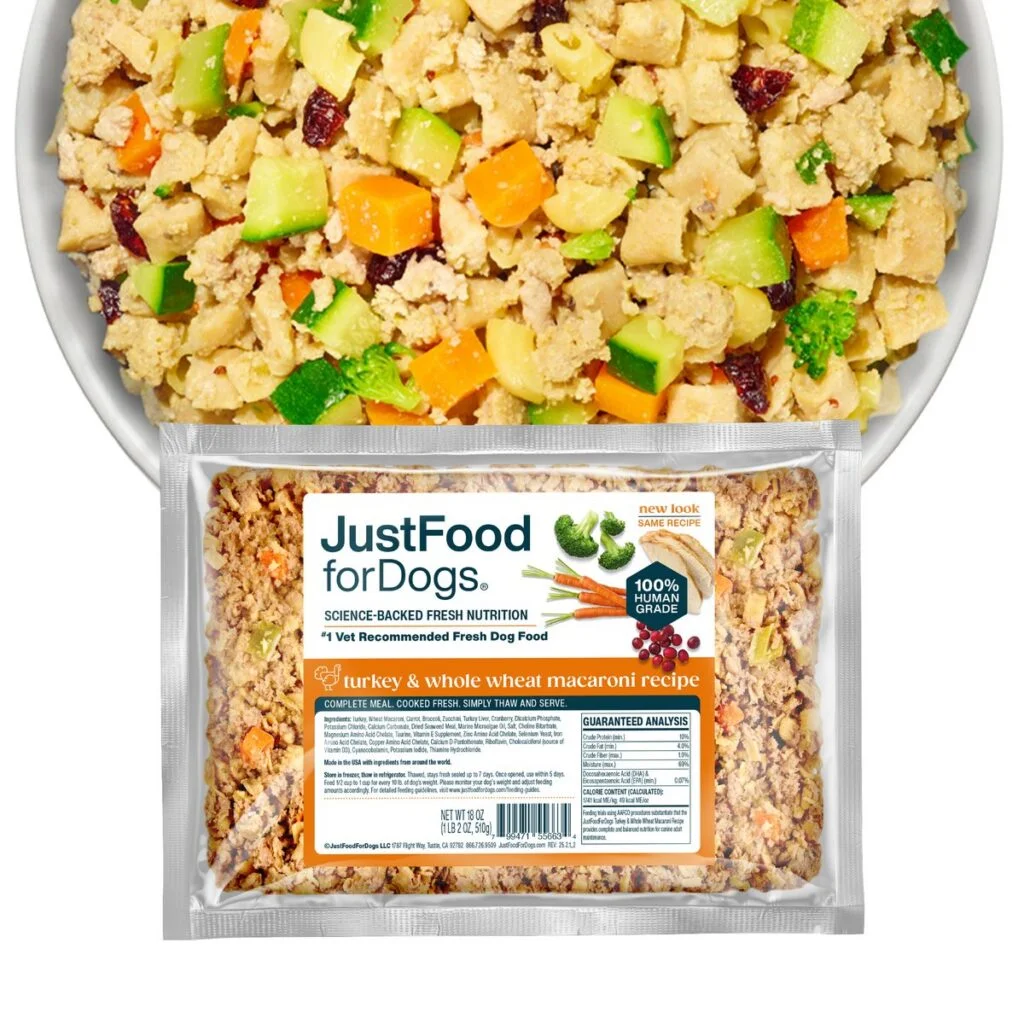
Turkey & Whole Wheat Macaroni has the highest calorie density among these four recipes, at 1,741 calories per kilogram, or about 49 calories per ounce. Its ingredient list includes turkey and turkey liver, whole wheat macaroni, broccoli, zucchini, carrots, and cranberries. The manufacturer’s product page identifies it as an adult-maintenance food and reports substantiation through feeding trials using AAFCO procedures.
For an illustrative 500 calories from the main food, the amount is about 10.2 ounces daily. That’s the smallest food weight among the four recipes at the same calorie allowance. It may be useful when planning portions for an adult dog or organizing food for a caregiver, but a smaller portion does not make the recipe automatically preferable.
The whole wheat ingredient is worth checking if you have a specific feeding instruction to follow. And because this is an adult-maintenance food, choose a growth-suitable recipe for a puppy’s main diet rather than assuming every recipe from the same company supports growth.

Fish & Sweet Potato: A fish-based choice with a larger serving weight
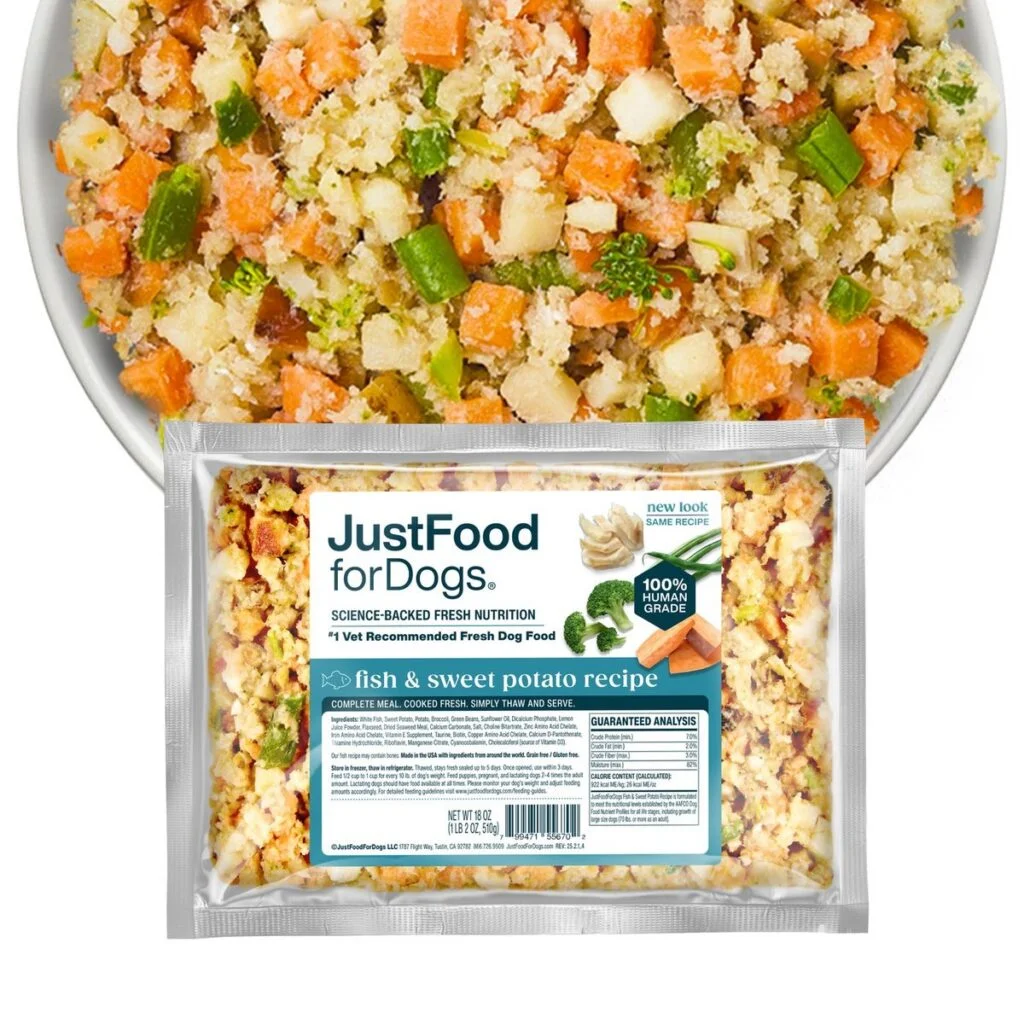
Fish & Sweet Potato includes whitefish, sweet and russet potatoes, green beans, broccoli, and oils. The current formula is grain-free, which describes its ingredients; it does not establish that the recipe is better for every Beagle.
The manufacturer’s product information lists 922 calories per kilogram, or about 26 calories per ounce. It also carries an all-life-stages adequacy statement. For an illustrative 500 calories, the portion is about 19.2 ounces per day, substantially more food by weight than the other options in this comparison.
That larger portion has practical consequences. A package may cover fewer days at a fixed calorie allowance, and you may need more refrigerator or freezer capacity. If you’re adding the recipe to an existing complete diet, decide how many calories it will supply first. A 100-calorie share works out to about 3.8 ounces; those calories replace the same amount from the existing food rather than adding on top of a full daily allowance.
JustFresh Home-Cooked Chicken: Pantry storage before opening
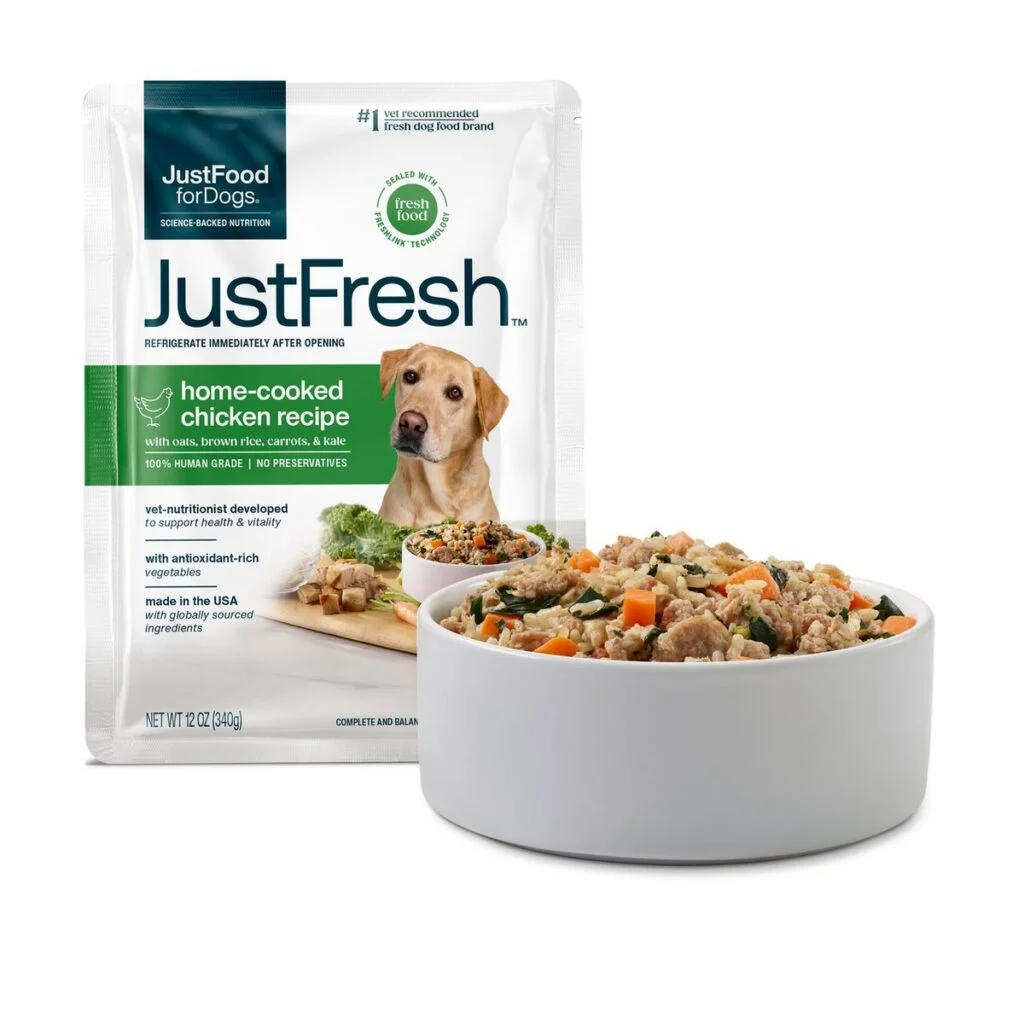
JustFresh Home-Cooked Chicken is an adult-maintenance food that can be stored in the pantry while unopened. Its ingredients include chicken and liver, oats, brown rice, carrots, kale, oils, potato starch, and a nutrient blend. The manufacturer’s product information lists 1,254 calories per kilogram, or about 36 calories per ounce.
An illustrative 500-calorie portion is about 13.9 ounces. Once opened, refrigerate the food and use it within three days, following the package instructions. Pantry storage applies to the unopened product; it does not make an opened pouch suitable for a warm car or unrefrigerated travel.
Write down when a package is opened and the measured daily amount, especially if a sitter or another family member may take over. Match the amount opened to what the household can use within the stated refrigerated period. When changing from another food, recalculate by the new recipe’s calories rather than carrying over the old food weight.
Plan feeding around growth, adulthood, and aging
For puppies, confirm growth suitability and divide the daily total
Chicken & Rice and Fish & Sweet Potato carry the growth suitability described here. Turkey & Whole Wheat Macaroni and JustFresh Chicken are adult-maintenance foods, so they should not replace a puppy’s growth diet as the main meal. The word “chicken” alone doesn’t answer the question: plain cooked chicken and an adult-maintenance chicken recipe are not the same as a complete food formulated for growth.
Vetstreet’s puppy food guide offers broader comparison context. When evaluating a fresh option alongside the puppy’s current food, put the two adequacy statements and calorie figures side by side. The ingredient appearance cannot establish that one product meets a puppy’s needs.

Young puppies generally need smaller, more frequent meals than mature dogs. The AKC’s puppy-feeding guidance describes a common progression: four meals for young puppies, three during the three-to-six-month period, then two as they mature. Confirm timing and amounts with your veterinarian for your puppy.
Meal frequency and daily intake are separate decisions. If a daily amount is divided into three meals instead of two, divide the same daily total; don’t serve the former two-meal amount three times. If rewards come from the puppy’s complete food, set them aside from that same measured total.
- Keep the recipe’s life-stage statement with your feeding notes.
- Record the total daily amount before dividing it into meals.
- Include food used for house training, handling practice, and recall.
- Review the plan as the puppy grows instead of treating the first calculation as permanent.
Training rewards can be difficult to track because they’re given in small pieces throughout the day. Portion the planned supply before the first session and have household members use the same container. That makes the reward budget visible and reduces the chance that several people each provide an unrecorded allowance.
Review the plan when moving to adult feeding
The move from puppy feeding is a good time to review the whole routine with your veterinarian. If an all-life-stages food remains suitable, the amount or schedule may change without necessarily requiring a new recipe. Once the dog is ready for adult feeding, adult-maintenance foods such as Turkey & Whole Wheat Macaroni or JustFresh Chicken may also be options, depending on the household’s ingredient and storage preferences.
Update the written instructions whenever the plan changes. Include the recipe, calorie information, daily amount, meal schedule, and reward allowance. Otherwise, an old note may keep the puppy’s previous portions in use after the food or schedule has changed.
Set adult portions for the individual dog
A hunting Beagle and a household companion may be able to eat the same complete adult recipe while needing different amounts. The activity label doesn’t determine a portion by itself. How often the dog works, how long the sessions last, body condition, and the individual feeding plan all matter.
Describe a typical week when discussing activity with your veterinarian. A single demanding outing followed by quieter days is different from sustained work throughout the week. If the routine changes substantially, review the calorie plan rather than increasing food indefinitely after one unusually active day.
Base senior food decisions on current needs
Age alone doesn’t specify a calorie amount, texture, or nutrient level for an older Beagle. Start with the dog’s current food and veterinary plan. An older dog doing well on a complete food may need a different discussion from one whose appetite, ability to eat, or daily routine has changed.
Vetstreet’s senior dog food guide provides broader shopping context. For any recipe, compare life-stage suitability, ingredients, calories, and serving requirements. A moist meal may be convenient to portion, but “fresh” alone doesn’t show that it addresses an individual senior’s needs. Bring an unexplained change in eating or a new difficulty with meals to your veterinarian.

Make meals, rewards, and mixed feeding add up
A useful feeding plan covers the full day: meals, training pieces, chews, food in toys, and snacks from anyone else in the household. First establish the daily calorie target with your veterinarian, then assign calories to meals and extras. A dog’s interest in another bite doesn’t reveal how many calories it has already eaten.
Before increasing a serving because the bowl was emptied quickly, check the written plan, confirm the recipe and unit, and ask whether someone else has already offered food or rewards. After switching recipes, use the new calorie figure. The same scoop or food weight may supply a different number of calories.
Use calories when combining foods
Fresh, dry, and canned describe formats; they don’t determine whether a product is a complete diet. Dry and canned foods can also be complete. Check nutritional adequacy first, then use calorie information to build the serving. If you combine complete foods, decide the calorie share for each and calculate each portion from its own label. Equal volumes or weights don’t necessarily provide equal calories.
Moisture also affects the nutrient percentages printed on labels. A fresh food and a dry food may show different protein percentages partly because they contain different amounts of water. The FDA’s pet-food guidance describes comparing foods on a dry-matter basis: divide the listed nutrient percentage by the percentage of dry matter, then multiply by 100. Dry matter is 100 minus the moisture percentage.
That calculation helps compare a particular nutrient, but it doesn’t identify an overall winner. Life-stage suitability, the full formulation, and the dog’s feeding plan still matter. Don’t turn one label percentage into a claim that every Beagle needs the highest number available.
Work through an example daily budget
Consider an illustrative adult plan of 550 calories per day. This number demonstrates the arithmetic; it isn’t a recommended intake for an average Beagle. If the established plan sets aside 50 calories for suitable rewards and extras, 500 calories remain for the main food.
Daily calculation: 550 total calories minus 50 calories in planned extras equals 500 calories from meals. Calculate the meal portion from that remainder. If the reward plan changes, update the meal calculation rather than keeping the same meal and simply adding more extras.
Keep extras a small part of the total so the complete diet continues to supply the intended nutrition. The WSAVA nutrition resources offer tools for discussing treats and intake with your veterinary team. An established feeding plan may set a stricter limit on extras, so follow that plan when it applies.
Food taken from a measured portion of the complete diet remains part of that portion. A separate treat is an extra with its own calories. Keep the two sources distinct in your notes so you don’t subtract the same food twice or overlook a separate treat.
Compare portions at the same calorie allowance
The following portions use the same illustrative 500 calories of main food and the rounded manufacturer figures per ounce. They’re alternatives, not servings to combine. Small differences can arise if you use the figures per kilogram and weigh in grams instead.
| Recipe | Calculation | Approximate daily amount | Approximate amount per meal, split into two |
|---|---|---|---|
| Chicken & Rice | 500 ÷ 43 calories per ounce | 11.6 ounces | 5.8 ounces |
| Turkey & Whole Wheat Macaroni | 500 ÷ 49 | 10.2 ounces | 5.1 ounces |
| Fish & Sweet Potato | 500 ÷ 26 | 19.2 ounces | 9.6 ounces |
| JustFresh Home-Cooked Chicken | 500 ÷ 36 | 13.9 ounces | 6.9 ounces |
Fish & Sweet Potato requires almost twice the food weight of Turkey & Whole Wheat Macaroni to supply the same example calories. That changes shopping and storage needs, but it doesn’t mean that the larger portion will keep every dog satisfied longer. The meal-size column assumes two equal meals; apply the same daily total to another schedule if your dog’s plan calls for one.
Weigh food and count reward pieces consistently
Chicken & Rice lists 1.53 kilocalories per gram. To provide the example’s 500 food calories, the portion is about 327 grams per day. Zero the empty bowl on the scale, weigh the food, and write the unit on the feeding note. Split evenly between two meals, that’s about 163 grams per meal.
Reward size can also change how many opportunities the planned calories provide. For example, 20 treats at two calories each contribute 40 calories. Breaking each into four smaller pieces gives 80 rewards with the same 40 calories. Use the actual calorie information for your treats and pieces that are appropriate for your dog.
Move measured food into training activities
In the example 550-calorie day, reserve 50 calories for separate treats and 500 calories for Chicken & Rice. If you set aside 33 grams of the approximately 327-gram daily portion for a feeding activity, about 294 grams remain for bowls. The food has moved from a bowl to an activity; the daily allowance hasn’t changed.
Moist food still requires appropriate cold storage and clean handling. A separate dry reward may be easier to carry outdoors. For training class, walks, and visitors, take rewards from one labeled supply rather than letting each person bring an untracked portion. A written note can show how much food is for bowls, how much is already reserved for an activity, and how many separate treats remain in the daily allowance.

Calculate a mixed fresh-and-dry meal
Suppose half of the example’s 500 main-food calories comes from Chicken & Rice and half from a suitable complete dry food. The fresh share is 250 calories. At 43 calories per ounce, that’s about 5.8 ounces per day.
For illustration, if the dry food lists 400 calories per cup, its 250-calorie share is 0.625 cup. That calorie figure is hypothetical; use the number on your own package. The combined meal supplies 500 calories, while the separate 50-calorie extras allowance remains unchanged. If you serve two meals, divide both daily portions across them.
You can apply the same method to two fresh recipes. A 500-calorie main-food plan split equally between Chicken & Rice and Fish & Sweet Potato would use about 5.8 ounces of the former and 9.6 ounces of the latter. That’s one possible calorie split, not a requirement to rotate recipes. For a puppy, every part of the main diet must fit the puppy’s growth plan.
Compare cost and storage using daily use
Package price is only part of the cost comparison. In the source’s price check dated September 28, 2026, the official Chicken & Rice listing showed $153.99 for 14 packs of 18 ounces, or 252 ounces total. Fish & Sweet Potato showed $167.99 for the same package count and size. The listed regular prices excluded tax and shipping; promotions and current prices may differ.
| Example at the listed regular prices | Chicken & Rice | Fish & Sweet Potato |
|---|---|---|
| Bundle quantity | 252 ounces | 252 ounces |
| Observed regular bundle price | $153.99 | $167.99 |
| Main-food allowance | 500 calories daily | 500 calories daily |
| Approximate daily cost | $7.11 | $12.82 |
| Approximate seven-day cost | $49.74 | $89.74 |
| Approximate days per bundle | 21.7 | 13.1 |
The estimates use the same example allowance and unrounded calculations; rounded daily costs may not multiply exactly to the weekly figures. Treats and any second food cost extra. Check current prices and your dog’s established portion before using the numbers as a shopping budget. In the mixed-food example, half of the main calories from Chicken & Rice costs about $3.55 per day at the observed price; add the actual cost of dry food and rewards to compare the full day.
Plan storage alongside use. Fresh Frozen requires a thawing routine. Unopened JustFresh Chicken can be stored in the pantry, but after opening it must be refrigerated and used within three days under the package directions. Check that a package can be used within the specific product’s handling period before buying a larger supply.
After the first week, compare how much food you used with the amount you estimated. If the difference comes from unmeasured extras, make the household routine clearer before changing recipes. If your dog’s intake or weight changes unexpectedly, review the individual plan with your veterinarian.
What the research can and can’t tell you
A 2021 University of Illinois study compared four diets in 12 healthy adult Beagles over repeated 28-day feeding periods. Two diets were JustFoodForDogs Beef & Russet Potato and Chicken & White Rice. The other diets were a fresh roasted food and an extruded dry food. Researchers measured nutrient digestibility, fecal output, and other laboratory outcomes.
The two JustFoodForDogs foods were highly digestible and produced less fecal output than the tested extruded food. That is product-specific evidence relevant to the fresh-food discussion. It doesn’t establish that every current recipe produces the same result, that all dry foods perform alike, or that puppies and dogs with medical conditions will respond the same way. The study tested the foods supplied for that experiment, not every product currently sold under the brand.
When weighing research, ask which exact food was studied, what the researchers measured, and whether the current recipe’s label suits your dog’s life stage. JustFoodForDogs also publishes feeding-trial certificates. Match the recipe name and feeding purpose in any documentation rather than applying a finding across a whole brand.
The adequacy statement and a study answer related but different questions. The FDA’s guidance explains the basis for complete-food statements, while a feeding study describes what happened with particular foods under particular conditions. Neither establishes that one recipe is best for every Beagle.
The WSAVA nutrition toolkit suggests useful topics for questions about a manufacturer’s nutritional expertise, formulation, quality control, and research. Ask about the exact recipe and the information that would change your decision. For example, if you’re choosing food for a puppy, request the specific adequacy statement for growth. Keep the answer with the current package details for your next discussion with the veterinary team.
Keep everyday food safety in the plan
Foods people enjoy aren’t automatically suitable dog rewards. Vetstreet’s guide to foods you should never share with your dog covers the broader question. Chocolate, grapes and raisins, onions, and products containing xylitol are examples to keep out of a reward supply.
Store approved training food where children and visitors can identify it. If your dog may have eaten something hazardous, contact a veterinarian or animal poison service promptly rather than trying to address it with a different meal. For routine feeding, a clear record of the food, amount, rewards, and storage instructions gives everyone in the household a practical plan to follow.
For more breed comparisons, see Petful’s guides to Corgis, Dachshunds, Dobermans, and Great Pyrenees, plus WebVet’s guide to Pugs.
Frequently asked questions
Which of these foods can a Beagle puppy eat?
Chicken & Rice and Fish & Sweet Potato carry the growth suitability described here. Turkey & Whole Wheat Macaroni and JustFresh Chicken are adult-maintenance foods. Choose a growth-suitable main diet and confirm its amount with your veterinarian.
Can fresh food be served with dry training rewards?
Yes. Calculate the meal from the calories remaining after the planned rewards. In the example used here, 50 calories of separate rewards leave 500 calories for the main food. That example explains the calculation; it isn’t a calorie prescription for every Beagle.
Should training treats count toward the day’s food?
Yes. Count them in the full-day plan. A reward taken from the measured complete-food portion stays within that portion; a separate treat uses part of the extras allowance. Setting aside the supply in advance helps several caregivers avoid giving the same allowance twice.
Can a hunting Beagle and a household Beagle eat the same recipe?
They may be able to eat the same complete recipe if it suits their life stages, while receiving different amounts. Base the plan on each dog and its actual workload. Review meaningful changes in activity with your veterinarian.
Is a topper the same as a complete meal?
No label word such as “topper” tells you by itself whether a product is complete. Check the exact product’s nutritional adequacy statement. A product intended only for supplemental or intermittent feeding shouldn’t replace a complete diet, and its calories still belong in the daily plan.
The practical choice is the recipe whose life-stage statement fits, whose ingredients suit your preferences and feeding instructions, and whose portions and storage work at home. Write down the calorie target, meals, and reward allowance together; that gives every caregiver the same plan to follow.


