Sample No. 0259
Why an Asian Openbill Stork Might Spread Its Wings
An Asian openbill’s skyward pose may look theatrical, but it can reflect ordinary feather care, temperature regulation or balance.
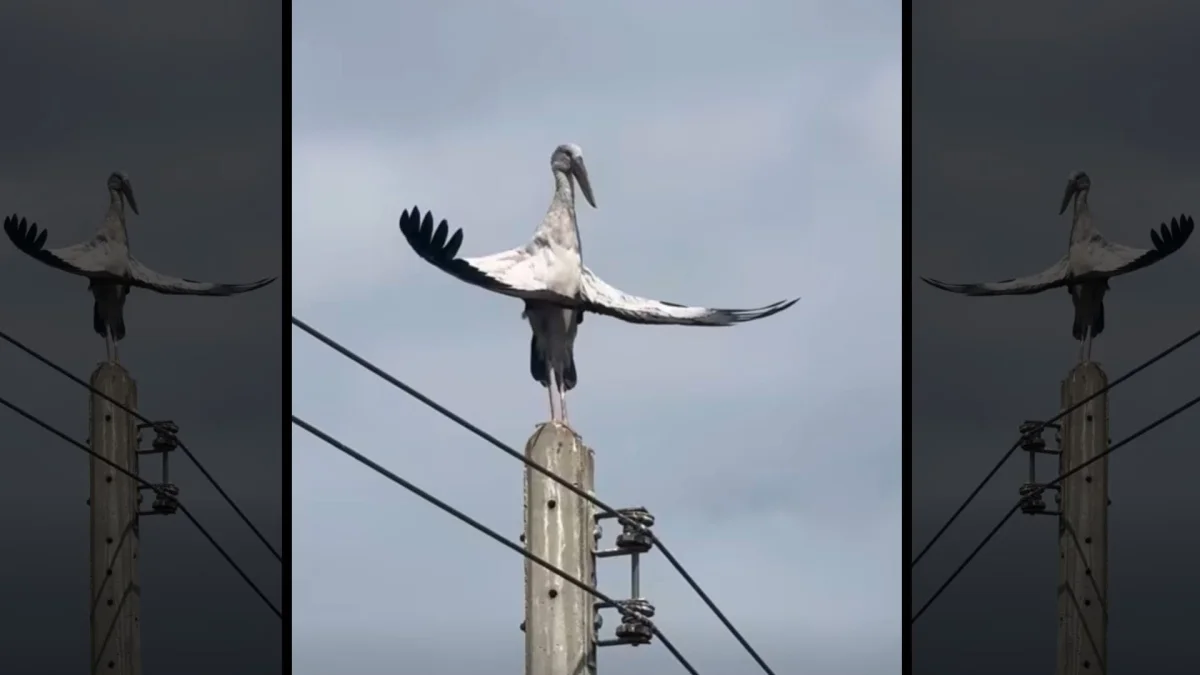
An Asian openbill stork perched high on a pole spreads its wings and tips its head toward the sky. The pose looks almost like a human gesture, but the footage doesn’t reveal what prompted it. The most grounded explanation is that the bird is showing a posture seen in storks and other birds, with several possible everyday functions.
That uncertainty matters: a single dramatic moment can’t tell us whether the bird is drying its feathers, managing heat or adjusting its balance. Each is a plausible explanation, but none is confirmed here. Watching wildlife is often a reminder that an action can look familiar to us while serving a practical purpose for the animal.
A stork built for wetland foraging
The bird appears to be an Asian openbill (Anastomus oscitans), a member of the stork family, Ciconiidae. Asian openbills are found mainly across the Indian subcontinent and Southeast Asia. Their long legs suit wading, and their pale bodies contrast with darker feathers on their wings.
Their bill gives the species its name. In adults, a gap separates the upper and lower mandibles. That distinctive shape is associated with a diet that includes freshwater snails. Asian openbills search for food in wetlands, shallow marshes and flooded fields, where their bills help them handle snails and remove the soft bodies from their shells.
A pole is a different setting from a marsh, but a bird may perch in places beyond its usual feeding habitat. The video shows this bird standing on a utility pole; it doesn’t show what the bird was doing before or after the pose. Without that context, its location alone can’t settle the reason for spreading its wings.
Several possible reasons for the posture
The openbill’s position resembles a spread-wing posture. In birds, holding the wings out can be associated with feather maintenance, including drying after time in wet surroundings. Exposing feathers to air may help moisture evaporate. That could fit a bird that has been foraging in wetlands, though the footage doesn’t establish that this one had recently been in the water.
Temperature is another possible factor. Depending on conditions and how the bird is positioned, spreading the wings may help it release excess body heat or expose more feathers to sunlight. The posture alone doesn’t tell us which effect, if either, is relevant at that moment. A brief clip also offers little information about the surrounding weather or the bird’s recent activity.
Spread wings may also help a bird steady itself or reposition its feathers. Those possibilities are consistent with the range of functions associated with this posture, but the video doesn’t show a clear balance problem or a specific feather adjustment. The careful conclusion is that the behavior has several plausible explanations, and the bird’s exact reason remains unknown.
Read the behavior without assigning a human motive
The pose invites a human interpretation: wings raised, neck stretched, head angled upward. It can look like a moment of celebration or prayer. That resemblance makes the scene funny, but it doesn’t mean the bird is expressing a human emotion or intention. Its posture is better understood through the ordinary tasks birds may perform with their feathers and bodies.
For people watching wildlife, a useful habit is to describe what can be seen before deciding what it means. Here, the bird is perched with its wings extended and head raised. Feather drying, temperature regulation and balance are possible explanations; the available view doesn’t confirm one. That distinction helps keep an entertaining observation from becoming an overconfident claim about animal behavior.
If you encounter a wild bird, give it room and observe from a distance. Avoid trying to prompt a pose or approach closely for a better view. A short display may be part of normal behavior, while signs such as an inability to perch or fly, visible injury, or distress call for guidance from a qualified wildlife rehabilitator or veterinarian. Nothing in this footage establishes that the stork is unwell.
The openbill’s skyward stance may remain a small mystery. What’s clear is that a familiar-looking gesture can have practical explanations, and a little restraint in interpreting it leaves room for the bird’s behavior to be what it is: a moment of wild activity we can appreciate without pretending to know more than the footage shows.


