Sample No. 0254
Bigfin Squid Sightings Stay Rare as Deep-Sea Footage Surfaces
A bigfin squid with elbow-like arms was filmed off California, only the second MBARI sighting in decades. Its biology remains largely unknown.
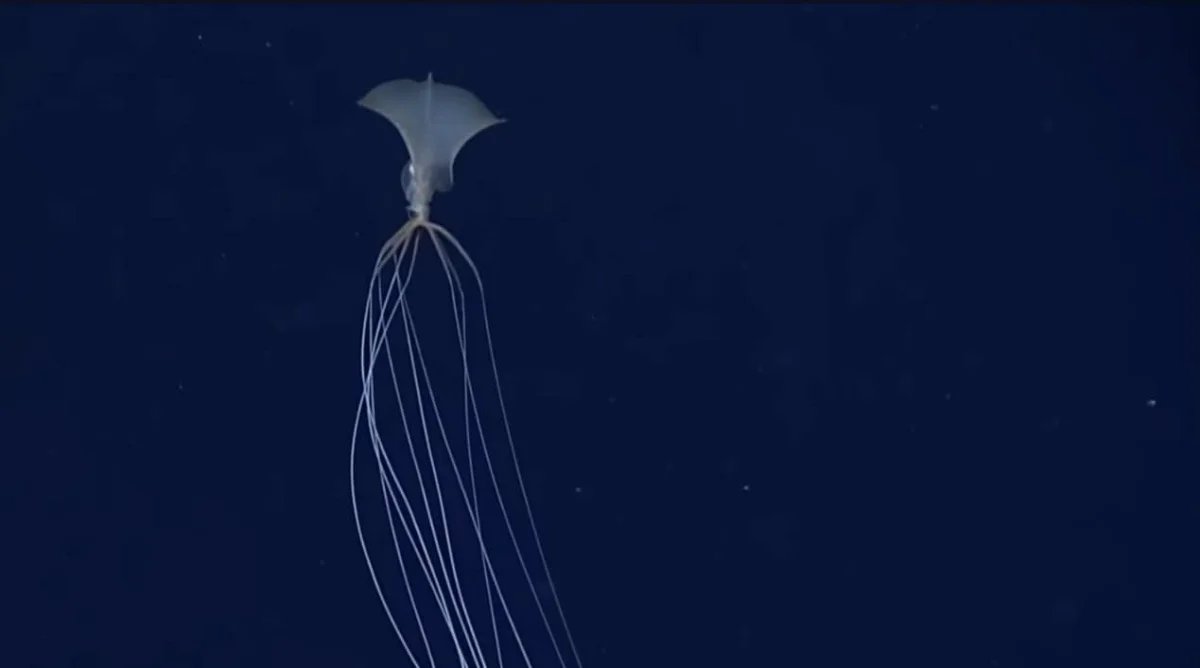
Some animals look like they were assembled from spare parts. The bigfin squid is one of them. Its trailing arms bend sharply in the middle like elbows, and its filaments can stretch to about twenty times the length of its body. A recent clip of one drifting over the deep seafloor has drawn plenty of attention, but the more striking detail is how seldom anyone gets to see one at all.
A Body Plan Unlike Most Squid
Bigfin squids belong to the genus Magnapinna, a group of cephalopods thought to live deeper than any other squid. Some individuals reach about 21 feet in total length once their trailing filaments are included. The body itself is elongated and teardrop-shaped. Eight arms and two longer tentacles trail behind, and each of those appendages carries a sharp 90-degree bend, which gives the animal its unusual silhouette.
Movement looks just as odd. The squid propels itself with the undulations of two large fins, a slow, rippling motion that suits the cold, dark water it inhabits. When it spreads its arms and tentacles wide and lets its filaments hang loose, the animal seems to float across the bottom rather than swim through it. That posture is one of the few behaviors researchers have actually been able to describe.
A Timeline Measured in Decades
The gaps in the bigfin squid's record are long enough to test anyone's patience. The first specimen was collected in 1883, but the species wasn't formally described until 1998, a stretch of 115 years between a physical sample and a scientific name. The Monterey Bay Aquarium Research Institute, known as MBARI, logged its first sighting in 2001 off the shore of O'ahu, Hawai'i. The next one came in August 2026, 25 years later, above the abyssal seafloor near Davidson Seamount off Central California.
That recent encounter is the one captured in the Instagram clip. The animal was just over four feet long, a size that shows how much of the species' full range sits outside what anyone has measured. Here's the thing: a single sighting can reshape what people think they know, but two sightings from one research institute in four decades is a very thin sample.
Where They Live and How Deep
Bigfin squids have been recorded at depths from roughly 5,200 feet to 20,300 feet. The deepest recorded sighting was about four miles below the surface, in the Philippine Trench in the Western Pacific. Their range is thought to be worldwide, spanning tropical and temperate waters, though the deep-water habitat makes that picture hard to confirm.
The Davidson Seamount sighting is a useful reminder of how these animals relate to the seafloor. Most reported individuals have been seen close to the bottom, where the animal's spread-out arms and hanging filaments seem to blend with the sediment and structure around it.
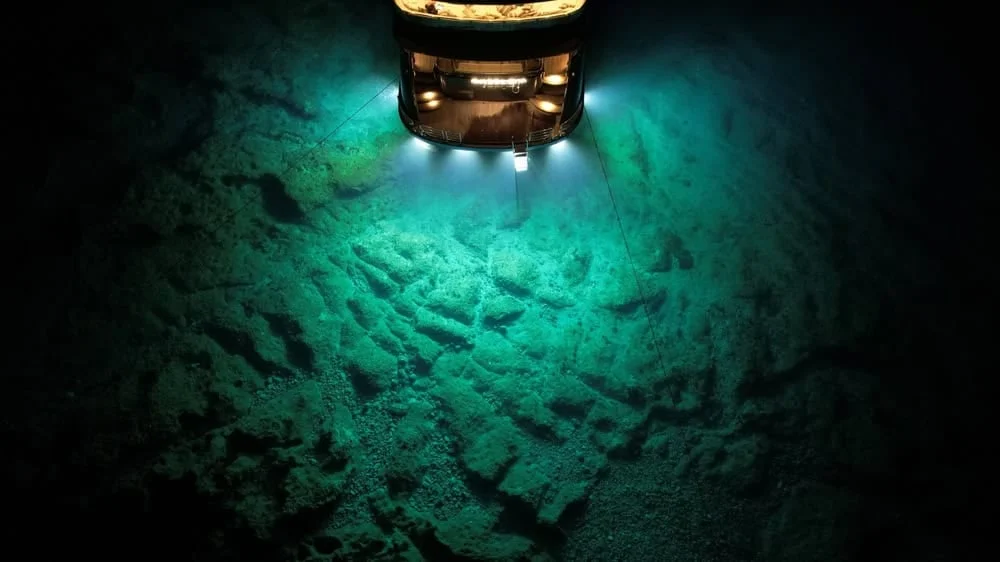
Scientists use submersibles to explore deep under the ocean.
©Wirestock Creators/Shutterstock.com
What Researchers Still Don't Know
Diet is one of the biggest open questions. Experts haven't confirmed what bigfin squids eat, which leaves a gap in understanding their role in deep-sea food webs. The reproductive and growth picture is just as incomplete. No adult specimen has ever been obtained. Researchers have only recovered damaged juveniles, so the full life cycle, adult size, and typical adult behavior remain largely a matter of inference.
Defensive behavior is another area with limited data. When disturbed, the filaments recoil quickly, a reaction that has been observed but not thoroughly studied. Any animal this fragile-looking and this hard to keep in view presents a real challenge for anyone who wants to measure how it responds to a stimulus.
Why Sightings Stay So Rare
Deep-sea research depends on tools like crewed submersibles and remotely operated vehicles, which carry cameras and lights into water where sunlight never reaches. Teams in this position typically face limited bottom time, weather windows, and the sheer size of the seafloor they're trying to cover. A rare animal that lives near the bottom, in water that's miles deep, can pass through a survey area without anyone noticing.
The count of worldwide sightings reported for this species is about 70, a figure that underscores how much of the deep ocean has never been observed in detail. Most of the animal's life happens out of view, and each new clip adds a small but meaningful data point to a very sparse record.
What Comes Next
My read is that the most valuable progress will come from patient, repeated observation rather than dramatic footage alone. Long-term video, careful documentation of depth and behavior, and any eventual collection of adult material would do far more to answer the diet and life-cycle questions than another striking single sighting. For anyone following the story, the clip is a good reminder that the deep ocean still holds animals that science has barely met. The next sighting could tell us something the last two couldn't.


