Sample No. 0252
Europe's Fire Salamanders Glow Green and Blue Under UV Light
Under ultraviolet light, fire salamanders show green and turquoise glows from their yellow markings. Researchers think the effect may play a role in communication or defense.
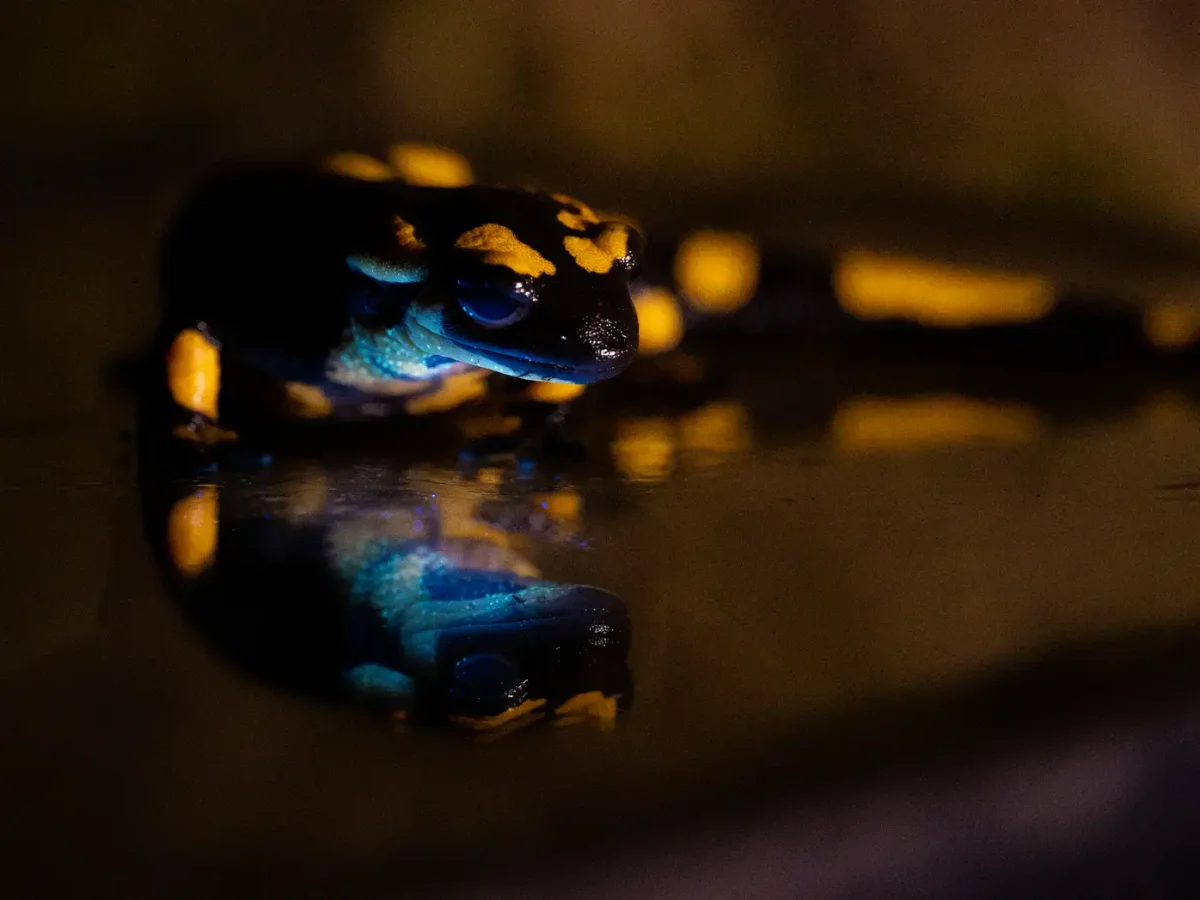
Fire salamanders are about as familiar as European amphibians get. Their black-and-yellow patterning shows up in field guides, garden ponds and forest streams. What nobody had documented until recently is that under ultraviolet light, their flanks and bellies light up in bright green and turquoise. That's a surprise for a species this well studied, and it raises a bigger question about how much we still miss in common animals.
The finding comes from an international team led by scientists at the Museum of Natural Sciences in Barcelona, working with the Institute of Evolutionary Biology (IBE), a joint center of the Spanish National Research Council (CSIC) and Pompeu Fabra University (UPF), and the Max Planck Institute for Chemical Ecology in Jena, Germany. They reported the work in Royal Society Open Science, in a new study.
Fire salamanders (Salamandra salamandra) typically weigh about 15 to 80 grams and reach 0.2 to 0.3 meters in length. They're easy to recognize in daylight, but their most striking feature only shows up in the dark, under the right kind of lamp.
What's Actually Producing the Glow
The chemicals behind the effect sit mainly in the yellow patches along the sides and belly. They're carried in secretions that the salamander releases through its skin glands. Those secretions are already known to be toxic, which makes the glow more interesting than a simple cosmetic trait. Once released, the fluorescence persists for more than 24 hours.
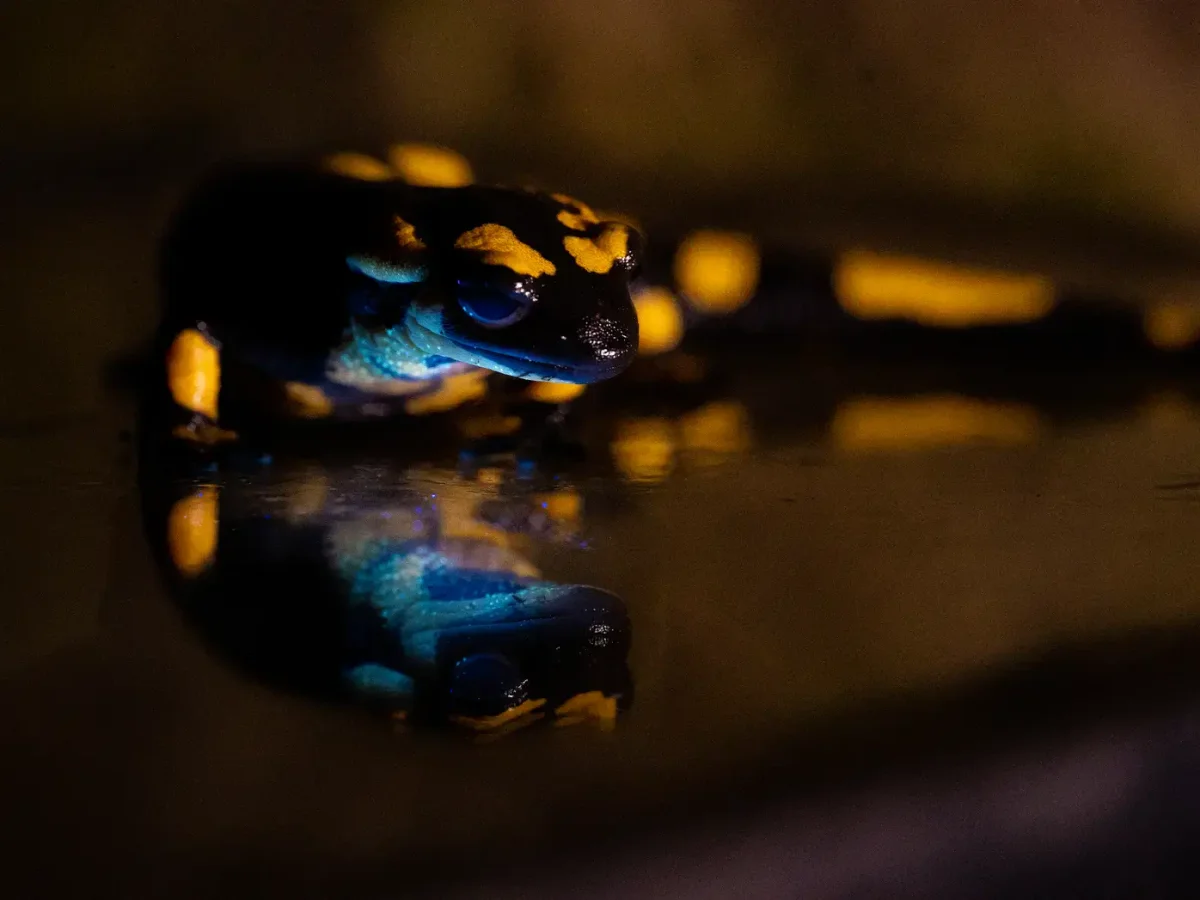
When exposed to UV light, fire salamanders emit a blue and green glow.
©Bernat Burriel-Carranza, Museu de Ciències Naturals de Barcelona, Spain – Original / License
Ultraviolet light is invisible to us, but the secretion's chemistry absorbs it and re-emits it at visible wavelengths. That's the whole trick: the salamander isn't making light from scratch. It needs an outside source, and it turns that energy into the green and blue we can see. This is called biofluorescence, and it's the same general category of effect that makes scorpions glow under UV.
Don't confuse it with bioluminescence, which is what fireflies do. Bioluminescent animals produce light through their own chemical reactions. Fluorescent animals depend on light that's already falling on them. Both are striking, but they work differently, and the distinction matters when researchers try to figure out how a trait evolved.
For a long time, biofluorescence was considered rare in land-dwelling animals, with scorpions and a range of marine species as the best-known examples. Finding it in a common European amphibian shifts that picture. It suggests the trait may be more widespread than anyone had checked for.
Why the Glow Might Exist
The team hasn't settled the function, and I'd treat the current explanations as working hypotheses. One possibility is that the glow helps salamanders signal to one another, including in mating. Another is that it works as a warning. Dense leaf litter and damp forest floors are dim places, and a visual cue could help individuals find each other there, especially at night.
Martin Kaltenpoth, director of the Department of Insect Symbiosis at the Max Planck Institute for Chemical Ecology and a co-author of the study, put it this way in the press release: "Fluorescence meets several criteria that suggest a communicative function. It could help salamanders detect each other in nocturnal or particularly dense environments, or act as an additional defense signal."
The defense idea has the stronger logic behind it, at least on paper. The fluorescent chemicals are part of the same toxic secretion that salamanders use to deter threats. Pairing a warning chemical with a visible marker fits what biologists call aposematic signaling, where bright coloration tells predators that a prey animal isn't worth the trouble. Fire salamanders already advertise through their yellow-and-black pattern. A glow that only appears under UV, which many predators may or may not perceive, would add another layer. Whether predators actually see it and respond is still an open question.
Andrés Brunetti, a researcher at the Max Planck Institute and co-first author, noted that the surprise was partly about timing. "The presence of this fluorescent compound was surprising because salamander skin secretions have been studied chemically for decades, and we were unaware of any published reports on fluorescence." In other words, the chemistry had been looked at closely. Nobody had shone the right light on it.
That's the gap the team still has to close. Salvador Carranza, a researcher at the IBE and co-author, said the compound responsible hasn't been identified yet: "Everything indicates that it is a molecule unknown until now in this species. Identifying it will be key to understanding its origin and function." Until that molecule is pinned down, the ecological story stays partly speculative.
Other Animals That Glow Under UV
Fire salamanders now join a growing list. Scorpions are the best-known case, but they aren't alone.
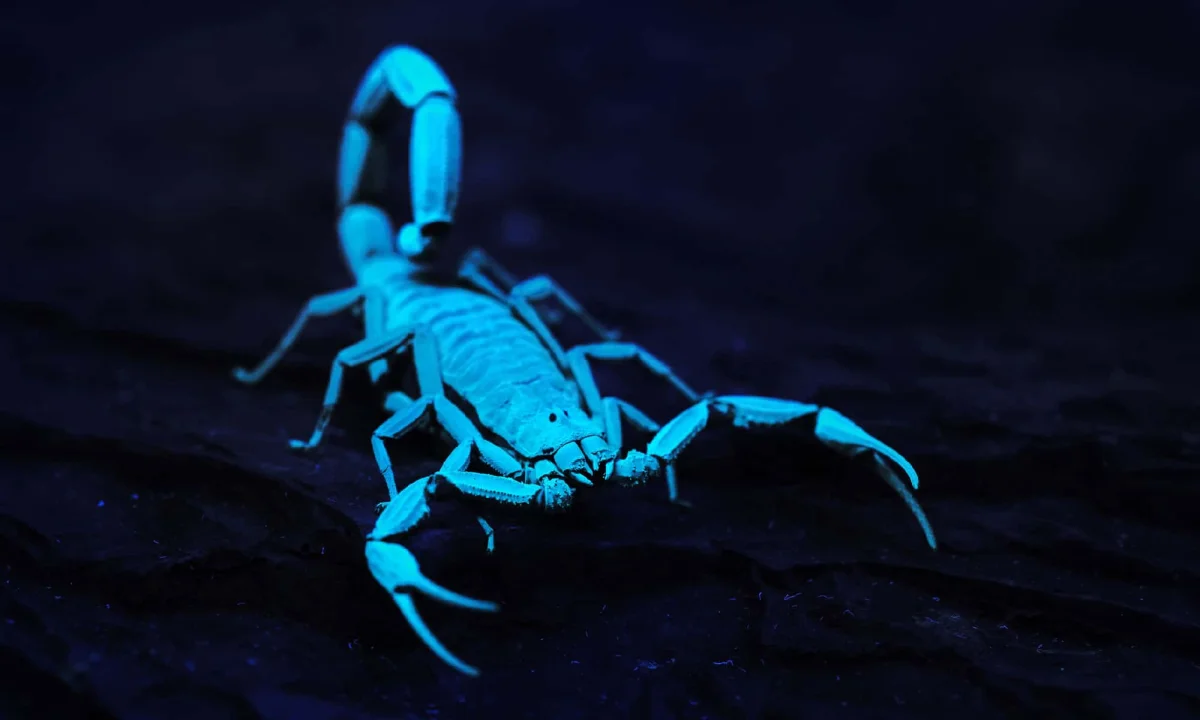
Scorpions are another species that has biofluorescence.
©iStock.com/alekseystemmer
Flying squirrels glow pink under UV. The brown fur of the platypus shows blue-green fluorescence, a finding that came from researchers examining museum specimens. Puffin beaks, tree frog skin and millipede shells also respond to UV. These examples span very different body plans and habitats, which hints that fluorescence has evolved more than once, through different chemistry.
What This Means for Care and Conservation
Fire salamanders live in humid forests, along streams and in mountain areas. The main pressure on their populations, as described in the research coverage, is habitat fragmentation and destruction. That's the thread that connects a surprising lab result to field protection. Knowing how a species signals to others, and what its chemistry does, gives conservation planners more to work with. If glowing displays affect breeding or survival, that's information that can shape where and how habitat is protected.
For keepers and anyone who handles these animals, the practical takeaway is simpler. Their skin secretions are toxic, so wash hands after handling and keep them away from eyes and mouths. Limit handling to what's needed. Frequent handling stresses amphibians, and their skin is sensitive. A UV lamp is a useful way to observe the glow, but it isn't something to point at an animal for long periods. If a salamander shows changes in its skin, appetite or behavior, a vet who knows amphibians is the right person to ask.
More broadly, this is a good reminder that familiar animals can still hold surprises. Fire salamanders have been observed for generations, and yet the glow stayed hidden because nobody looked with the right light. My read is that many common species probably have similar gaps, and the next round of discoveries will likely come from re-examining well-known animals with new tools.


