Sample No. 0227
Dog Food Label Names: What the 95%, 25%, 3% and Flavor Rules Mean
A few words on a dog food label can change how much of a named ingredient the recipe must contain. Learn what the percentages show—and what to check next.
On a dog food package, a small word can change what an ingredient name tells you. “Beef Dog Food” has a much higher beef threshold than “Dog Food with Beef,” while “Beef Flavor Dog Food” has no fixed minimum amount of beef. Reading those phrases carefully gives you a useful starting point when comparing recipes, though the name alone can’t tell you whether a food is nutritionally complete or right for your dog.
The naming thresholds described here come from model pet food regulations published by the Association of American Feed Control Officials (AAFCO). Its Reading Labels page explains the main categories. The rules use the ingredient name and the words around it to set minimum amounts. For some categories, the calculation excludes water added during processing; the package’s total weight is also used for a second threshold.
Start with the wording on the front
Look at the whole product name, including words that may be printed in smaller type. The four main categories are:
- Ingredient name alone: The 95% rule applies, as in “Beef Dog Food.” The named ingredient must make up at least 95% of the product’s weight excluding added water, and at least 70% of the total weight.
- A descriptor such as “dinner”: The 25% rule applies. “Beef Dinner for Dogs,” for example, must contain at least 25% beef excluding added water and 10% of the total product weight.
- “With”: Each ingredient introduced with “with” must make up at least 3% of the total product. “Dog Food with Beef” therefore has a lower beef threshold than “Beef Dog Food.”
- “Flavor” or “flavored”: There is no fixed minimum percentage. A listed ingredient must provide the named flavor.
That difference can be easy to miss on a shelf. Compare “Beef Dog Food” with “Dog Food with Beef”: the first name requires at least 95% beef by weight after excluding added water; the second requires at least 3% beef by total product weight. The ingredient list and nutritional information can answer other questions, but the wording is the first clue to what the named ingredient’s share must be.
The 95% rule covers names built around an ingredient alone, such as “Beef Dog Food” or “Chicken and Rice Dog Food.” AAFCO says the named ingredients must account for at least 95% of the product by weight without added water, and at least 70% when the water is included. The remaining share can include small amounts of other ingredients used to formulate the food, such as vitamins and minerals.
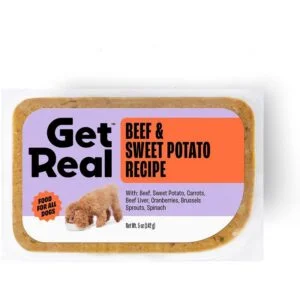
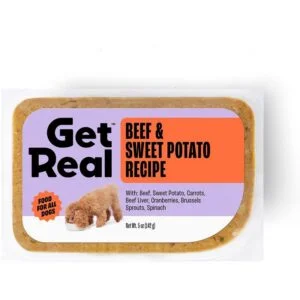
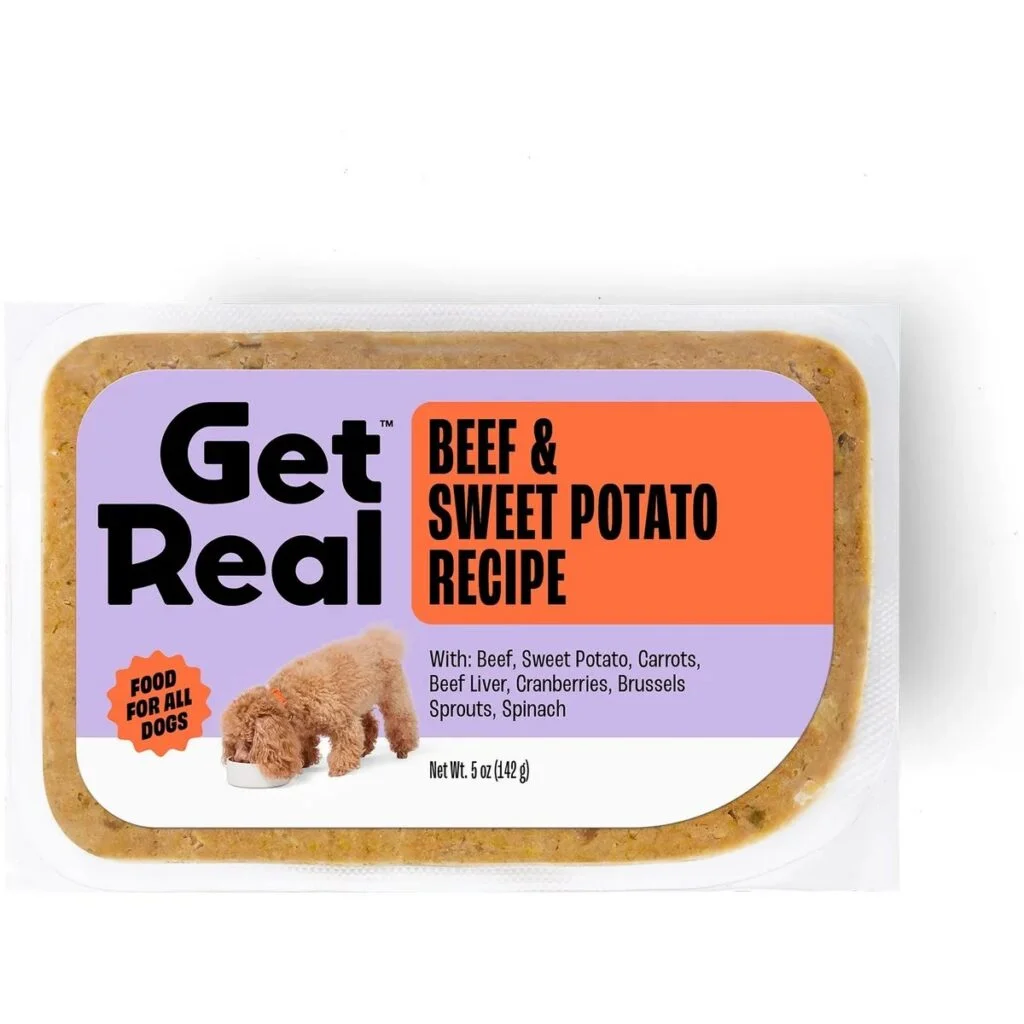
Get Real Beef & Sweet Potato Recipe. Beef is listed first, followed by sweet potato, in this gently cooked fresh recipe.
AAFCO’s guidance also describes which form of an ingredient is meant by a name. A product named “Beef Dog Food” must be based on beef meat, rather than beef meal or beef byproduct. A playful or altered spelling doesn’t change the threshold: AAFCO gives “Chik’n” as an example of a name that still has to meet the 95% rule.
The two percentages account for the effect of added water. Canned and other high-moisture foods may include water to help process the product. Dry foods also receive water during mixing, but much of it is removed during drying. That’s why some naming categories use one percentage calculated without added water and another calculated against the total product.
What “dinner,” “entrée” and “platter” signal
Words such as “dinner,” “entrée,” “platter,” “nuggets” and “formula,” along with similar descriptors, place a name under the 25% rule. AAFCO’s examples include “Chicken Dinner,” “Beef Entrée” and “Lamb and Rice Platter.” The full descriptor list is in its Model Regulations for Pet Food, under product names. For a descriptor name, the named ingredient or ingredients must account for at least 25% of the product excluding added water and at least 10% of the total product weight.
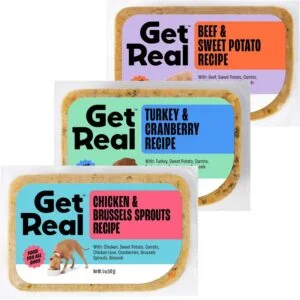
Get Real Sampler Pack, Beef, Chicken & Turkey Gently Cooked Fresh Dog Food, 6 pack bundle (2 of each recipe). The sampler includes two packs of each named recipe.
That threshold leaves room for a recipe made up of several components. Think of a dinner plate: the named protein can be accompanied by vegetables, grains or other ingredients. The name indicates that the ingredient is a meaningful part of the food, but it doesn’t promise that it is the recipe’s only or largest ingredient.
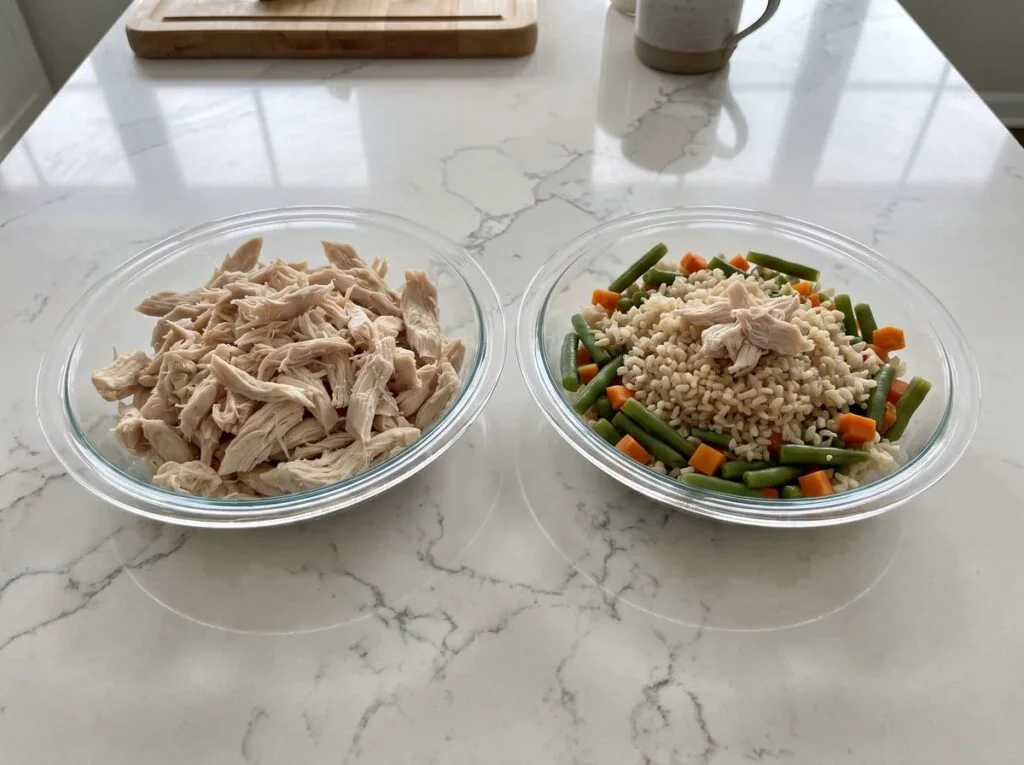
Combination names have an extra condition. If the name includes more than one ingredient, those named ingredients together must meet the 25% threshold. Each individual named ingredient must also be at least 3% of the total product. Their order in the name reflects their relative predominance: in “Lamb and Rice Platter,” lamb should outweigh rice.
When comparing foods in this category, check the descriptor first and then read the ingredient list. The named ingredient may not be the first item, and another protein may appear ahead of it. That doesn’t automatically mean the food is a poor choice; the 25% rule describes the name’s minimum, while the full recipe and nutritional adequacy statement help you assess the food itself.
- “Dinner,” “entrée,” “platter,” “formula” and similar wording point to the 25% rule.
- Named ingredients in a combination name must total at least 25% excluding added water.
- Each named ingredient must make up at least 3% of the total product.
- The ingredient list shows the order of ingredients by weight.
Why “with” changes the threshold
The 3% “with” rule is a common source of confusion because the named ingredient can appear prominent on the front of the package. AAFCO’s guidance says that each ingredient introduced with “with” must account for at least 3% of the total product. Its examples include dog food “With Chicken” and cat food “with Tuna and Rice”; in the latter, both tuna and rice must meet the minimum.
- “Dog Food with Beef” requires at least 3% beef.
- “Dog Food with Beef and Rice” requires at least 3% beef and 3% rice.
- “Beef Dinner for Dogs with Carrots” combines the 25% rule for beef with the 3% rule for carrots.
“Dog Food with Beef” and “Beef Dog Food” share nearly the same words, but the placement of “with” changes the threshold dramatically. The word may be printed in smaller type, so read the full name rather than scanning only for a protein. To find which ingredients make up most of the recipe, consult the ingredient list, where items are ordered by weight.
A “with” name can be a useful way to call attention to an added ingredient. It doesn’t tell you much about the main protein, though, and it doesn’t establish whether the food is complete and balanced.
What a flavor name tells you
“Flavor” and “flavored” names have no minimum percentage requirement. A listed ingredient must provide the flavor, and AAFCO says the flavor descriptor must be printed in the same font and with the same prominence as the named flavor.
For example, “Beef Flavor Dog Food” doesn’t have to contain a set amount of beef meat. A source such as beef broth or beef fat may provide the flavor, and the ingredient list should show an ingredient that supplies it. AAFCO’s chicken example similarly points shoppers to chicken fat or another listed source of chicken flavor.
- Look for “flavor” or “flavored” in the product name.
- Check the ingredient list for a source of that flavor.
- Don’t assume the named animal protein is one of the food’s main ingredients.
Flavor wording is useful for understanding what a product is presenting to a dog, but it tells you nothing about how much meat the recipe contains. Treats and lower-cost foods may use these names. As with any category, the ingredient list and nutritional information provide more context than the name alone.
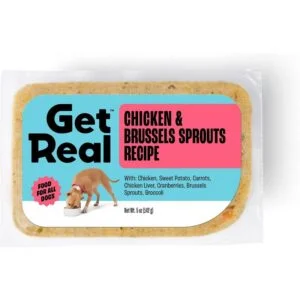
Get Real Chicken & Brussels Sprouts Recipe. This gently cooked fresh recipe is described as complete and formulated to meet AAFCO nutrient profiles for all life stages.
How to account for added water
The 95% and 25% categories use two calculations. First, remove added water from the weight and check that the named ingredient meets the category’s threshold. Then check that it meets the lower floor against the full product weight: 70% for the 95% rule and 10% for the 25% rule.
Consider a hypothetical 100-pound batch of canned food named “Beef Dog Food”:
- 72 pounds beef
- 25 pounds water added during processing
- 3 pounds vitamins, minerals and other ingredients
Without the added water, the batch weighs 75 pounds. Beef accounts for 72 of those pounds, or 96%. With water included, beef makes up 72% of the full batch. The recipe meets both thresholds: at least 95% without added water and at least 70% with water included.
Now consider a batch with 65 pounds beef, 30 pounds water and 5 pounds other ingredients. Beef makes up 65% of the total batch, but only about 93% of the weight excluding water. It therefore falls short of the 95% threshold. A “Beef Dinner” name would have a much lower minimum: 25% excluding added water and 10% of the total.
Combination names also use ingredient order. A “Chicken and Rice” food must meet the applicable combined threshold for the named ingredients, and chicken must outweigh rice because it appears first. A “Rice and Chicken” name implies the reverse order. Under the 95% rule, no named ingredient in a combination name can be less than 3% of the total product.
Moisture also affects how nutrient percentages look on a package. Fresh and canned foods contain more water than kibble, so protein and fat may appear lower when listed on an as-fed basis. The dry matter calculation removes moisture from the comparison. It can help when comparing formats, but guaranteed minimums and maximums still don’t reveal the exact nutrient content.
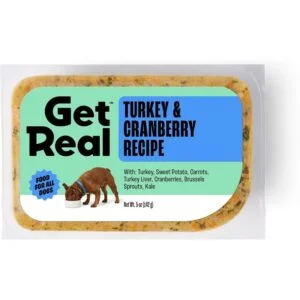
Get Real Turkey & Cranberry Recipe. This gently cooked, frozen recipe is described as containing 10 ingredients or fewer, plus vitamins and minerals.
Who develops the labeling framework?
AAFCO publishes model pet food regulations and nutrient profiles for dogs and cats. These are model standards that states can adopt into their feed rules. The naming thresholds discussed here come from those model regulations; AAFCO’s labeling guidance explains them for shoppers.
The U.S. Food and Drug Administration (FDA), through its Center for Veterinary Medicine, sets federal requirements for pet food. Its pet food program covers matters such as product identification, net quantity, manufacturer or distributor details and ingredient lists ordered by predominance. Pet food must also be safe, made under sanitary conditions and labeled truthfully.
AAFCO doesn’t approve, certify or test individual products. When a food label refers to AAFCO, it means the food was formulated to meet the nutrient profiles for a stated life stage or was evaluated in feeding trials based on those profiles. The profiles address nutritional needs; the model regulations address label information, including product names, guaranteed analysis and nutritional adequacy statements.
Because the same naming framework applies across formats, shoppers can use it for kibble, canned food and frozen fresh food. A practical label check has three parts: read the full product name, inspect the ingredient list, then look for the nutritional adequacy statement. The name helps explain the minimum amount of a named ingredient; it doesn’t replace those other checks.

What the name can’t tell you
The naming rules answer a narrow question: how much of the named ingredient must be in the food? They don’t determine ingredient quality, calories, suitability for a particular dog or whether the recipe is complete and balanced. A food can meet the 95% rule and still be the wrong choice for an individual dog; a “dinner” food can be a balanced diet.
To assess nutritional completeness, find the adequacy statement. It should identify whether the food is complete and balanced for a stated life stage under AAFCO nutrient profiles or say that it passed feeding trials. Life stage matters: a food intended for adult maintenance may not be formulated for growth.
The guaranteed analysis lists minimum crude protein and fat and maximum crude fiber and moisture. “Crude” refers to the laboratory method used to measure the nutrient, rather than a judgment about its quality. A separate calorie statement lists energy per kilogram and often per familiar unit, such as a can, cup or pack. Feeding directions offer a starting amount; adjust portions in light of your dog’s body condition and needs.
When comparing fat across formats, dry matter calculations can help. The formula is: divide the fat percentage by 100 minus the moisture percentage, then multiply by 100. For example, a food guaranteeing at least 7% fat and at most 75% moisture works out to about 28% fat on a dry matter basis. A kibble guaranteeing 15% fat and 10% moisture works out to about 17% by the same calculation. These figures use guaranteed minimums and maximums, not actual nutrient values, so treat the result as a rough comparison.
Third-party testing is another separate matter. The Clean Label Project, for example, offers voluntary certification based on testing for contaminants such as heavy metals. A certification doesn’t show whether a food meets the 95% naming rule or is nutritionally complete; those are separate label questions.
- Nutritional adequacy statement: whether the food is complete and balanced, and for which life stage.
- Guaranteed analysis: minimum protein and fat, and maximum fiber and moisture.
- Calorie statement: the food’s energy content for portioning.
- Ingredient list: ingredients in order of predominance by weight.
- Feeding directions: a starting portion to tailor to your dog.
Once those details suit your dog, the product name can help compare protein options and recipes. For general guidance on protein sources, see this guide to protein in pet food. For help weighing life stage and body condition, read about choosing a food for your dog.
A worked example: reading a fresh food label
The Get Real Beef & Sweet Potato Recipe label shows how the name, ingredient list and nutrition panel answer different questions. The product’s published ingredient list and guaranteed analysis provide the details below. The precise percentage of beef isn’t published, so the ingredient list can show order but not the amount of each item.
Start with the name: “Beef & Sweet Potato Recipe.” It pairs two ingredients with the descriptor “Recipe,” so the name alone doesn’t establish a 95% threshold for either ingredient. The ingredient list is the next place to look. Its first seven ingredients are listed in this order:
- Beef
- Sweet potato
- Carrots
- Beef liver
- Cranberries
- Brussels sprouts
- Spinach
Beef comes before sweet potato, matching the name’s order, and beef liver appears as a later ingredient. After spinach, the list includes dicalcium phosphate, canola oil, potassium chloride, calcium carbonate, salt, fish oil, choline chloride, magnesium sulfate, a mineral blend, mixed tocopherols and a vitamin blend. The product description says the recipes contain 10 ingredients or fewer, plus vitamins and minerals.
The guaranteed analysis lists a minimum of 9% crude protein and 7% crude fat, plus maximums of 1.5% crude fiber and 75% moisture. The product page lists 451 kilocalories per 12-ounce pack. The recipes are described as formulated to meet AAFCO nutrient profiles for all life stages, including growth of large dogs expected to weigh 70 pounds or more as adults.
Here’s what those details establish:
- Ingredient order: beef is first, sweet potato second, and beef liver appears fourth.
- Completeness: the recipe is formulated for all life stages, including large-breed growth.
- Fat: 7% is a guaranteed minimum, not the exact fat content.
- Calories: the page lists 188, 451 and 902 kilocalories for the 5-, 12- and 24-ounce packs.
- Format: the food is described as gently cooked and frozen, and made with human-grade ingredients.
The same method applies to the Chicken & Brussels Sprouts and Turkey & Cranberry recipes. Their names pair a protein and produce with “Recipe,” so check the ingredient order and guaranteed analysis rather than assuming the name gives a percentage. The Get Real Beef & Sweet Potato Recipe page lists product details. The line is described as sold only at Chewy in select markets. For a protein comparison, see chicken, beef and turkey for dogs.
For more label context, read about what “natural” means on a dog food label or review how to read a dog food label.
Frequently asked questions
How do you calculate fat percentage on a dry matter basis?
Divide the guaranteed fat percentage by 100 minus the moisture percentage, then multiply by 100. A food with a minimum 7% fat and maximum 75% moisture works out to about 28% fat on a dry matter basis. A kibble with a minimum 15% fat and maximum 10% moisture works out to about 17%. Because the calculation uses guarantees rather than exact nutrient values, it’s a rough comparison only.
What is the 80/20 rule for dog food?
The 80/20 rule is a raw feeding ratio used by some people who prepare food at home. It’s commonly described as about 80% muscle meat, with the remainder divided between bone and organ. It isn’t an AAFCO naming rule, and a diet following that ratio isn’t automatically complete and balanced. Ask your veterinarian to review a homemade feeding plan.
Is there such a thing as AAFCO-approved dog food?
No. AAFCO doesn’t approve, test or certify individual foods. A label reference means the food was formulated to meet nutrient profiles, or assessed in feeding trials based on those profiles, for a stated life stage.
What are AAFCO dog food guidelines?
AAFCO publishes model pet food regulations and nutrient profiles for dogs and cats. The model regulations cover label information, including names, guaranteed analysis and nutritional adequacy statements. The nutrient profiles set nutrient levels for growth and adult maintenance.
What does the Clean Label Project do?
The Clean Label Project is a nonprofit that offers voluntary third-party certification based on testing for contaminants such as heavy metals. Its certification is separate from naming rules and doesn’t establish whether a food is complete and balanced.
Who oversees pet food labels?
The FDA Center for Veterinary Medicine covers federal requirements for pet food, while state feed control officials apply labeling requirements in their states. Many state rules draw on AAFCO’s model regulations.
What does “flavor” mean on a dog food label?
A flavor name has no minimum percentage requirement. A listed ingredient must provide the flavor, and the flavor wording must be displayed as prominently as the named flavor.
The useful takeaway is simple: read every word in the product name, including “dinner,” “with” and “flavor,” then use the ingredient list and adequacy statement to fill in what the name can’t tell you. That gives you a clearer basis for comparing foods and choosing a recipe that fits your dog’s needs.


