Sample No. 0211
French Bulldog Food Guide: Puppy Eligibility, Portions, and Feeding Comfort
Compare four fresh recipes by life stage and calories, then plan measured portions, treats, storage, and comfortable meals for your Frenchie.
For French Bulldogs, a useful food choice starts with two checks: whether the recipe suits the dog’s life stage and how much food supplies the intended daily calories. Those details matter more than a breed label or a claim about ingredients. A short muzzle can also make the way a meal is served worth observing, but it does not point every Frenchie toward one recipe.

This guide compares four JustFoodForDogs recipes using their current labels: Chicken & Rice, Fish & Sweet Potato, Beef & Russet Potato, and Turkey & Whole Wheat Macaroni. The comparison covers nutritional eligibility, calorie density, portion calculations, and daily handling. It does not claim that a recipe improves skin, stool, or gas, or report hands-on taste tests.
Start with the life-stage statement
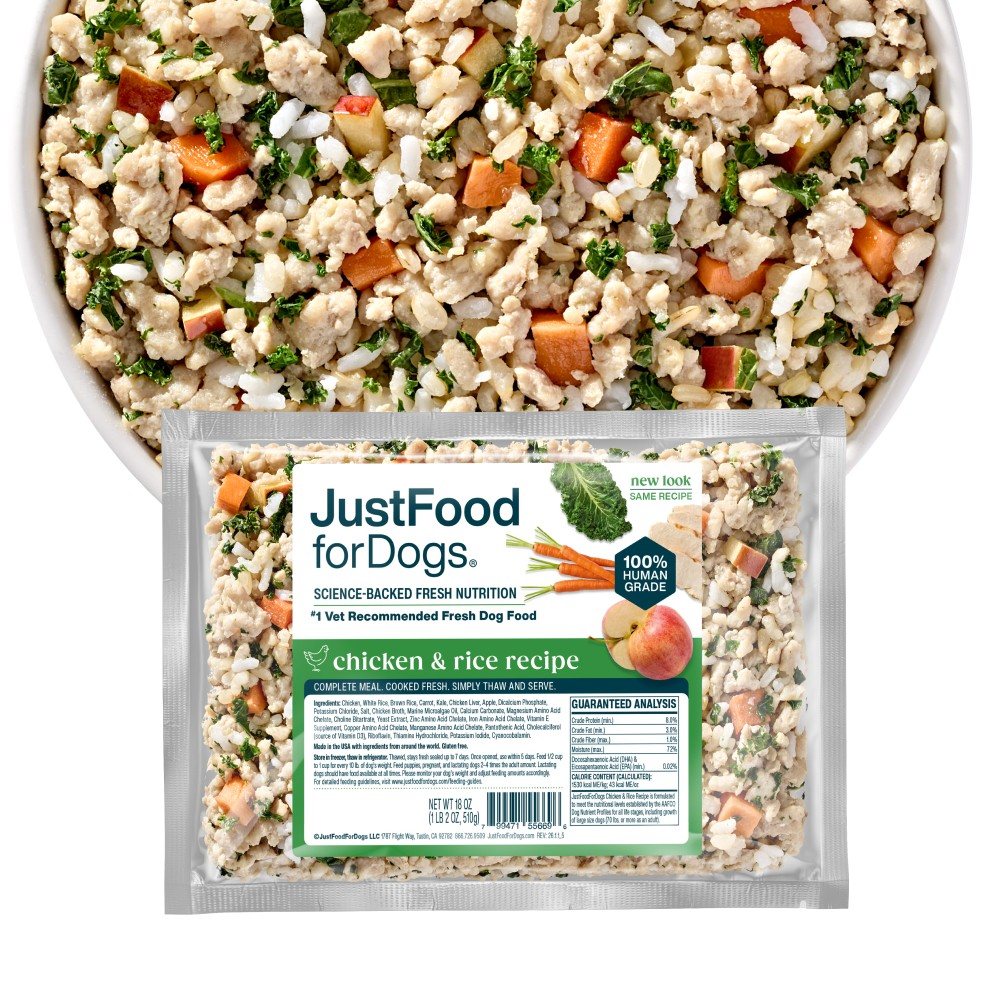
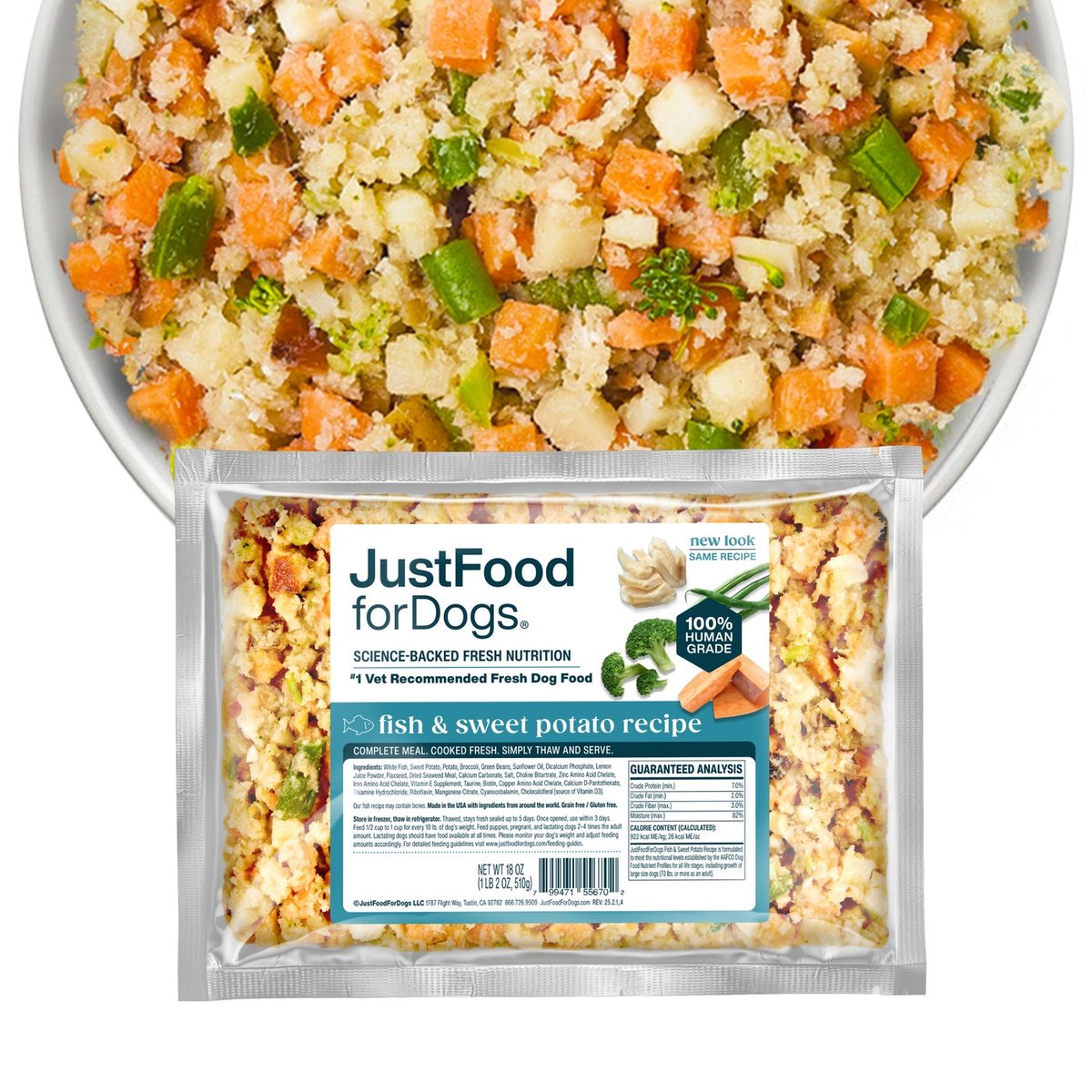
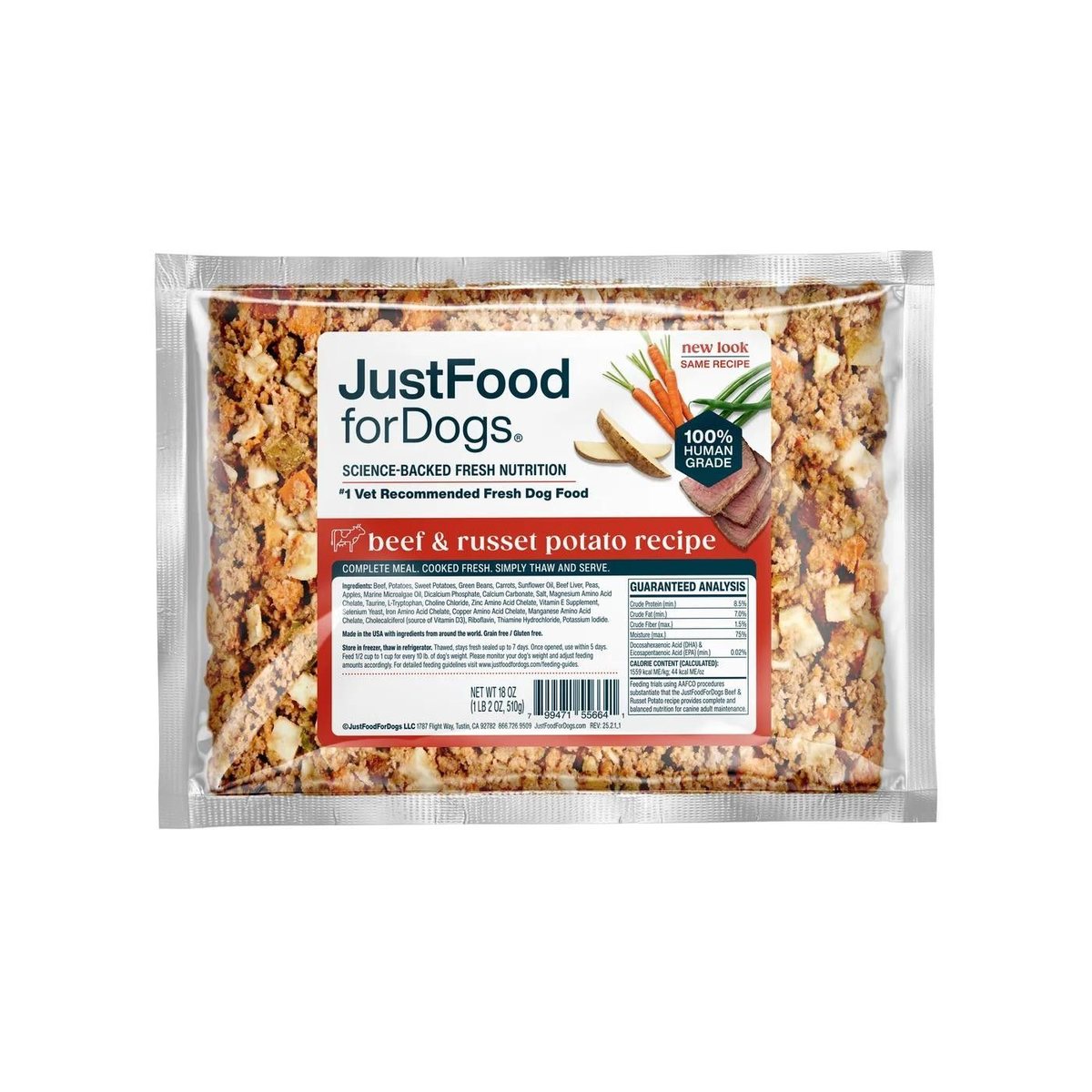
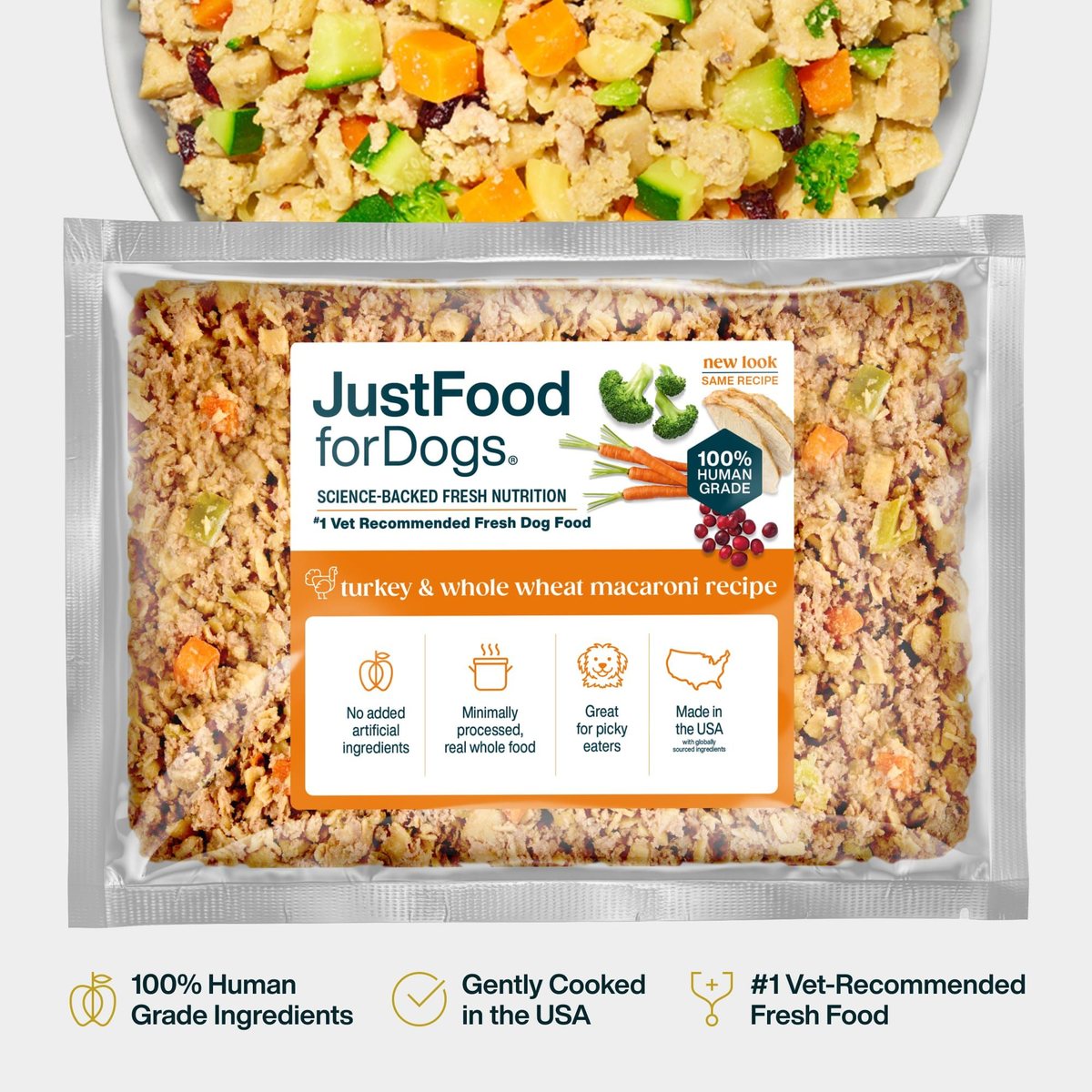
Among these four options, Chicken & Rice and Fish & Sweet Potato carry current all-life-stages statements that include growth. Beef & Russet Potato and Turkey & Whole Wheat Macaroni are labeled for adult maintenance. That distinction makes the first pair eligible starting points for puppies, while the latter two should not be used as a growing puppy’s main diet.
Chicken & Rice includes chicken, white and brown rice, carrots, kale, chicken liver, apples, chicken bone broth, algae oil, and a nutrient blend. Fish & Sweet Potato uses a white fish blend containing cod, pollock, and haddock. The recipes also differ in calorie density, so a portion of one will not weigh the same as an equal-calorie portion of another.
For adult dogs, all four recipes can be considered in light of ingredients, calorie needs, and any medical restrictions. Fish & Sweet Potato is the least calorie-dense of the four options listed here. An equal-calorie serving therefore weighs more than servings of the other recipes; that arithmetic alone does not make it the right choice for every adult.
| Recipe | Current life-stage statement | Calories per kilogram | Approximate grams per 100 calories |
|---|---|---|---|
| Chicken & Rice | All life stages, including large-size growth | 1,530 kcal/kg | 65 g |
| Fish & Sweet Potato | All life stages, including large-size growth | 922 kcal/kg | 108 g |
| Beef & Russet Potato | Adult maintenance | 1,559 kcal/kg | 64 g |
| Turkey & Whole Wheat Macaroni | Adult maintenance | 1,741 kcal/kg | 57 g |
Labels and formulations can change, so check the current life-stage statement and calorie information for the exact recipe you buy. A breed name, “natural” description, or grain-free claim does not establish that a food meets an individual dog’s needs. Your veterinarian can help connect the label to your Frenchie’s age, condition, and health history. See the French Bulldog’s characteristics for background on the breed, and the broader JustFoodForDogs review for information about the brand’s range.
Set puppy portions with growth in mind
A puppy’s calorie needs change as the dog grows, so a portion calculated once may not remain appropriate. Ask your veterinarian to establish a starting target and a schedule for reassessing it. Don’t apply an adult weight-loss portion to a puppy or assume that a homemade bowl of chicken and rice offers the same complete formulation as a prepared recipe.
Chicken & Rice and Fish & Sweet Potato are the two recipes in this comparison whose current statements include growth. Their ingredients differ, but the label’s nutritional adequacy statement is the relevant starting point for life-stage eligibility. Choose between them with your veterinarian if the puppy has particular needs or a diagnosed condition.
JustFoodForDogs Chicken & Rice
Check the current Chicken & Rice recipe, portions and ordering options.
JustFoodForDogs Fish & Sweet Potato
Check the current Fish & Sweet Potato recipe, portions and ordering options.
Calculate a daily amount instead of guessing
There is no single gram allowance that fits every French Bulldog. Begin with the dog’s daily calorie target, reserve calories for treats and other additions, and calculate the amount of main food from the recipe’s kcal/kg.
Grams per day = calories assigned to the food ÷ recipe kcal/kg × 1,000.
For illustration, if 500 calories have been assigned to the main food, Chicken & Rice would provide that amount in about 327 grams. Fish & Sweet Potato would require about 542 grams. These weights supply similar calories because the recipes have different energy densities; 500 calories is only an example, not a recommendation for your dog.
- Confirm the daily calorie target with your veterinarian when needed.
- Subtract calories assigned to treats, chews, or food used with medication.
- Use the current calorie figure for the exact recipe.
- Weigh the daily amount and divide it between meals.
- Review weight and body condition over time and adjust the plan as needed.
The AAHA nutrition and weight-management guidelines emphasize individual assessment. A calculated amount is a starting point; the dog’s response helps show whether it needs adjustment.
A kitchen scale makes portions repeatable. Set the empty bowl on the scale, zero it, and add the food. That routine also helps when more than one person feeds the dog: everyone can use the same daily amount rather than estimating by eye.
Include extras in the calorie plan
General guidance is to provide at least 90% of daily calories from complete food, leaving no more than 10% for treats and other extras. A veterinarian-directed plan may allow less. In a hypothetical 500-calorie daily allowance, 50 calories would be the ceiling for extras, leaving 450 for complete meals.
Track the full diet, including training rewards, dental chews, table scraps, toppers, supplements, flavored medication, and food from another pet’s bowl. Small additions can make a feeding plan harder to interpret or alter the intended calorie balance.
Cost comparisons are more useful when they account for portions. Package price alone doesn’t show how many days of feeding it provides: package weight and calorie density affect how much the dog eats. Consider the regular price, estimated feeding days, delivery costs, and whether the household can use the food within its refrigerated storage window.
If your Frenchie needs to gain or lose weight, discuss the reason and target with your veterinarian. Picking the richest recipe or adding unmeasured food may miss an underlying issue. For weight changes in either direction, the plan should preserve nutritional adequacy and include follow-up on body condition.
JustFoodForDogs Beef & Russet Potato
Check the current Beef & Russet Potato recipe, portions and ordering options.
A simple record of recipe, daily grams, treats, and periodic weight or body-condition observations gives your veterinary team useful details if the plan needs to change.
Investigate digestive or skin symptoms carefully
Gas or itchy skin does not identify its own cause. A short muzzle does not prove a food allergy, and a fish-based or limited-ingredient recipe is not automatically a treatment for itching. Fish is not universally hypoallergenic, and no recipe in this comparison promises to resolve a rash or digestive problem.
Tell your veterinarian when the symptoms began, whether they persist, what the dog eats, and what changed beforehand. Bring the names of the exact recipes, not only the main protein. If the dog has persistent gas alongside other digestive signs or discomfort, seek veterinary advice rather than cycling through foods marketed for sensitive stomachs.
When food allergy is suspected, a veterinarian may recommend a structured diet trial. The selected food, permitted extras, trial duration, and interpretation of the response all matter. Follow the plan as prescribed; casually alternating proteins or adding familiar foods can make the results difficult to assess. There is no universal ingredient blacklist for every itchy French Bulldog.
Turkey & Whole Wheat Macaroni is another complete option for an adult whose needs and ingredient tolerance fit the recipe. Its adult-maintenance label and wheat-containing ingredients should be considered alongside any specific restriction from a veterinarian. It is a food choice, not a promise to stop gas or clear skin.
JustFoodForDogs Turkey & Whole Wheat Macaroni
Check the current Turkey & Whole Wheat Macaroni recipe, portions and ordering options.
Guaranteed minimum fat is not the same as a recipe’s typical fat level or proof that it meets a medical restriction. If your dog needs a prescribed fat limit, ask for the relevant analysis and compare foods using the basis your veterinarian specifies.
Make meals comfortable and manageable
Observe how your Frenchie handles the bowl and food. A stable bowl on a nonslip surface gives the dog a chance to eat without chasing the dish. A shallow bowl may suit some short-muzzled dogs, but comfort varies. Watch whether your dog can pick up the food or repeatedly pushes it out of reach.

Persistent coughing, choking, or difficulty eating calls for veterinary advice, not repeated experiments with bowl shapes or textures. Fresh food has a moist texture, but texture by itself does not establish nutritional completeness. The same applies to kibble, canned, freeze-dried, or home-prepared diets: check nutritional adequacy first, then consider what your dog can eat comfortably and what your household can store safely.
For a healthy dog changing foods, follow the manufacturer’s transition directions and increase the new food gradually as tolerated. If the change is part of a medical plan, follow the clinician’s instructions. Keep daily calories steady during the transition, measure both foods, and avoid adding a full new portion on top of the old one. Keep treats consistent, watch appetite and digestion, and recalculate the final daily grams for the new recipe.
Fresh food also requires attention to thawing and opening dates. The current JFFD FAQ gives fish-based meals a refrigerated limit of 5 days after sealed thawing and 3 days after opening. For the other proteins covered here, the general limits are 7 days sealed after thawing and 5 days after opening. Follow shorter directions on the package itself.
The number of days a package may be refrigerated is different from the number of feeding days it contains. A small daily ration may leave food beyond its opened-storage window. Before ordering a large quantity, consider freezer space and daily use; ask the manufacturer about handling if package size doesn’t fit your plan. Don’t extend the storage window based on appearance alone.
Home-prepared diets need formulation too
A bowl of meat, rice, and vegetables is not automatically a complete puppy or adult diet because its ingredients resemble a commercial recipe. Homemade and raw feeding approaches need their own nutritional and food-safety assessment. If you want to prepare the main diet at home, use an appropriately formulated recipe and provide its required nutrient supplementation.
Common questions
Can a puppy eat any of these four recipes?
No. Chicken & Rice and Fish & Sweet Potato have current statements that include growth. Beef & Russet Potato and Turkey & Whole Wheat Macaroni are labeled for adult maintenance. Check the exact current label and choose a growth-appropriate main food.
Is fish food the best choice for itchy skin?
Not automatically. Itching can have several causes, and a fish label doesn’t establish that food is responsible or that the recipe suits a diagnostic diet trial. Ask your veterinarian whether a food assessment is appropriate.
Does gas mean my dog has a food allergy?
No. Gas alone is not diagnostic. Discuss persistent symptoms, especially with other digestive changes or discomfort, and bring a complete feeding history that includes treats, supplements, and recent changes.
Can I keep feeding the same number of grams after switching recipes?
Not necessarily. Recalculate using the new recipe’s kcal/kg and the dog’s calorie target. Equal gram portions of these four recipes can provide different amounts of energy, so continue to monitor body condition after a change.
A workable routine combines a recipe eligible for the dog’s life stage, a measured daily amount, and a feeding setup the dog can use comfortably. Keep the recipe and portions consistent enough to spot changes in appetite, weight, or tolerance, then review those changes with your veterinarian.
Related reading: Petful reviews JustFoodForDogs Fish & Sweet Potato, and WebVet explains fish-based dog food for skin and digestion.


