Sample No. 0181
RECOVER’s 2026 Pet First Aid Guidelines: Practical Steps for Common Emergencies
New RECOVER guidance gives veterinary teams clear advice to teach for allergic reactions, toxin exposure, heat illness, low blood sugar, and choking.
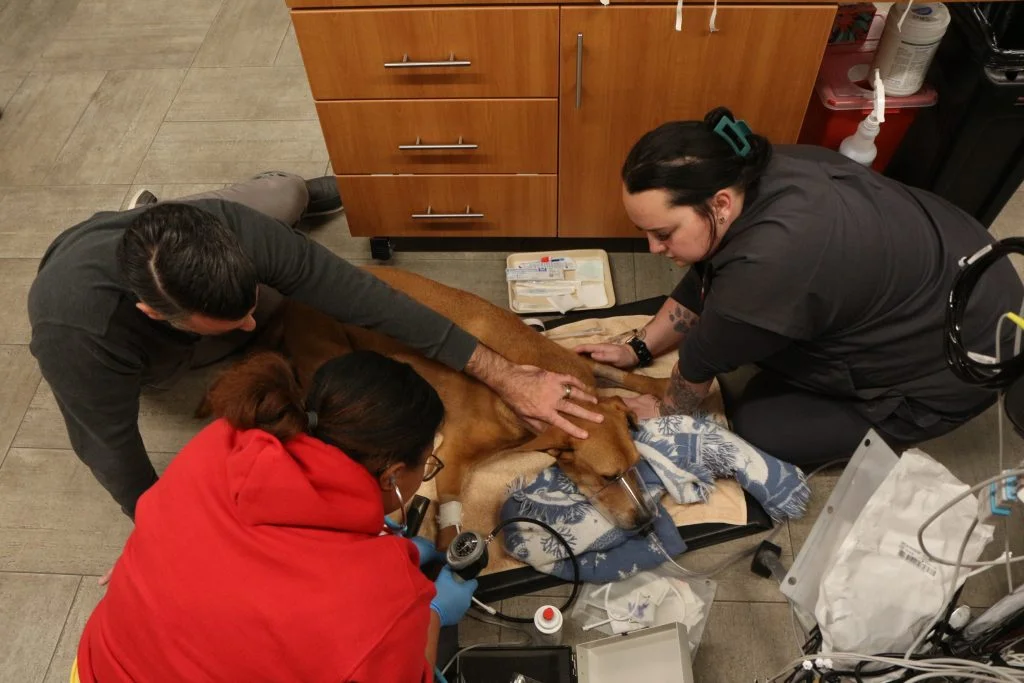
In a pet emergency, the first few minutes can shape what happens next. An owner may be tempted to give a familiar medicine, induce vomiting, or rush straight to the car. The 2026 RECOVER First Aid guidelines offer veterinary teams evidence-informed advice to help owners choose safer immediate steps while getting veterinary care underway.
The recommendations come from the RECOVER Initiative, known for its canine and feline CPR guidelines published in 2012 and 2024. This new series contains 50 treatment recommendations: 38 covering general first aid and 12 addressing acute allergic reactions and anaphylaxis. Owners and other bystanders provide the care, while veterinary professionals guide them through client education and triage.
The guidance also covers burns, oxygen before hospital arrival, CPR outside the clinic, suspected opioid exposure, and tourniquets for severe limb bleeding. The examples below focus on situations that may come up in everyday practice. They’re not a substitute for veterinary assessment: even when first aid appears to work, the animal should be examined.
Separate a mild allergic reaction from anaphylaxis
The recommended response depends on the severity of the reaction. An uncomplicated allergic reaction may begin suddenly, within minutes or hours, and cause hives, facial swelling, or itching. A single episode of vomiting or diarrhea may occur, but the animal is not showing signs of an immediate, life-threatening crisis.
Anaphylaxis is a severe reaction affecting the body more broadly. It can involve breathing, circulation, digestion, or the skin; visible skin signs aren’t always present. After a suspected sudden allergic reaction, collapse, low blood pressure, or severe difficulty breathing should be treated as severe anaphylaxis—even if only one body system appears affected.
For an uncomplicated reaction, the guidelines recommend an oral H1 antihistamine, such as diphenhydramine or cetirizine, before arrival at the clinic, and an H1 antihistamine in the clinic. Veterinary teams should make clear that these medicines don’t treat the breathing or cardiovascular effects of established anaphylaxis.
The evidence helps explain that limit. In an experiment, antihistamine pretreatment blocked the effects of administered histamine in dogs, but didn’t prevent cardiovascular collapse when an allergen triggered anaphylaxis. Human observational studies link earlier antihistamine use with lower odds of progression or later escalation of care. In other words, antihistamines may help with an uncomplicated reaction; they can’t replace emergency treatment when anaphylaxis is underway.
The guidelines also advise against routine glucocorticoids for uncomplicated reactions. In two veterinary studies, involving 880 dogs and 73 cats, adding dexamethasone to diphenhydramine didn’t improve the immediate response, how long signs lasted, whether they resolved, or whether further care was needed. A human trial found worse hives scores at one week and one month among participants given oral prednisolone.
If an uncomplicated reaction doesn’t respond to an H1 antihistamine, the guidelines suggest considering a short course of low-dose prednisolone equivalent—0.5 mg/kg per day or less, for no more than five days—while continuing the antihistamine. This is a veterinarian-directed option, not a reason for owners to use leftover medication.
Anaphylaxis needs prompt veterinary care
Epinephrine is the recommended treatment for anaphylaxis. When breathing is affected, don’t delay transport to try to give an oral antihistamine. Getting a tablet into a dog that’s struggling to breathe can take time and risks a bite, while delaying epinephrine and veterinary care.
Before arrival, intramuscular epinephrine may be appropriate if it can be given without delaying transport. The guidelines describe delivery by autoinjector, prefilled syringe, or vial and syringe. For context, a 0.15 mg pediatric autoinjector corresponds to the 0.01 mg/kg dose for a 15 kg patient. A veterinarian may arrange weight-based prefilled syringes for a pet with a previous anaphylactic event, provided the owner receives instruction and feels able to give the injection.
The guidelines cite research suggesting that in-date epinephrine, drawn aseptically into recapped plastic syringes and stored at room temperature away from light, may remain stable and sterile for up to 90 days. Veterinary teams should handle any preparation and owner instruction as part of an individual care plan.
In the clinic, the recommendations suggest giving intramuscular epinephrine as early as possible for moderate anaphylaxis. For severe anaphylaxis accompanied by low blood pressure, they suggest a continuous intravenous infusion adjusted to a mean arterial pressure of 70 mm Hg rather than bolus dosing. In experimental canine anaphylactic shock, intramuscular and subcutaneous boluses didn’t improve blood flow measures compared with placebo. An intravenous bolus raised blood pressure only briefly, while a continuous infusion maintained the target pressure with a lower total epinephrine dose.
For phone triage, the practical distinction is straightforward: if facial swelling is present but breathing remains normal, a veterinarian-directed oral antihistamine may be given if it’s safe, followed by a clinic visit. If the animal has trouble breathing, repeated vomiting or diarrhea, or collapses, advise immediate transport and don’t wait to give oral medication.
Skip routine vomiting after toxin ingestion
When an owner reports that a dog has eaten something harmful, the familiar impulse may be to reach for hydrogen peroxide. RECOVER recommends against routine at-home vomiting after an acute ingestion of a non-caustic toxin.
Human studies found that induced vomiting didn’t improve survival, the course of illness, or time in care. It could also delay activated charcoal, which appeared more effective than stomach emptying in alert patients. Hydrogen peroxide at doses used to induce vomiting can injure the gastrointestinal tract in both dogs and cats.
There is a narrow exception: if veterinary care is genuinely out of reach and a veterinarian or animal poison control center specifically directs the owner to induce vomiting, the guidelines suggest following that instruction. For dogs prone to eating inappropriate items in remote areas, a veterinarian may consider prescribing ropinirole ophthalmic solution in advance. That option still requires veterinary guidance.
A useful triage instruction is brief: don’t give hydrogen peroxide unless specifically directed; bring the pet and the product packaging to the clinic promptly. Knowing what was eaten helps the veterinary team assess the exposure.
Start cooling a heat-affected animal before transport
With suspected heat illness, the guidelines recommend moving the animal to a cool place and beginning active cooling before transport. The aim is to shorten the time the body remains dangerously hot, while arranging prompt veterinary care.
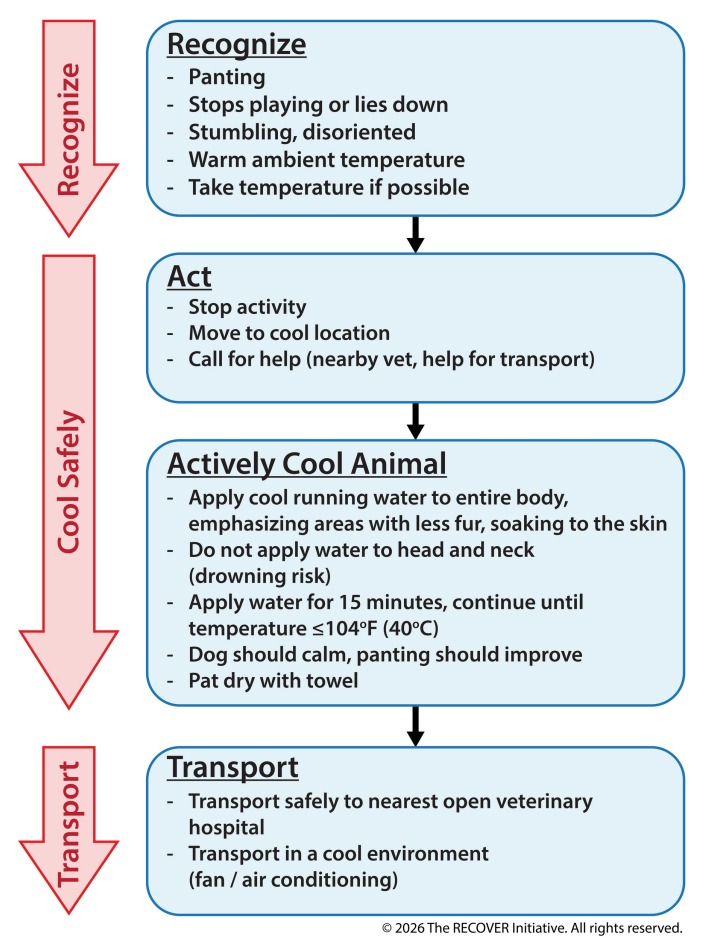
The recommended method is cool running water over the body behind the neck, directed at the areas with the thinnest coat and soaked through to the skin. The underside of the abdomen is often one such area. Running water is favored over a single pour, which can leave a still layer of water that limits further cooling.
RECOVER advises against putting the whole animal in a tub or sink because immersion creates handling and drowning risks. Cooling only the paws exposes too little body surface to be effective. In human studies, misting, fanning, and local ice packs cooled less effectively than faster whole-body approaches. Cool running water offers several ways for heat to leave the body without the risks associated with immersion.
If a rectal thermometer is available, cool to 39.7–40.0°C (103.5–104.0°F), then stop and dry the animal. Without a thermometer, cool for 15 minutes. If the animal has stertor or stridor—noisy, obstructed breathing—continue cooling until panting clearly improves or the temperature reaches 38.6°C (101.5°F), then transport immediately.
Evidence from people and observational studies in dogs points in the same direction: delayed or absent cooling is associated with worse outcomes. In one dog study, about half of surviving dogs had been cooled by their owners before transport, compared with one-fifth of dogs that died. These findings support a practical seasonal reminder, especially when warm weather begins and animals may not yet be acclimatized to the heat.
For suspected low blood sugar, apply sugar inside the cheek
Insulin-treated dogs and cats are a predictable group at risk of low blood sugar. If one becomes weak, unsteady, or dull, the guidelines suggest applying a viscous simple carbohydrate, such as corn syrup or glucose syrup, to the inner cheek. The suggested amount is approximately 0.2 to 10 mL, scaled to the animal’s size.
Apply it between the cheek and upper premolars or molars to coat the mouth lining. The goal is absorption through the mucosa, not swallowing. In healthy dogs, buccal corn syrup raised blood glucose within 15 minutes; in hypoglycemic children, absorption through the mouth lining worked better than swallowed sugar.
There are two firm safety limits: don’t put anything in the mouth of an animal that’s having a seizure, and don’t attempt to apply syrup if there’s a serious bite risk. If the animal is actively seizing, protect people from injury and arrange immediate veterinary transport.
Syrup may buy time, but it doesn’t resolve the underlying emergency. It may not raise glucose enough to correct a life-threatening episode, so don’t delay veterinary assessment or intravenous dextrose support. If a home meter or continuous monitor shows a low reading but the animal has no signs, feed its regular food. Seek care if signs appear or glucose hasn’t returned to normal within 20 minutes.
For conscious choking, use back blows first
For a conscious dog or cat choking on an obstruction, RECOVER recommends up to five firm blows to the back over the caudodorsal chest, on either side of the spine rather than directly on it. Abdominal thrusts, sometimes called the Heimlich maneuver, aren’t the first step.
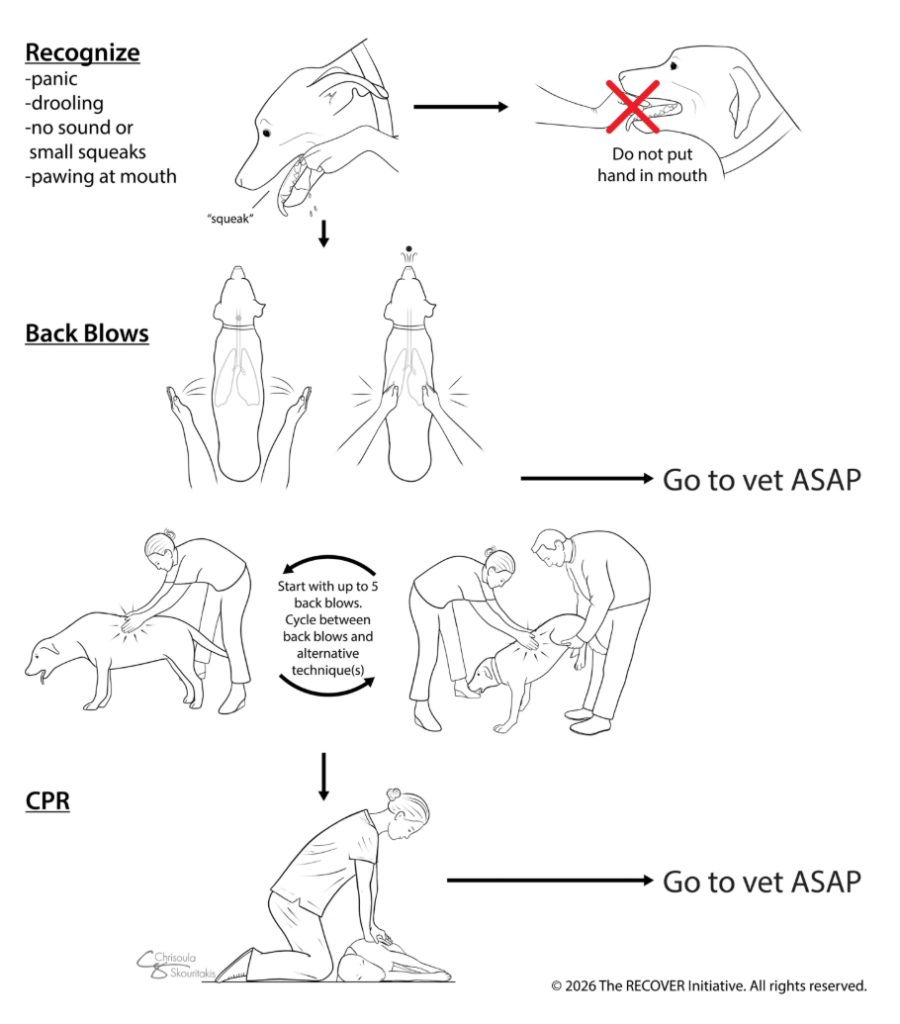
The committee’s preference draws on a direct human comparison in which back blows were about twice as likely as abdominal thrusts to clear an obstruction. Abdominal thrusts have also been associated with injuries including aortic and stomach rupture. The guideline authors judged those risks especially relevant across the wide range of dog sizes.
If five back blows don’t work, try another appropriate maneuver, such as abdominal or chest thrusts or repositioning. Continue only with techniques that can be performed safely, until the obstruction clears or the animal loses consciousness. Don’t perform a blind finger sweep: it can push the object deeper. Don’t reach into the mouth of a conscious animal.
If the animal becomes unconscious, begin chest compressions immediately. Give 30 compressions at a rate of 100–120 per minute, briefly check the airway, and remove an object only if it’s visible. Give two mouth-to-nose breaths, then repeat the sequence. Compressions may shift an obstruction and are more likely to help once the animal is unconscious than abdominal thrusts. Starting with compressions also marks a change to RECOVER’s single-rescuer CPR algorithm.
The CPR recommendation is supported by a large human evidence base: 23 observational studies covering roughly one million people found that bystander CPR increased survival two to three times, including in arrests caused by suffocation. Even if an object comes out, the animal needs immediate veterinary assessment because the obstruction or rescue efforts may have injured the airway, chest, or abdomen.
Turn recommendations into everyday client guidance
Veterinary teams can put the guidance to work in four parts of practice. The first is telephone triage: staff need concise wording for emergencies, including “cool first,” “don’t induce vomiting unless directed,” and “don’t give an oral antihistamine when breathing is affected.” A short instruction can help an owner act while making clear that the pet still needs care.
The second is education during prescribing and discharge. When starting a pet on insulin, discuss what to do if signs of low blood sugar appear at home, including when to apply syrup and when not to touch the mouth. For a pet with a history of anaphylaxis, the veterinarian can consider whether a weight-based epinephrine supply and owner training are appropriate.
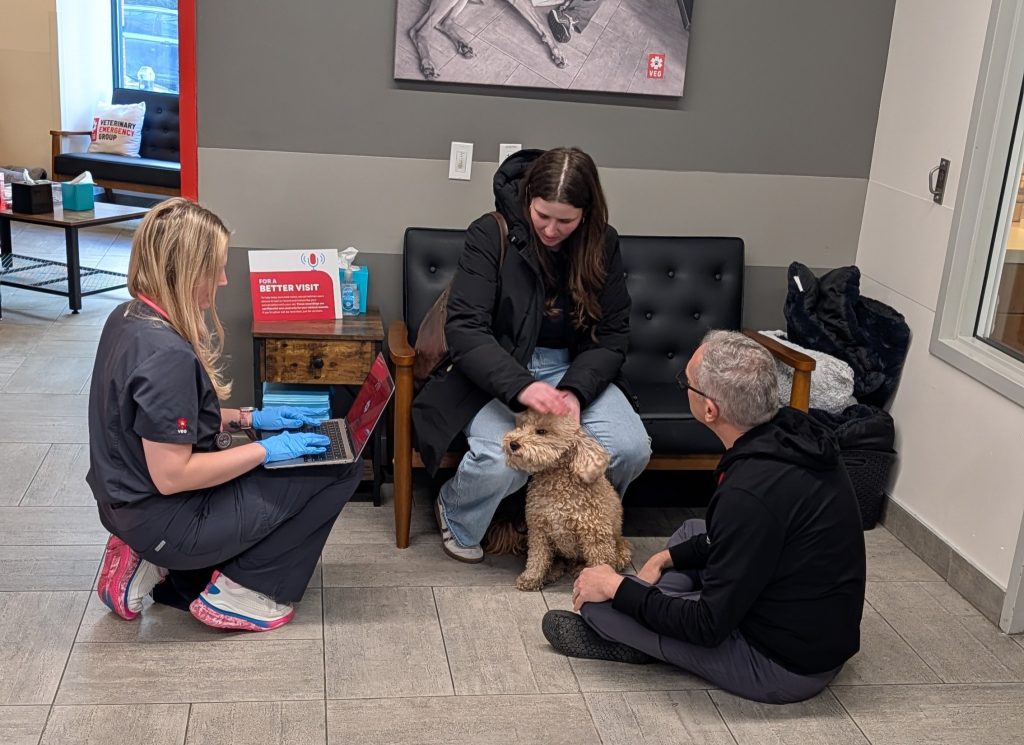
Third, the veterinary team needs to understand the updated single-rescuer and out-of-hospital CPR recommendations, since staff may teach them or explain them to callers. Fourth, clinics can use RECOVER’s layperson-focused recognition and action materials in waiting areas, discharge packets, and puppy classes.
Across all of these conversations, provider safety comes first. Owners shouldn’t attempt first aid when doing so puts them at high risk of injury. The other constant is follow-up: first aid supports an animal during the time before definitive care, but it doesn’t replace a veterinary visit.
| Situation | What to say |
| Facial swelling; breathing normal | Give the veterinarian-directed oral antihistamine if safe; then come in. |
| Allergy with breathing trouble, repeated vomiting/diarrhea, or collapse | Come in now; do not delay for oral medication. |
| Possible toxin ingestion | Do not induce vomiting unless directed; bring the pet and product packaging in now. |
| Suspected heat illness | Start cool running water over the trunk; transport after initial cooling. |
| Hypoglycemic signs; no seizure | Apply corn or glucose syrup inside the cheek if safe; then come in. |
| Active seizure | Put nothing in the mouth; transport immediately. |
| Conscious choking | Give up to five firm back blows beside the spine; seek immediate care. |
| Unconscious; not breathing normally | Call for help on speakerphone and start chest compressions immediately. |
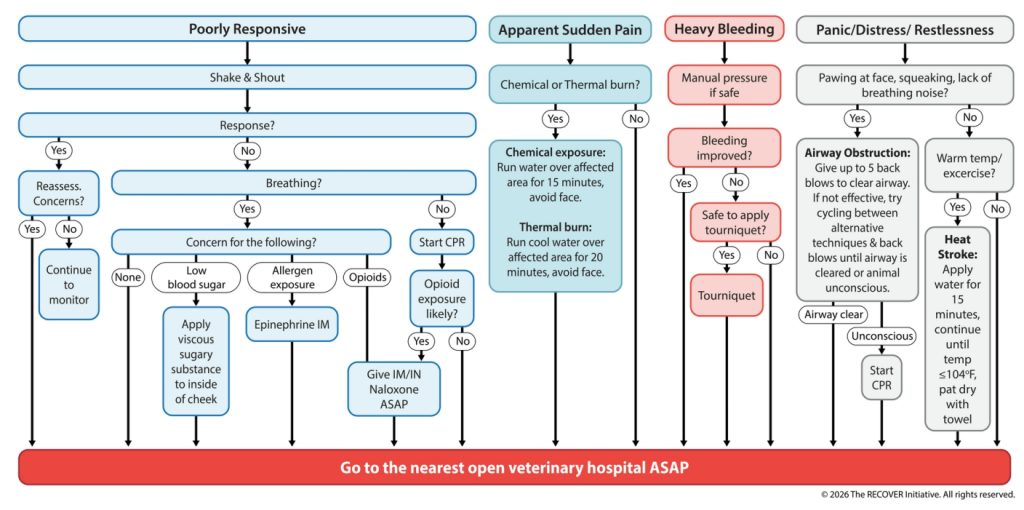
Prepare owners before the emergency
Across the evidence reviewed for the guidelines, delays matter: lack of epinephrine before arrival was associated with deaths from anaphylaxis, slower cooling tracked with worse heat-illness outcomes, and a fully blocked airway can become fatal within minutes. First aid will happen whether or not owners have received clear instruction. Veterinary teams can shape what they do by teaching safe, simple steps in advance and reinforcing them during triage.
That preparation starts with a few specific conversations: what to do if an insulin-treated pet becomes weak, how to recognize breathing trouble during an allergic reaction, why not to induce vomiting without direction, and how to cool an animal before transport. Owners also need to know when not to intervene and when to leave immediately. Clear guidance helps them act quickly while keeping veterinary assessment at the center of the plan.