Sample No. 0250
A Montana Grizzly's Shed Scratch Doubles as a Bear ID Lesson
A grizzly rubbing its back on a Montana generator shed shows why bears scent-mark objects, and how shoulder hump and claws help tell it from a black bear.
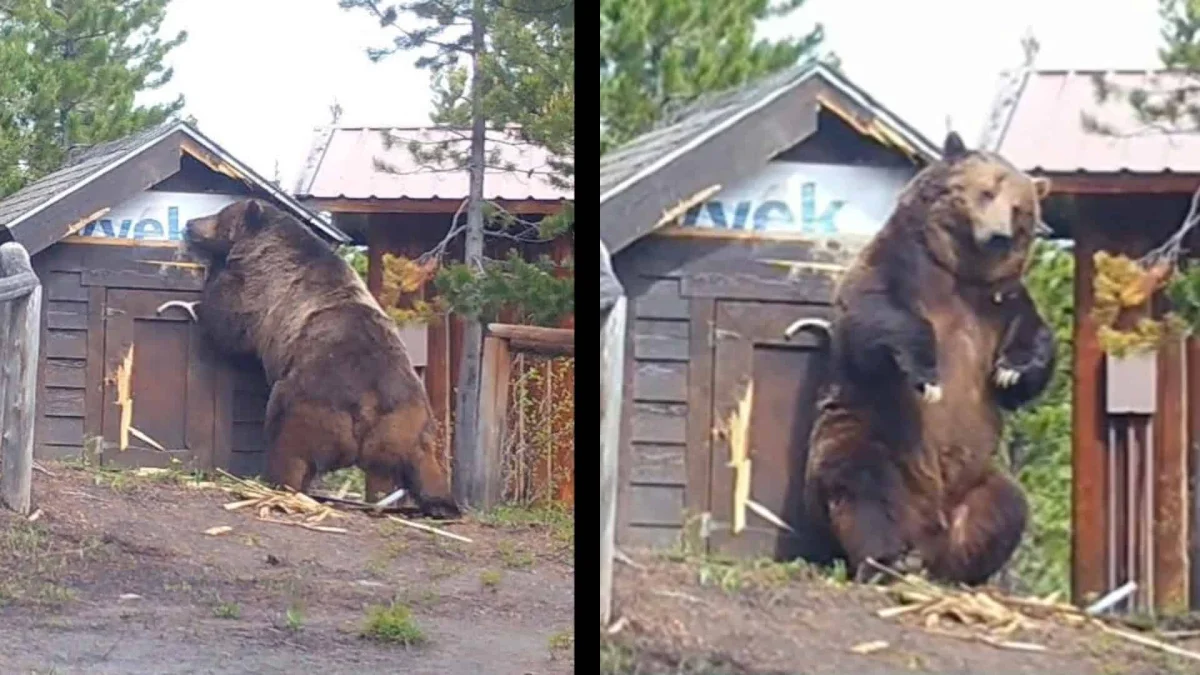
Most people would expect a bear to find a tree for a good back rub. This one settled for a weathered generator-storage shed on Montana's eastern Rocky Mountain Front. Photos shared by Jamie Goguen show a very large grizzly standing on its hind legs against the little building, shoulders pressed to the wood, looking like it had found the perfect scratching post. The bear, nicknamed Brutus in the original social-media post, later stretched out nearby for a nap.
The pictures are funny, but they also show two things worth knowing: why bears rub on objects at all, and how to tell a grizzly from a black bear without getting close enough to find out the hard way. NBC Montana's short report on the sighting has drawn more than five million views, which suggests plenty of people are curious about the same questions.
Why a Shed Works as a Scratching Post
To a human eye, a bear wriggling against a wall looks like it has finally reached an itch it couldn't get to any other way. Rubbing can help with loosened fur or irritation. Still, research indicates that many of the rub sites bears return to serve a second purpose: communication.
When a bear presses its back, shoulders and flanks against a tree, it leaves hair and scent behind. Other bears come across those sites and pick up information without ever meeting face to face. A 2022 study of black bears and grizzlies in northern Yellowstone found that scent-marking on rub objects along well-traveled routes likely helps bears communicate both within and between the two species. That's a useful reminder that a rub site is more than a random scratch.
That doesn't prove why this grizzly picked this shed. Maybe the corner simply felt good. But the building offered the same sturdy, upright surface that makes a tree useful, and the bear may have left more than a few hairs behind for the next visitor to find.
Size Is a Weak Clue
Montana Fish, Wildlife & Parks reshared the photos as a bear-identification lesson, and the agency's point was pointed: size alone can mislead. A young grizzly can be smaller than an adult black bear. Both species also range in color from blond or cinnamon to dark brown and nearly black. Fur tells you very little.
Photos taken from a distance make the problem worse. Perspective makes it impossible to work out this bear's exact height or weight from the images. The pictures do leave little doubt that it is a large adult grizzly, and they show the raised shoulder area that serves as one of the species' most dependable visual markers.
What to Look for Instead
Grizzlies are inland North American brown bears (Ursus arctos), while American black bears (Ursus americanus) are a separate species. Because color overlaps so much, wildlife managers encourage people to check several physical traits together rather than relying on any single one.
A grizzly usually shows a prominent muscular hump above its shoulders, with a rump noticeably lower than that hump. Its ears are short and rounded, and its face appears dished between the eyes and nose. Its front claws are relatively straight and generally about two to four inches long, a shape suited to digging.
A black bear lacks that shoulder hump. Its rump is often the highest point of its back, its ears look taller and more pointed, and its facial profile runs straighter. Its front claws are shorter and more curved, which suits climbing.
Here's a quick comparison of the traits:
- Grizzly: prominent shoulder hump, short rounded ears, dished face
- Black bear: rump as the highest point, tall pointed ears, straighter facial profile
For reference, a grizzly typically weighs 220 to 794 pounds (100 to 360 kg) and measures 6.2 to 9.6 feet (1.9 to 2.9 m) in length. It can reach speeds of up to 35 mph (56 km/h). Those figures help explain why a bear this size looks so imposing beside a building, but they aren't a reliable way to identify one from a photo taken at a distance.
Keep the Distance, Keep the Shed
Identification should never become a reason to move closer. The useful habit is to note the shoulders, ears and rump from far away, then back off. Give every wild bear plenty of room, keep food and other attractants secured, and carry bear spray where you can reach it when you're in bear country.
Brutus's shed scratch is a good example of what a bear does with a sturdy, upright surface. For anyone who spends time outdoors in grizzly habitat, the practical takeaway is simple: learn the clues from a safe distance, and let the bear keep the shed.


