Sample No. 0220
Zoo Animal Rehabilitation Shows How Tailored Therapy Can Improve Mobility
Zoo teams adapt rehabilitation exercises to each animal’s body, using observation, cooperative care and measurable progress to support comfort and movement.
Rehabilitation starts with changes in movement
When a zoo animal begins to move differently, careful observation can reveal a need for rehabilitation. Mani, a five-year-old male tamandua at San Diego Zoo Wildlife Alliance, had become stiff, struggled to climb and pull himself up from a tail hang, and descended sloped perches slowly. Keepers also saw him fall a couple of times.
A CT scan showed spondylosis in several parts of Mani’s spine. Senior veterinarian Deena Brenner, DVM, DACZM, also found moderate stiffness in his rear legs, limited hip extension, mild spinal curvature near the junction of his thoracic and lumbar regions, and deliberate tail use. The findings led to a rehabilitation plan focused on strength, function and comfortable movement.
His exercises included walking between vertical poles, stepping over raised rails, moving through a tunnel to encourage spinal extension, and using a balance board and an incline ramp. After seven months, staff reported that Mani moved more comfortably and held his rear limbs more strongly. He was no longer slipping, and they had seen no further falls.
Shared principles, species-specific plans
Zoo rehabilitation draws on many of the same ideas used in general veterinary practice. James Steeil, DVM, DACZM, a supervisory veterinarian at the Smithsonian’s National Zoo and Conservation Biology Institute, says the approach to arthritis in a domestic cat can resemble care for a tiger. Diagnostics, treatment and specialist collaboration may be similar, though safety considerations can affect what is possible.
Brenner sees canine rehabilitation techniques adapted across zoological species. The exercises must suit each animal’s anatomy, but common tools include pain management, movement and range-of-motion activities. Age-related joint problems are a frequent reason for zoo referrals: animals in managed care may live longer, and conditions such as osteoarthritis can affect the spine, hips, knees and elbows. Rehabilitation can also support recovery after an injury or surgery.
Assessment helps teams decide what an animal needs and whether a plan is working. Veterinarians may use physical exams, radiographs, CT scans, joint-angle measurements and muscle-girth measurements to establish a baseline, support diagnosis and track changes over time. The particular exercises and therapies depend on the animal and its condition.
Trust makes cooperative care possible
Animal care specialists often notice subtle changes because they work with animals every day. Jennifer McGee, director of Wildlife Experiences at Brookfield Zoo Chicago, describes these relationships as deep and respectful. Keepers and veterinary teams can use that familiarity to spot mobility changes and shape care around the individual.
Specialists also train many animals to participate voluntarily in health care, such as presenting a body part for examination. Positive reinforcement builds cooperation: a completed behavior may earn food, a toy or gentle contact. Trainers divide complex actions into smaller steps, giving the animal time to learn each part. McGee emphasizes that participation should be a positive experience, with the animal’s welfare and choice guiding the process.
That preparation can make an exam more practical. At the Smithsonian’s National Zoo, keepers noticed that Mandara, a 44-year-old female gorilla, was slowing down and shuffling her feet. Because she had learned to present her feet, the team could examine her ankles and identify arthritis, then work with her on physical therapy.
Different bodies call for different methods
Rehabilitation does not suit every zoo animal. Some are too small or fragile, while others may find the process stressful. Still, programs have adapted care for a striking range of species. Zola, a female aardvark at San Diego Zoo, injured her neck when young; her plan includes therapeutic exercises twice a week, pain relief, acupuncture and manual therapy.
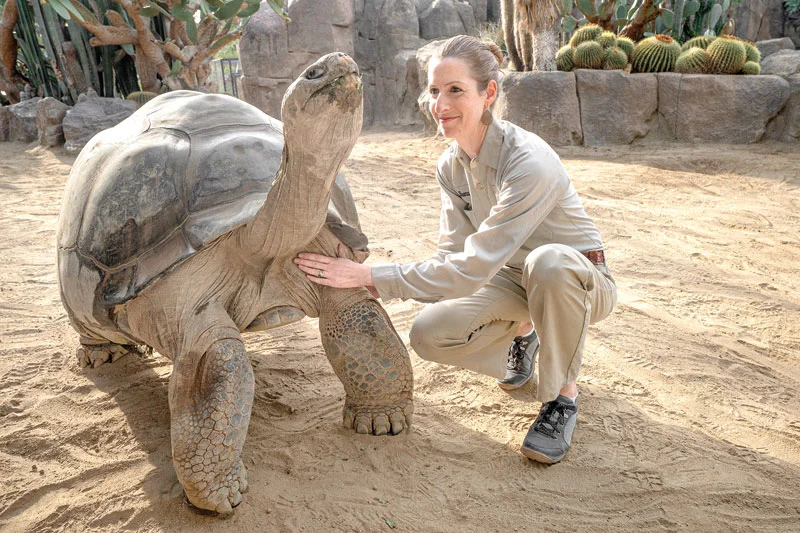
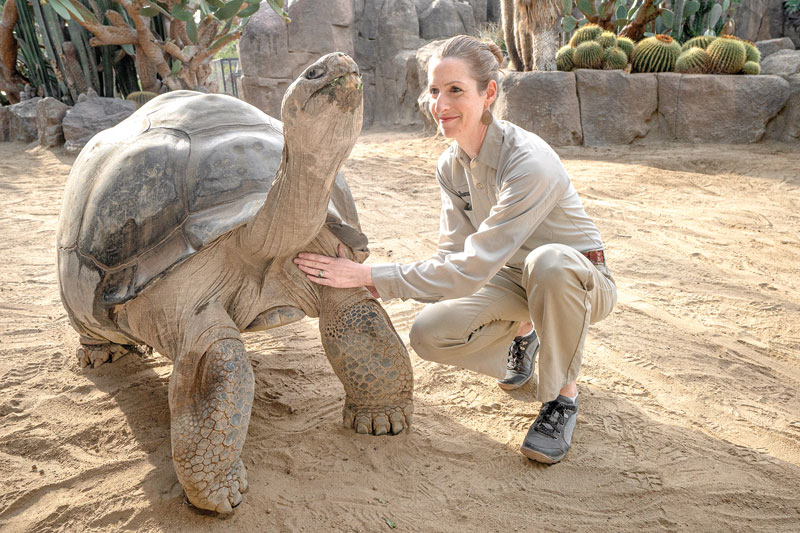
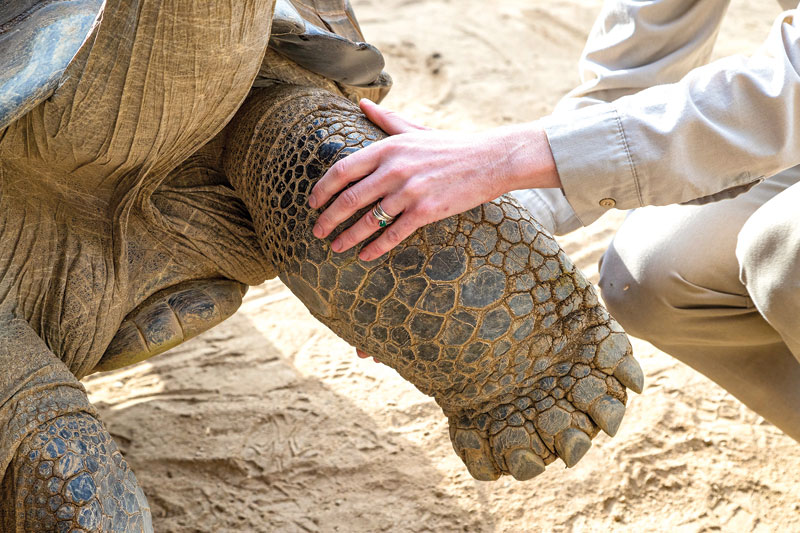
Three older Galapagos tortoises at the zoo receive weekly manual therapy for osteoarthritis. Brenner’s team moves the shell and body through different planes, using the shell in a way that relates to the ribs and spine in other animals, and massages the limbs. At Brookfield Zoo Chicago, Kaya, a female leopard tortoise, receives rehabilitation for a spinal deformity associated with difficulty defecating and weakness in her hind legs. Her exercises include core work on a balance ball with staff assistance, an obstacle course and an incline.
Murphy, a male Komodo dragon at the Smithsonian’s National Zoo, was treated for joint arthritis. Steeil worked with Matt Brunke, DVM, DACVSMR (Canine), CCAT, a canine sports medicine and rehabilitation specialist, on a plan that included an injection of Synovetin OA, a radioactive isotope developed for dogs. The team tracked mobility, gait and joint flexion and found that Murphy became more comfortable. His joint problems worsened with age despite therapy, and he was euthanized in December 2024.
Research and practical takeaways
Zoo rehabilitation teams may use treatments such as epidural steroid injections, cold laser therapy, shockwave therapy and therapeutic exercise. Brunke describes these as options for targeted care of arthritis, tendinitis and other painful conditions. Choosing among them requires veterinary assessment; a therapy used for one species or patient may need adjustment for another.
Zoos share findings through veterinary journals, conferences and public videos. Brunke said a short Smithsonian video about Murphy prompted four people to consult him about their pets’ therapy. Some also asked whether the approach could help their own knee pain. The story drew attention to rehabilitation while underscoring that animal treatments don’t automatically translate to people.
Brenner says community veterinarians are likely to hear more requests for rehabilitation as options for small animals expand. For pet owners, the useful lesson is to mention changes in climbing, walking, posture or falls to a veterinarian. A veterinary team can assess the cause and discuss whether a tailored rehabilitation plan could help an animal move with greater comfort.


